How Does a Fire Extinguisher Work? A Practical Guide for Vehicle Fires
A fire extinguisher works by using stored pressure to push an extinguishing agent out of a nozzle and onto the burning material. That agent stops the fire by removing one or more of the things combustion needs: heat, oxygen, fuel, or the chemical chain reaction that keeps flames going. Water-based agents mainly cool, carbon dioxide mainly displaces oxygen, and the dry chemical powder found in most vehicle extinguishers mainly interrupts the chain reaction and smothers the burning surface. The key condition is that a portable extinguisher is designed for small, early-stage fires. It holds a limited amount of agent and empties quickly. In a vehicle fire, getting everyone out and away from the car and calling emergency services always comes before any attempt to fight the fire.
What a Fire Needs to Keep Burning
Understanding how portable fire extinguishers stop a fire starts with understanding what a fire needs. Firefighters often describe this as the fire tetrahedron, which has four parts. Remove any one of them and the fire goes out.
Heat: an ignition source such as a hot exhaust component, an electrical short or a spark raises material to the point where it burns. Fuel: combustible material such as gasoline, diesel, engine oil, upholstery, plastic trim or wiring insulation. Oxygen: supplied by the surrounding air, including airflow through the engine bay. Chemical chain reaction: the self-sustaining reaction in the flame that keeps releasing heat and burnable gases.
Every extinguishing agent targets at least one of these elements. The type of fuel involved determines which agent is effective and which could make the situation worse.
Inside the Extinguisher: How the Discharge Works
Most portable extinguishers share the same basic layout: a pressurized steel or aluminum cylinder, a valve assembly with a carrying handle and squeeze lever, a safety pin that locks the lever, a siphon tube running down inside the cylinder, and a hose or nozzle. Many models also have a pressure gauge on the valve.
1) Pulling the safety pin unlocks the operating lever. 2) Squeezing the lever pushes a valve stem down and opens the valve. 3) The pressurized gas inside the cylinder forces the agent up the siphon tube. 4) The agent travels through the valve and out the nozzle or hose. 5) Releasing the lever lets a spring close the valve, stopping the flow.
In a stored-pressure extinguisher, the agent and the propellant gas share the same cylinder, which is why the gauge can show whether the unit is still charged. Some heavier-duty units are cartridge-operated, meaning a separate gas cartridge pressurizes the cylinder only when the extinguisher is activated. Carbon dioxide extinguishers are different again: the CO2 is stored as a liquid under its own pressure and expels itself, so these units typically have no gauge and are checked by weight.
In practice, this means discharge time is short, often only a matter of seconds for the small units commonly carried in cars. Aiming correctly from the first moment matters, because there is little agent to waste.
How Each Agent Stops a Fire
Multipurpose dry chemical (usually monoammonium phosphate): interrupts the chemical chain reaction in the flame and melts into a coating on burning solids such as fabric and plastic, smothering them. This is the most common type for vehicles and general use. Sodium or potassium bicarbonate dry chemical: interrupts the chain reaction in flammable liquid and electrical fires, but does not form the same coating on ordinary solid combustibles. Carbon dioxide: displaces the oxygen around the fire and provides some cooling. It leaves no residue, but it disperses quickly in wind or open air, which limits its usefulness outdoors and at the roadside. Water: absorbs heat and cools burning solids. It is unsuitable for fuel fires, where it can spread burning liquid, and for energized electrical equipment. Foam: forms a blanket over burning liquid, separating the fuel from oxygen and suppressing flammable vapors. Clean agents: gaseous agents that interrupt the chain reaction and evaporate without residue, often chosen to protect electronics. Wet chemical: designed for cooking oil fires; it reacts with the hot oil to form a soapy layer that seals the surface. Not relevant to typical vehicle fires.
Fire Classes and Extinguisher Ratings in the US
In the United States, fires are grouped into classes based on the fuel, and extinguishers are labeled with the classes they are tested for.
Class A: ordinary combustibles such as wood, paper, cloth, rubber and many plastics. Class B: flammable liquids and gases such as gasoline, diesel, oil and grease. Class C: energized electrical equipment. Class D: combustible metals, which require specialized agents. Class K: cooking oils and fats in commercial kitchens.
A fire extinguisher rating on the label combines numbers and letters. The letters show which classes the unit is approved for. The numbers in front of A and B indicate relative firefighting capacity for those classes, with higher numbers meaning greater capability. The C designation carries no number; it simply means the agent does not conduct electricity. A vehicle fire can involve all three common classes at once: fuel and oil (B), interior materials and plastics (A), and wiring (C). That is why a unit rated for A, B and C is widely recommended for cars and light trucks. Check the label of any extinguisher you buy to confirm its classes and rating rather than relying on its appearance.
Why Vehicle Fires Are Harder Than They Look
A car combines fuel, oil, pressurized fluids, plastics and electrical energy in a compact space. Several features limit what a portable extinguisher can achieve:
Engine bay fires are partly hidden by the hood, so agent may not reach the source. Opening the hood suddenly can feed the fire a rush of oxygen and expose you to flames. Hot components can reignite fuel or oil after the visible flames are knocked down. Wind at the roadside can blow dry chemical or CO2 away from the fire. Tires, struts, bumpers and other components can fail or burst when heated. High-voltage battery fires in hybrids and electric vehicles can involve thermal runaway, a self-heating reaction inside battery cells that a portable extinguisher generally cannot stop. These fires can also reignite well after they appear to be out.
How to Use a Fire Extinguisher in a Vehicle Fire
Prerequisites: an extinguisher rated for the fire classes involved, a charged unit (gauge needle in the green zone if it has one), and a fire that is small and has not spread into the passenger compartment, fuel tank area or high-voltage battery. Follow the instructions printed on your extinguisher, since operation varies slightly between models.
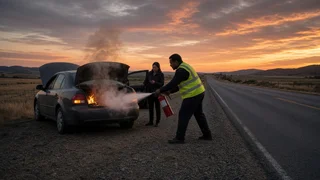
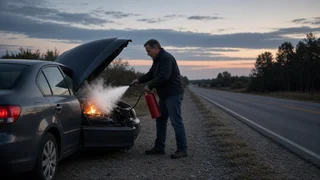
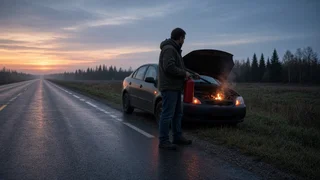
1) Pull over safely, as far from traffic, buildings and dry vegetation as you can, and switch off the ignition. Turning off the engine stops the fuel pump on most vehicles and is the simplest form of electrical isolation available to a driver. 2) Get everyone out and move well away from the vehicle, upwind if possible. Do not go back for belongings. Safe evacuation comes first. 3) Call emergency services (911 in the US) and give your location, even if you plan to try the extinguisher. 4) Decide whether to fight the fire. Stop here and stay back if the fire is large or spreading, if the passenger compartment is burning, if flames are near the fuel tank, if fuel is pouring onto the ground, if the vehicle is a hybrid or EV with battery involvement, if smoke is thick, or if you have any doubt. 5) Keep a clear escape route behind you and stand a safe distance from the fire, at the range indicated on the extinguisher label. 6) For an engine fire, do not lift the hood fully. If the hood is already slightly open or you can reach gaps at the grille, wheel wells or under the vehicle, aim through them. If not, leave it closed and wait for firefighters. 7) Use the PASS method: Pull the pin, Aim the nozzle at the base of the fire, Squeeze the lever, and Sweep side to side across the base until the flames are out or the extinguisher is empty. 8) Back away while watching the fire. Do not turn your back on it.
Stop immediately and retreat if the fire does not shrink quickly, if it grows or reappears, if you hear popping or hissing, or if the extinguisher runs out. Your goal is to protect people, not the vehicle.
Checking the Result and What Comes Next
A fire is not confirmed out just because visible flames have stopped. Stay at a distance and watch for renewed smoke, flames or glowing material, because hot surfaces can reignite fuel or plastics. Let firefighters inspect the vehicle and declare it safe. Do not restart or drive the vehicle; any fire involving the engine bay, wiring or fuel system needs inspection by a qualified technician, and a hybrid or EV with possible battery damage should be handled according to responder and manufacturer guidance.
Replace or recharge the extinguisher after any use, even a brief one, because a partially discharged unit can lose pressure. Dry chemical residue can be corrosive to electrical connectors and metal surfaces, so tell the repair shop that it was used.
Choosing and Carrying an Extinguisher for Your Vehicle
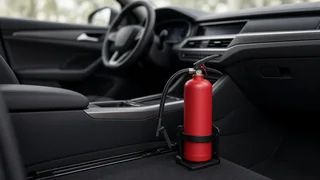
Choose a unit rated for A, B and C fires unless you have a specific reason to use another type. Mount it securely with a proper bracket so it cannot become a projectile in a crash or roll under the pedals. Keep it where you can reach it quickly after leaving the vehicle, rather than buried under cargo. Check the gauge regularly and inspect for damage, corrosion or a missing pin. Follow the manufacturer's guidance on shaking, inspection and replacement, as dry chemical can settle and compact over time. Read the operating instructions on the label before you ever need them.
A fire extinguisher works by delivering the right agent to break the fire tetrahedron, but its capacity is small and its window of usefulness is short. Treat it as a tool for an early, contained fire, and treat getting clear of the vehicle and calling for help as the steps that matter most.