What Do Fire Extinguishers Do? How They Work and How to Use One in a Vehicle Fire
The Short Answer
A fire extinguisher is a portable, pressurized container that sprays an extinguishing agent onto a small fire to put it out or hold it back while people get to safety. The agent works by removing one or more things a fire needs to keep burning: heat, fuel, oxygen, or the chemical chain reaction of combustion.
Two conditions change this answer. First, an extinguisher is only effective on a small fire in its early stage. Once a vehicle fire has spread through the engine bay, into the passenger compartment, or near the fuel tank, an extinguisher will not control it, and the only correct action is to move away and call emergency services. Second, the extinguisher must be rated for the type of fire. Using the wrong agent can fail to put the fire out or make the situation more dangerous.
How a Fire Extinguisher Works
Fire needs heat, fuel and oxygen, plus a self-sustaining chemical reaction between them. This is often called the fire tetrahedron. Remove any one element and the fire goes out. Each type of extinguisher is designed to attack one or more of these elements.
Pressure: the cylinder holds the agent under pressure, either stored in the same cylinder or supplied from a separate gas cartridge. Release: pulling the safety pin and squeezing the handle opens a valve, and the pressure forces the agent out through the hose or nozzle. Suppression: the agent lands on the burning material and cools it, smothers it by cutting off oxygen, or interrupts the chemical reaction, depending on the agent. Result: if the fire is small enough and the agent is suitable, the flames die down. If the fuel is still hot, the fire can reignite after the agent stops flowing.
Common Extinguishing Agents
Agent | How it works | Typical use and limits; Multipurpose dry chemical (often monoammonium phosphate) | Coats burning material and interrupts the chemical reaction | Rated for ordinary combustibles, flammable liquids and energized electrical equipment; leaves a powdery residue that can be corrosive and should be cleaned off promptly; Sodium bicarbonate dry chemical | Interrupts the chemical reaction | Suited to flammable liquid and electrical fires; not intended for deep-seated fires in solids such as upholstery; Carbon dioxide (CO2) | Displaces oxygen and provides some cooling | Leaves no residue; less effective outdoors or in wind because the gas disperses quickly; Clean agent (halocarbon types) | Interrupts the chemical reaction and displaces oxygen | Leaves little or no residue, useful around electronics; generally more expensive; Water | Cools burning material | Only for ordinary combustibles; dangerous on fuel, oil or electrical fires
Fire Classes in the United States
Extinguishers sold in the US are labeled with letter classes that tell you which fires they are rated for. Check the label before you rely on an extinguisher.
Class A: ordinary combustibles such as fabric, paper, plastics and upholstery. Class B: flammable liquids and gases such as gasoline, diesel, oil and grease. Class C: energized electrical equipment, such as wiring and electrical components. Class D: combustible metals, which require specialized agents. Class K: cooking oils and fats, mainly in commercial kitchens.
Vehicle fires usually involve a mix of fuel, oil, wiring and interior materials, so an extinguisher rated for classes A, B and C, or at minimum B and C, is the type typically recommended for cars and light trucks. The label also carries a numerical rating that indicates relative capacity; a larger rating generally means more fire-fighting capacity.
What This Means in Practice
Discharge time is short. A portable extinguisher empties in seconds, not minutes, so there is little room for wasted spray. It buys time; it does not replace firefighters. Even when the visible flames are out, hidden fire or hot fuel can reignite. Range is limited. You have to stand fairly close, which puts you at risk if the fire grows or something ruptures. Wind affects some agents. Dry chemical and especially CO2 can be blown away outdoors. Residue matters. Dry chemical powder can damage electrical connections and metal surfaces if left in place, so a vehicle that has been sprayed should be cleaned and inspected.
Which Statements About Fire Extinguishers Are True?
Quizzes and safety courses often ask which statements about fire extinguishers are true. The following are consistent with generally accepted fire safety principles:
They are intended for small, contained fires, not fires that are spreading or producing heavy smoke. They must match the class of fire; one type does not suit every fire. Your safety and getting everyone away from the fire come before trying to put it out. They must be checked regularly and recharged or replaced after any use, even a partial one. They should be kept where they can be reached quickly and mounted securely so they do not become a loose object in a crash. You should always keep a clear escape route behind you while using one.
What to Do If Your Vehicle Catches Fire
The following sequence reflects general vehicle fire safety guidance. It cannot account for every vehicle design. Follow the instructions printed on your specific extinguisher and in your vehicle owner's manual, and treat the steps below as a general framework.
Before You Need It
Choose an extinguisher rated for the fire classes likely in a vehicle, typically A, B and C. Mount it in a secure bracket within the driver's reach, not loose in the cabin or buried in the trunk under cargo. Read the operating instructions on the label so you are not learning them during an emergency. Check it on a regular schedule: the pressure gauge needle should sit in the operable range, the safety pin and tamper seal should be intact, and the cylinder, hose and nozzle should show no damage, corrosion or blockage. Follow the manufacturer's guidance on servicing intervals and replacement. Gauge readings and service requirements vary by model.
During a Vehicle Fire
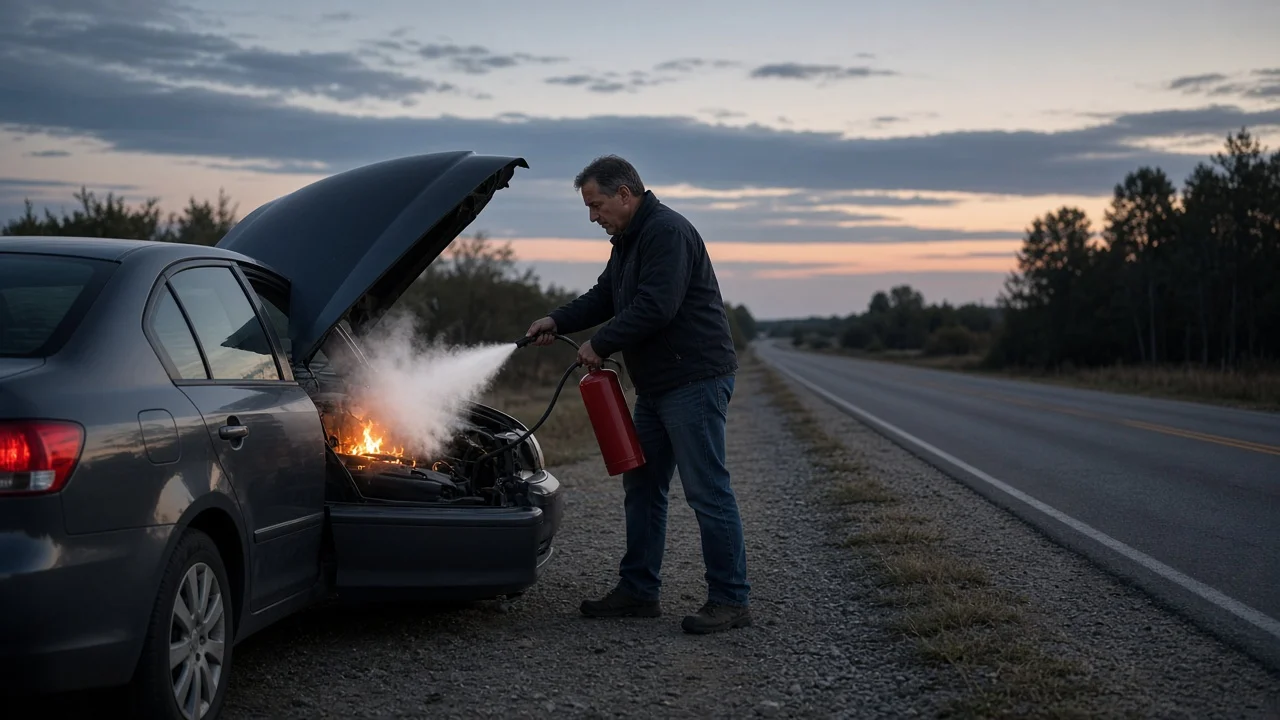
1) Signal and pull over as soon as it is safe, away from traffic, buildings, dry vegetation and fuel pumps. 2) Turn off the engine. This stops fuel delivery and electrical flow in many vehicles. 3) Get everyone out immediately and move well away from the vehicle. Do not go back for belongings. 4) Call emergency services and give your location. 5) Decide whether to use the extinguisher. Stop here and stay back if the fire is large, spreading, near the fuel tank, inside the passenger compartment, producing heavy smoke, or if you have any doubt. 6) Do not open the hood fully. Lifting it lets in a rush of oxygen and can cause flames to flare toward you. If the fire is under the hood, aim through the grille, wheel wells or a small gap. 7) Position yourself with your back to a clear escape route, keeping a safe distance and, outdoors, with the wind behind you if possible. 8) Use the PASS method: Pull the pin, Aim the nozzle at the base of the fire rather than the flames, Squeeze the handle, and Sweep side to side across the base until the fire appears out or the extinguisher is empty. 9) Back away while watching the area. Reignition is common with vehicle fires. 10) If the fire is not clearly controlled within a few seconds of spraying, stop and move away. Do not try to fight it further.
Electric and Hybrid Vehicles
Fires involving high-voltage lithium-ion batteries behave differently. Battery thermal runaway, a self-sustaining heating reaction inside the cells, can continue or restart even after visible flames are knocked down, and it can release toxic gases. A portable extinguisher is generally not adequate for a battery fire. Evacuate, call emergency services, tell the dispatcher that the vehicle is electric or hybrid, and keep a wide distance. Small fires clearly not involving the battery, such as a smoldering item in the cabin, follow the same general principles as in any other vehicle, but your safety still comes first.
Afterward: Confirming the Outcome
Let firefighters confirm the fire is fully out, even if it looks extinguished. Do not restart or drive the vehicle. Fire can damage wiring, fuel lines, brake components and hoses in ways that are not visible. Have the vehicle towed and inspected by a qualified technician before any decision about repair. If dry chemical agent was used, ask that the residue be cleaned from electrical components and metal surfaces. Contact your insurer about the incident. Recharge or replace the extinguisher. A partially used unit may lose pressure and cannot be relied on.
Limits of This Guide
No vehicle-specific or product-specific data was available for this article, so it does not give discharge times, capacity ratings, recommended extinguisher sizes, servicing intervals or legal requirements. These vary by extinguisher model, vehicle type and jurisdiction. Check the extinguisher label and manufacturer instructions, your vehicle owner's manual, and any state or local rules that apply to you, particularly if you operate a commercial vehicle, which can be subject to separate requirements.