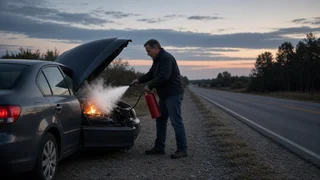
How Do CO2 Fire Extinguishers Work?
A CO2 fire extinguisher works by flooding the fire with carbon dioxide gas. The gas pushes away the oxygen the flames need, so combustion can no longer continue. The discharge also cools the fire slightly, but that is a secondary effect. CO2 leaves no residue and does not conduct electricity, so it suits fires involving flammable liquids and live electrical equipment. It is much less effective on burning solids such as upholstery, wood or paper, and it struggles in wind or in the open. Both limits matter if you are thinking of using one on a vehicle fire.
How carbon dioxide extinguishes a fire
Fire needs three things at once: heat, fuel (any combustible material), and oxygen. A fourth element, the chemical chain reaction between them, keeps the flames going. Take away any one of these and the fire goes out. CO2 targets the oxygen.
Smothering: carbon dioxide is heavier than air. When discharged onto a fire, it forms a blanket that displaces the surrounding air and lowers the oxygen concentration around the fuel below the level combustion needs. Cooling: the extinguisher stores carbon dioxide as a liquid under high pressure. When released, the liquid expands rapidly and gets extremely cold. Part of it forms solid CO2 "snow," which pulls some heat from the burning material. This helps, but it is not the main way CO2 puts out a fire. No residue: the gas simply disperses afterward. Nothing has to be cleaned off electrical components, engine parts or sensitive equipment.
What happens inside the extinguisher
1) The cylinder holds carbon dioxide compressed into a liquid. That is why CO2 extinguishers have thick-walled, heavy cylinders compared with other types of similar capacity. 2) Pulling the safety pin unlocks the operating lever. 3) Squeezing the lever opens a valve. Internal pressure forces the liquid CO2 up a siphon tube and out through the discharge horn. 4) As the CO2 leaves the horn, it expands into a cold mix of gas and snow. That is the white cloud you see during discharge, and it is often accompanied by a loud hiss. 5) The wide horn slows the discharge and shapes it, so the gas reaches the fire as a concentrated cloud instead of a narrow jet.
Most CO2 extinguishers have a hard horn instead of a soft nozzle, and many have no pressure gauge. The gas pressure inside changes with temperature, so a gauge would not reliably show how much agent is left. These units are usually checked by weighing them during inspection.
Fire classes and ratings: where CO2 fits
In the US, extinguishers carry a fire extinguisher rating that shows which classes of fire they are approved for. CO2 extinguishers are typically rated for Class B and Class C fires. They do not normally carry a Class A rating.
Fire class | What burns | CO2 suitability; Class A | Ordinary solids: upholstery, carpet, plastics, paper, wood | Poor; may knock down flames but rarely stops smoldering material; Class B | Flammable liquids and gases: gasoline, diesel, oil | Suitable, especially in still air; Class C | Energized electrical equipment | Suitable; CO2 does not conduct electricity; Class D | Combustible metals | Not suitable; Class K | Cooking oils and fats | Not suitable
Limits that matter for vehicle fires
A car fire rarely stays in one category. A fault in the engine bay can begin as an electrical fire, spread to leaking fuel or oil, and then reach plastic trim, wiring insulation and interior materials. CO2 handles the first two well and the last poorly. Several other limits are worth understanding before relying on a CO2 unit:
Wind and open air: the gas works by building up a concentrated cloud. Outdoors, especially at a windy roadside, the cloud is quickly blown away. Re-ignition: CO2 leaves nothing behind to coat or cool the fuel, so hot metal or smoldering material can reignite the fire once the gas clears. This is a real risk with hot engine and exhaust parts. Short range: CO2 has to be applied close to the fire, which puts you near heat and flames. Short discharge time: a portable unit empties quickly, which leaves little margin for error. Weight and bulk: CO2 cylinders are heavy for the amount of agent they hold, which makes them less practical to carry in a vehicle. Electric vehicle batteries: a high-voltage battery in thermal runaway can produce its own heat and keep burning without outside oxygen. A portable CO2 extinguisher will not stop it.
For these reasons, many drivers carry a vehicle-rated multipurpose dry chemical extinguisher, labeled for A, B and C fires, instead of CO2. CO2 is more often chosen for workshops, garages and electrical areas, where residue-free discharge matters and the air is still. Whatever type you carry, check that its label lists the fire classes you are likely to face and that it is mounted securely, not loose in the cabin or trunk.
Using a CO2 extinguisher on a vehicle fire
An extinguisher is for a small, early-stage fire only. Your first priority is safe evacuation, not saving the vehicle. Follow these steps in order, and stop at any point where the conditions in a step are not met.
1) Pull over and stop: move off the road to a safe spot, away from buildings, dry grass and other vehicles if possible. Put the vehicle in park and apply the parking brake. 2) Remove the ignition source: switch off the engine. This stops the fuel pump and cuts power to many circuits. Do not reach into a burning engine bay to disconnect the battery. Electrical isolation at the battery is only appropriate if it is clearly safe, which during an active fire it usually is not. 3) Get everyone out: evacuate all occupants and move well away from the vehicle and from traffic, ideally upwind. Leave belongings behind. 4) Call emergency services: in the US, dial 911. Give your location and say it is a vehicle fire. Mention if the vehicle is an electric vehicle or hybrid. 5) Decide whether to fight it: only attempt it if the fire is small, you have a clear escape route, and you are not alone. Do not attempt it if flames are coming from under the vehicle, near the fuel tank, from the battery area of an EV or hybrid, or inside the passenger cabin and spreading. In those cases, stay back and wait for firefighters. 6) Do not fully open the hood: lifting the hood feeds the fire a rush of oxygen. If smoke or flames are coming from the engine bay, aim through the grille, through the gap at the hood edge, or underneath from the side. 7) Use the PASS method: Pull the pin. Aim the horn at the base of the fire, not at the flames. Squeeze the lever. Sweep side to side across the base. 8) Handle the horn safely: hold the extinguisher by its handle and the insulated part of the horn only. The metal parts get cold enough during discharge to cause frostbite-type injuries to bare skin. 9) Back away and watch: when the extinguisher is empty or the flames are out, step back and keep watching. Because CO2 leaves no residue, the fire may flare up again once the gas disperses. Do not restart or drive the vehicle.
How to tell whether it worked
Visible flames going out is not the same as the fire being out. Signs that it may still be active include continued or thickening smoke, a hissing or popping sound, smells of burning plastic or fuel, and heat radiating from the area. Even if everything looks calm, let firefighters confirm the fire is fully out. Then have the vehicle towed and inspected by a qualified technician. Fires often start from a fuel leak, damaged wiring or a fault in the electrical system, and the cause needs to be found and repaired before the vehicle is used again.
Safety cautions specific to CO2
Enclosed spaces: CO2 displaces oxygen for people as well as for flames. In a closed garage or inside a vehicle cabin, a discharge can create a suffocation hazard. Ventilate the space and leave it after use. Cold burns: never touch the horn's metal parts or the discharge cloud with bare skin. Noise and visibility: the discharge is loud and the white cloud can briefly block your view. Be ready for both so they do not startle you. After use: a partly used CO2 extinguisher should be recharged or replaced. Do not assume it still holds enough agent for another fire.
Key takeaways
Carbon dioxide puts out fire mainly by smothering it, lowering the oxygen around the fuel until it can no longer burn, with some added cooling. That makes CO2 clean and effective on flammable-liquid and electrical fires in still air. It is less reliable outdoors, on burning solids, and wherever hot surfaces can reignite fuel after the gas drifts away. For roadside vehicle fires, treat any extinguisher as a tool for a small, early fire only. Getting everyone out and calling for help always comes first.