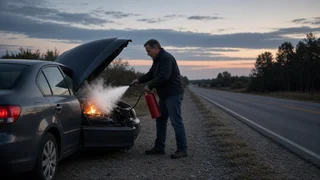
What Gas Puts Out Fire? CO2, Inert Gases and Clean Agents Explained for Drivers
The gas most people mean when they ask what gas puts out fire is carbon dioxide (CO2), the agent in the familiar extinguisher with a wide black horn. CO2 is not the only one. Inert gases such as nitrogen and argon, and a group of engineered "clean agents" (halocarbon gases, including the older halons), also suppress fire. One qualification matters a great deal on the roadside: a gas extinguisher is effective only on certain fires and only in the right conditions. A gas extinguisher is not a substitute for getting out of the vehicle and calling emergency services. This guide explains how fire-suppressing gases work, how they differ, and how they fit into responding to a vehicle fire.
The short answer
• Carbon dioxide (CO2): the most common gas extinguishing agent, suited to flammable liquid and energized electrical fires. • Nitrogen and argon (and blends of them): inert gases used mainly in fixed suppression systems that protect rooms and equipment enclosures. • Clean agents: halocarbon gases that leave no residue. Examples include the HFC agents sold under names such as FM-200 and FE-36, fluoroketone agents, and Halotron-type blends used in portable extinguishers. • Halons: highly effective but ozone-depleting. New production ended in the US in the 1990s, and use is now limited to recycled stock in specialized applications.
How a gas puts out a fire
A fire needs three things: heat (an ignition source), fuel (a combustible material) and oxygen. It also needs a self-sustaining chemical chain reaction. Fire scientists often describe these four elements as the fire tetrahedron. Remove any one of them and the fire goes out. Extinguishing gases attack different parts of the tetrahedron.
Oxygen displacement: CO2, nitrogen and argon do not burn and do not support combustion. When enough of one of these gases floods the space around a fire, it lowers the oxygen concentration below the level that flames need. CO2 also cools somewhat as it expands out of the cylinder, but smothering is its main effect.
Chain-reaction interruption: Halons, and to varying degrees some modern clean agents, chemically interfere with the free radicals that keep combustion going. They also absorb heat. Because they do not rely only on pushing oxygen away, they can work at lower concentrations than the inert gases.
Two practical effects follow from this. Gas agents leave no powder or foam behind, which is why they are used around electronics, aircraft and engine bays. But the gas disperses quickly once discharge stops. It also does little to cool glowing embers inside solid materials. Fires in upholstery, wiring insulation bundles or other solid fuel can rekindle after the gas drifts away.
Comparing fire-suppressing gases
Agent | Main mechanism | Typical use | Key limitations; Carbon dioxide (CO2) | Displaces oxygen, some cooling | Portable extinguishers, fixed systems for machinery and electrical spaces | Poor on deep-seated solid-fuel fires; wind disperses it outdoors; dangerous to breathe in enclosed spaces; very cold discharge; Nitrogen, argon and inert blends | Displaces oxygen | Fixed total-flooding systems for rooms and enclosures | Needs large volumes and sealed spaces; not practical as a handheld vehicle extinguisher; HFC and fluoroketone clean agents | Heat absorption and some chemical interruption | Fixed systems for electronics; some portable units; some vehicle and motorsport suppression systems | Usually more expensive; environmental rules on some agents are tightening; Halotron-type portable clean agents | Chemical interruption and cooling | Portable extinguishers where residue must be avoided, such as aviation and vehicles | Higher cost per unit of firefighting capacity than dry chemical; Halons | Chemical chain-reaction interruption | Legacy and specialized uses, mainly aviation, from recycled supply | Ozone-depleting; no new production in the US
Gases that do the opposite
Not every gas suppresses fire. Oxygen strongly accelerates combustion. Flammable gases such as propane, natural gas, hydrogen and gasoline vapor are fuels in their own right. In a vehicle, fuel vapor and leaking refrigerant oils or fluids can feed a fire. For that reason, a leak combined with a hot exhaust or an electrical fault is a classic fire scenario.
Fire extinguisher ratings and where CO2 fits
In the US, portable extinguishers are rated by the class of fire they are tested against. Class A covers ordinary solid combustibles such as fabric, plastic and paper. Class B covers flammable liquids and gases such as gasoline and oil. Class C indicates the agent does not conduct electricity, so it is safe on energized electrical equipment. Classes D and K cover combustible metals and cooking oils. A label such as 2-A:10-B:C shows both the classes and the relative capacity; a higher number means more firefighting capacity within that class.
CO2 extinguishers normally carry only B and C ratings, because they are not effective at extinguishing burning solids. Portable clean-agent units are also commonly rated B:C, and some larger sizes earn an A rating as well. Dry chemical extinguishers, often labeled ABC or BC, are a powder rather than a gas. They are the type most often recommended for passenger vehicles. They cover the likely fuels in a car, are compact for the capacity they deliver, and handle outdoor conditions better than CO2. The tradeoff is a corrosive, messy residue. A clean agent avoids that residue but costs more for the same capacity. Whichever you choose, look for a unit labeled as suitable for vehicle use, mount it securely so it cannot become a projectile, and check its pressure gauge or condition at the interval its label specifies.
Why gas alone is a weak tool in a vehicle fire
A car on the roadside is close to a worst case for gas agents. The fire is outdoors, so wind carries the gas away before it can build an oxygen-starved concentration. Engine bays are open underneath and partly vented. Interior fires involve foam, plastics and fabric that hold heat and can reignite. A small handheld cylinder empties in seconds.
Electric and hybrid vehicles add a further limit. A lithium-ion traction battery in thermal runaway generates its own heat and releases flammable gases inside sealed cells. Displacing outside oxygen does not stop that internal reaction, and these fires can flare up again long after they appear to be out. Responding firefighters typically need large volumes of water applied over an extended period, along with specialized procedures. A driver should not attempt to fight a high-voltage battery fire with a portable extinguisher.
What to do if your vehicle catches fire
Your priority is safe evacuation, not saving the vehicle. A fire can spread through a car very quickly, and burning plastics release toxic smoke.
1) Signal, pull over to a safe spot away from traffic, buildings and dry vegetation, and stop. 2) Turn off the ignition. This provides basic electrical isolation and stops the fuel pump on most vehicles. Do not stay in the car to disconnect the battery. 3) Get everyone out, including pets, and leave belongings behind. 4) Move well away from the vehicle and upwind of the smoke. A common rule of thumb is at least 100 feet. Keep people out of traffic lanes. 5) Call 911 and give your location, describe the vehicle, and say whether it is an electric or hybrid model if you know. 6) Do not open the hood or trunk fully. Fresh air can make a contained fire flare up violently. 7) Use an extinguisher only if the fire is small, you have a clear escape path, everyone else is safe, and the vehicle is not an EV or hybrid with a battery fire. Aim at the base of the flames through a gap, such as a slightly lifted hood edge or the grille, from a safe distance. 8) If the fire grows or the extinguisher runs out, walk away and wait for emergency services.
If you do use a CO2 extinguisher, hold it only by the handle and insulated parts. The discharge horn gets cold enough to cause frostbite. Avoid discharging CO2 into the closed cabin while anyone is inside, because a high concentration in an enclosed space can quickly become dangerous to breathe.
Verdict: which gas, and when
CO2 is the gas that puts out fire in most everyday extinguishers. Inert gases and clean agents do the same job in fixed systems and specialized portable units. Gas agents are a good choice where cleanliness matters and the fire is a liquid or electrical fire in a reasonably enclosed space. For a typical driver, a vehicle-rated dry chemical or clean-agent extinguisher is a sensible precaution, with CO2 a narrower choice. Even the best extinguisher is a secondary measure. In a vehicle fire, the steps that protect you are stopping safely, cutting the ignition, getting everyone clear, and calling emergency services.