What Comes Out of a Fire Extinguisher? Agents, Residue and Vehicle Use Explained
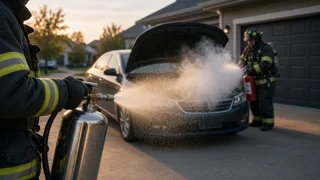
What comes out of a fire extinguisher depends on the type of extinguisher. Most portable units sold for cars, homes and garages spray a fine dry chemical powder, usually yellow or white. Others discharge carbon dioxide gas, plain water, foam, a wet chemical solution or a clean agent that evaporates without residue. The label on the cylinder tells you which agent is inside and which classes of fire it is designed to fight. For drivers, the distinction matters because it determines what the extinguisher can and cannot put out, what mess it leaves behind and how safe it is to use in or around a vehicle.
The short answer: it depends on the extinguisher type
Every portable extinguisher holds two things: an extinguishing agent and a way to push it out. In most designs the agent is stored under pressure from an inert propellant gas such as nitrogen, so squeezing the handle opens a valve and the pressure drives the agent through the hose or nozzle. Carbon dioxide extinguishers are different because the CO2 itself is stored as a pressurized liquid and expels itself as it turns into gas. So when people ask what a fire extinguisher sprays, the practical answer is the agent, carried out by gas pressure.
Extinguisher type | What comes out | Typical fire classes | Residue; Dry chemical (ABC, multipurpose) | Fine powder, commonly monoammonium phosphate, often pale yellow | A, B, C | Heavy, clingy powder; Dry chemical (BC) | Fine powder, commonly sodium bicarbonate or potassium bicarbonate | B, C | Powder, generally easier to clean than ABC; Carbon dioxide (CO2) | Very cold gas with a white cloud of dry-ice particles | B, C | None; Water | Pressurized water stream or mist | A | Water damage; Foam (such as AFFF) | Water mixed with a foaming concentrate | A, B | Wet foam residue; Wet chemical | Potassium-based solution, often potassium acetate | K, sometimes A | Soapy film; Clean agent | Gas or liquid that evaporates, such as halocarbon-based agents | Varies, often B and C, larger units also A | None or minimal
Fire classes in the US system describe the fuel involved. Class A covers ordinary combustible material such as paper, cloth, wood, upholstery and many plastics. Class B covers flammable liquids and gases such as gasoline, diesel, oil and grease outside the kitchen. Class C covers fires involving energized electrical equipment. Class D covers combustible metals, and Class K covers cooking oils and fats in commercial kitchens. A vehicle fire can involve A, B and C materials at the same time, which is why multipurpose dry chemical units are the most common choice for cars.
What's inside each type and how it stops a fire
A fire needs heat, fuel, oxygen and an ongoing chemical chain reaction. Removing any one of these stops the burning. Each extinguishing agent attacks one or more of them, which explains why different agents suit different fires.
Dry chemical powder
Dry chemical is what's inside the fire extinguisher in most vehicles. The powder interrupts the chemical chain reaction of combustion and helps smother the fuel. Monoammonium phosphate, the agent in ABC units, also melts on hot surfaces and forms a coating that helps keep solid materials from reigniting, which is why it is rated for Class A fires. Sodium and potassium bicarbonate powders in BC units work well on flammable liquids but do not provide that coating, so they are less effective on burning upholstery or other solid materials. All dry chemical agents are electrically nonconductive, making them suitable around live electrical circuits.
Carbon dioxide
A CO2 extinguisher sprays carbon dioxide that displaces oxygen around the fire and cools it slightly. The discharge looks like white smoke because some of the gas freezes into tiny dry-ice particles. CO2 leaves no residue and does not conduct electricity, so it is used around sensitive electronics. Its limitations are that the gas disperses quickly outdoors or in wind, it does little to cool deep-seated burning material, and fires can reignite once the gas drifts away. The discharge horn becomes extremely cold and can cause frostbite if gripped, and in a small enclosed space the gas can displace breathable air.
Water and foam
Water extinguishers cool burning solid materials below the temperature at which they keep burning. They should not be used on flammable liquids, which can spread, or on energized electrical equipment, because water can conduct current. Foam extinguishers add a concentrate that creates a blanket over liquid fuel, separating it from oxygen and suppressing flammable vapors while the water content cools. Some foam and water-mist units carry ratings for additional classes, so the label is the deciding reference.
Wet chemical
Wet chemical extinguishers spray a solution, typically potassium-based, that reacts with hot cooking oil to form a soapy layer on the surface. This process, called saponification, seals the oil from oxygen while the liquid cools it. These units are designed for kitchens and are not a typical vehicle choice.
Clean agents
Clean agent extinguishers discharge a liquefied gas that evaporates after use, leaving little or no residue. They work mainly by interrupting the combustion chemistry and absorbing heat. They are popular for aircraft, boats, server rooms and collector or show cars, where powder residue would be costly to clean. They generally cost more than dry chemical units of similar capability.
Is fire extinguisher powder harmful?
Dry chemical agents are generally considered low in toxicity, but the powder is a strong irritant. Breathing the cloud can cause coughing and throat irritation, and it can irritate the eyes and skin. In the confined space of a car cabin, a discharge can briefly make it hard to see and breathe, so ventilate the area and move to fresh air. Anyone with breathing difficulty or persistent symptoms after exposure should seek medical attention.
For vehicles, the bigger long-term concern is corrosion. Monoammonium phosphate residue is mildly acidic and can attract moisture, and left on metal, wiring and connectors it can contribute to corrosion over time. Bicarbonate powders are less aggressive but still need to be removed. CO2 and clean agents avoid this issue entirely.
Choosing an extinguisher for a car
For most passenger vehicles, a compact multipurpose dry chemical extinguisher is the practical default because it covers the mix of upholstery, fuel, oil and wiring found in a car. A BC unit is a reasonable alternative where the main concern is fuel or oil fires and easier cleanup is valued. Clean agent units suit owners who prioritize avoiding residue and accept a higher price.
The fire extinguisher rating printed on the label shows what the unit is tested to handle. In the US format, a number before A indicates relative capability on ordinary combustibles, a number before B indicates relative capability on flammable liquids, and a C means the agent is safe on energized electrical equipment. An example of the format is 1-A:10-B:C. Higher numbers mean greater capability within that class, generally from a larger or more effective unit.
Points to consider when choosing a vehicle extinguisher: Class coverage that matches vehicle fire risks, typically including B and C; A mounting bracket designed for vehicle use, so the cylinder cannot become a projectile in a crash or hard stop; A pressure gauge on stored-pressure units for quick visual checks; A size you can reach and operate quickly, balanced against capability; Whether residue cleanup is a major concern for the vehicle
Electric vehicles and hybrids need a specific caveat. A fire in a high-voltage lithium-ion battery pack can involve thermal runaway, a self-sustaining reaction that a portable extinguisher is not designed to stop. Such fires can reignite and release toxic gases. A small extinguisher may still be useful on minor fires elsewhere in the vehicle, but if the battery pack is involved, the right action is safe evacuation and a call to emergency services, not firefighting.
Using an extinguisher during a vehicle fire
People always come before property. A portable extinguisher is meant for small, early-stage fires with a clear escape route. If flames are spreading, smoke is heavy, the fire is under the vehicle near the fuel tank, or a battery pack is involved, get everyone away from the vehicle, stay well clear and upwind, and call 911.
1) Pull over safely, stop the engine and switch off the ignition. This removes a key ignition source and provides basic electrical isolation by cutting most circuits fed through the ignition. 2) Get all occupants out and well away from the vehicle and traffic. 3) Call emergency services, even if you plan to attempt suppression. 4) Do not fully open a hood if fire is in the engine bay. A sudden rush of air can intensify the flames. If you can, aim the agent through gaps around the hood edges or grille. 5) Stand back several feet, with the wind behind you and an exit path clear. 6) Use the PASS method: Pull the pin, Aim the nozzle at the base of the flames, Squeeze the handle, Sweep side to side across the base of the fire. 7) Back away once the fire appears out and watch for reignition. Do not drive the vehicle; have it inspected.
Most compact vehicle extinguishers empty within seconds, so short, controlled bursts aimed at the base of the fire are more effective than spraying at the flames themselves. If the extinguisher is empty and the fire persists, stop and move away.
Cleaning up after a discharge
Cleanup depends on what came out of the extinguisher. CO2 and clean agents need no cleanup beyond ventilating the area. Dry chemical residue should be removed promptly, because it becomes harder to clear and more likely to cause corrosion once it absorbs moisture.
For dry chemical residue in or on a vehicle: Let hot components cool fully before touching anything. Wear gloves and eye protection, and consider a dust mask. Vacuum or brush away loose powder first, rather than wetting it. Wipe remaining residue from interior surfaces with a damp cloth once loose powder is gone. Have the engine bay, wiring and connectors inspected and cleaned by a qualified technician if powder reached them.
Any extinguisher that has been partially or fully discharged should be recharged by a qualified service provider or replaced. A partly used unit may lose pressure and fail when needed next. Check the gauge on stored-pressure units regularly and follow the inspection guidance on the label.
Key takeaway
A fire extinguisher sprays whatever agent its type contains: dry chemical powder in most car and home units, or CO2, water, foam, wet chemical or a clean agent in others. Each works by removing heat, oxygen, fuel or the chemical reaction that keeps a fire burning, and each is rated for specific fire classes. For a typical vehicle, a properly mounted multipurpose or BC dry chemical extinguisher offers broad coverage at the cost of messy, potentially corrosive residue. Whatever you carry, treat it as a tool for small fires only, and put getting people clear and calling emergency services first.