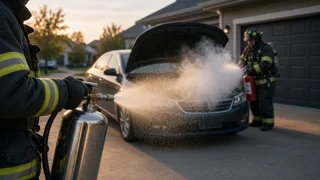
What Type of Fire Extinguisher Should You Keep in a Car?
For most private cars, trucks and SUVs in the US, the practical choice is a compact multipurpose dry chemical extinguisher rated for Class A, B and C fires, usually labeled "ABC." A vehicle fire can involve upholstery and plastics, fuel or oil, and live wiring at the same time, and an ABC unit is designed to handle all three. There are important qualifications. A handheld extinguisher is meant for small, early fires only, it will not stop a lithium-ion battery fire in an electric or hybrid vehicle, and commercial vehicles have their own federal requirements. The rest of this guide explains the fire classes, the main extinguisher types, and how to choose, mount and use one.
What Puts Out a Fire: The Basic Principle
A fire needs four things to keep burning: fuel, heat, oxygen and an ongoing chemical chain reaction. This is often called the fire tetrahedron. Every extinguisher works by removing or interrupting at least one of these. Water mainly removes heat. Carbon dioxide and foam mainly displace or block oxygen. Dry chemical agents interrupt the chain reaction and, in the case of ABC powder, also form a coating that helps smother burning solid material. Which method works safely depends on what is burning, which is why extinguishers are sorted into classes.
Fire Classes Used in the US
US extinguishers are labeled by the classes of fire they are listed to fight. The letters below appear on the label, often with pictograms.
Class | What is burning | Vehicle relevance; A | Ordinary combustibles such as fabric, paper, wood, rubber and many plastics | Seats, carpet, headliner, cargo, tires; B | Flammable liquids and gases such as gasoline, diesel, oil and grease | Fuel leaks, engine oil, transmission fluid, some vapors; C | Energized electrical equipment | Wiring, battery cables, alternator, aftermarket electronics; D | Combustible metals such as magnesium | Rare in ordinary vehicle fires; some components contain magnesium alloys; K | Cooking oils and fats | Mainly food trucks and RVs with kitchens
Class C is a special case: the label means the agent does not conduct electricity, so it is safe to use on live equipment. Once the power is off, an electrical fire is usually treated as Class A or B depending on what remains burning.
What Types of Fire Extinguishers Are There?
Extinguishers are also described by the agent they contain. Each agent suits some fire classes and is unsafe or ineffective on others.
Type | Typical classes | How it works | Fit for a passenger vehicle; Multipurpose dry chemical (ABC) | A, B, C | Powder interrupts the chain reaction and coats burning solids | The usual recommendation; covers the mix of materials in a car; BC dry chemical (sodium or potassium bicarbonate) | B, C | Powder interrupts the chain reaction on liquid and electrical fires | Effective on fuel fires but weaker on upholstery and other solids; Clean agent (halocarbon types) | Often B, C; larger units may add A | Gas or vaporizing liquid interrupts combustion and leaves little residue | Useful where residue is a concern, but costlier and less effective in wind; Carbon dioxide (CO2) | B, C | Displaces oxygen and cools slightly | Disperses quickly outdoors, so poorly suited to roadside use; Water | A only | Cools burning solids | Unsafe on fuel and live electrical fires; not recommended for vehicles; Foam (AFFF and similar) | A, B | Smothers and seals the surface of flammable liquids | Used in some fleet, marine and motorsport settings; not C-rated; Wet chemical | K, sometimes A | Cools and forms a soapy layer on hot oils | For cooking appliances in food trucks or RVs, not the engine bay; Class D dry powder | D | Smothers and absorbs heat from burning metals | Specialized; not a general vehicle extinguisher
What Type of Fire Extinguisher Is Most Common?
The multipurpose ABC dry chemical extinguisher is the most common type in homes, offices and vehicles in the US. Its agent is typically based on monoammonium phosphate. Its popularity comes from coverage: one unit handles most fires an ordinary person is likely to face, and it is widely available and relatively inexpensive.
Which Fire Extinguisher Suits Your Vehicle
The right choice depends on the vehicle and how it is used. The criteria below matter most.
Fire classes: look for A, B and C on the label for a general-purpose car extinguisher. A BC unit is acceptable for fuel and electrical fires but gives up capability on interior materials. Rating and size: US labels carry a UL rating such as "2-A:10-B:C." The number before A indicates relative capacity on ordinary combustibles, the number before B indicates relative capacity on flammable liquids, and C has no number. Higher numbers mean more firefighting capacity, and generally a larger, heavier unit. Choose the largest unit you can mount securely and handle comfortably. Temperature tolerance: cabins and trunks get very hot and very cold. Check that the label's operating temperature range suits your climate. Construction: units with a metal valve and a pressure gauge let you check readiness at a glance. Rechargeable models can be serviced after use; disposable models are replaced. Mounting: choose a model that comes with, or accepts, a sturdy bracket for vehicle use. Residue: dry chemical powder is messy and the ABC type can corrode metals and electronics if left in place. Clean agent avoids most of that but costs more and has less reach outdoors.
Special cases
Commercial motor vehicles: trucks and buses operating under federal motor carrier rules must carry an extinguisher meeting specific minimum ratings, with higher requirements for vehicles carrying placarded hazardous materials. Check the current federal and state rules that apply to your operation. Electric and hybrid vehicles: a handheld extinguisher may help with a small fire in the cabin or a 12-volt circuit, but it cannot stop thermal runaway in a high-voltage lithium-ion battery pack. Class D extinguishers are not the answer for these battery fires either. RVs and food trucks: consider an ABC unit for general use plus a Class K unit near any cooking appliance that uses oil or fat. Motorsport and off-road builds: sanctioning bodies may require specific agents, sizes or plumbed suppression systems. Follow the rulebook for your class.
Strengths and Limitations of an ABC Extinguisher in a Car
An ABC dry chemical unit is the most versatile option for a passenger vehicle and knocks down flames quickly when applied early. Its limitations are worth understanding. Compact vehicle-sized units empty fast, so they buy seconds rather than minutes. Powder can obscure vision in an enclosed space and irritate eyes and lungs. It provides little cooling, so a fire in hot metal or deep-seated material can reignite. And the residue requires prompt cleanup to limit corrosion. For most drivers the benefits outweigh these drawbacks, provided the extinguisher is treated as a tool for very small fires and a way to protect an escape route, not as a way to save the vehicle at any cost.
How to Respond to a Vehicle Fire
People come first. Vehicles contain fuel, pressurized components and materials that produce toxic smoke, and fires can grow rapidly. Use an extinguisher only if the fire is small, you have a clear way to back off, and everyone is already out of the vehicle.
1) Signal, pull over to a safe spot away from traffic, buildings and dry grass, and turn off the engine. 2) Get everyone out and move well away from the vehicle, staying upwind and off the roadway. Do not go back for belongings. 3) Call 911, even if you think you can handle the fire. 4) Decide whether it is safe to act. Do not attempt to fight the fire if it is large, spreading, near the fuel tank, coming from a high-voltage battery, or producing heavy smoke. 5) Do not open the hood if you suspect an engine fire. Fresh air can make it flare up suddenly. If you have a clear opening such as the gap at the grille or wheel well, aim through that. 6) Use the PASS method: Pull the pin, Aim at the base of the flames, Squeeze the handle, Sweep side to side. 7) Keep a safe distance as indicated on the extinguisher label, and back away if the fire does not shrink quickly. 8) Once the flames are out, stay clear and watch for reignition until firefighters arrive. Have the vehicle inspected before driving it again.
Electric vehicle fires
If smoke, hissing, popping or flames come from the battery area of an EV or hybrid, do not try to fight it. Get everyone away, call 911 and tell the dispatcher the vehicle is electric. Battery fires can reignite hours or even days later, so the vehicle should be handled by responders and towing personnel who know how to manage it.
Mounting and Maintaining a Vehicle Extinguisher
Secure it in a bracket attached to a solid part of the vehicle. A loose extinguisher can become a dangerous projectile in a crash. Keep it within reach of the driver or in a consistent, accessible spot such as under the front seat in a bracket or in the cargo area near the opening, not buried under luggage. Check the pressure gauge regularly. The needle should sit in the green zone. Inspect for dents, corrosion, a missing pin or tamper seal, and a cracked hose or nozzle. For dry chemical units, follow the manufacturer's guidance on inverting or shaking the extinguisher periodically, since vehicle vibration can compact the powder. Replace or professionally recharge the extinguisher after any use, even a brief discharge, because it may lose pressure. Respect the expiration or service interval marked on the label, and replace disposable units when they reach the end of their stated life.
Quick Answer
For a typical passenger vehicle in the US, choose a securely mounted, UL-listed ABC multipurpose dry chemical extinguisher in the largest size you can store and handle. Know the PASS method, keep the unit charged and inspected, and remember its limits: get everyone out first, call 911, never open the hood on an engine fire, and leave high-voltage battery fires to firefighters.