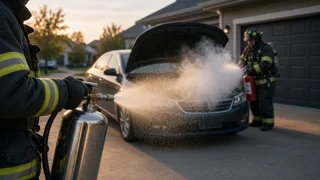
Halotron Fire Extinguisher: What It Is and How It Compares for Vehicle Use
A Halotron fire extinguisher is a clean agent extinguisher. It discharges a liquefied gas that evaporates quickly and leaves no powder or residue. It was developed to replace Halon 1211, which was phased out because it damages the ozone layer. Drivers, racers, pilots and owners of valuable equipment choose Halotron mainly because it is clean and does not conduct electricity. The trade-off is that it typically costs more and is less effective per pound than a dry chemical extinguisher. You need a larger Halotron unit to reach the same fire extinguisher rating. The short answer for vehicle owners: Halotron is a good choice when protecting wiring, electronics, an engine bay or an interior from cleanup damage matters more than cost and size. It is not a cure-all. It does not make an established vehicle fire safe to fight. It is also not a reliable answer to a lithium-ion traction battery fire in an electric or hybrid vehicle.
What Halotron Is
Halotron is a brand name for a family of clean extinguishing agents. Halotron I, the version most people mean, is a blend based on the hydrochlorofluorocarbon HCFC-123. It leaves the nozzle as a liquid stream, which gives it more reach than a pure gas. It then flashes to vapor, cooling the fire and interrupting the chemical reaction of combustion. Once it evaporates there is nothing left to vacuum or wash off.
Halotron BrX is a newer agent based on a different chemical, often referred to as 2-BTP. It was developed largely for aviation as a closer replacement for Halon 1211 with a lower environmental impact. The two agents are not interchangeable in a given extinguisher. If a product listing simply says Halotron, check which agent it contains.
How Halotron Differs From Other Extinguisher Types
Type | Residue after use | Electrically nonconductive | Typical strengths | Typical drawbacks; Halotron I (clean agent) | None | Yes | Clean discharge, safe around electronics and wiring, good reach for a gaseous agent | Higher cost, larger and heavier for a given rating, HCFC agent subject to phase-out rules; Halotron BrX (clean agent) | None | Yes | Clean discharge, lower environmental impact, aimed at aviation use | Usually costs more and is less widely stocked than Halotron I; ABC dry chemical | Fine powder, corrosive once it absorbs moisture | Yes | Inexpensive, effective per pound, covers ordinary combustibles, liquids and electrical fires | Messy cleanup, can damage electrical connectors and aluminum and steel parts if left in place; BC dry chemical (sodium bicarbonate) | Fine powder, generally less corrosive than ABC | Yes | Inexpensive, effective on flammable liquids | No rating for ordinary combustibles such as upholstery, still requires cleanup; Carbon dioxide | None | Yes | Clean, no residue | Short range, easily dispersed outdoors and in wind, rarely sized for vehicle carry
Dry chemical extinguishers knock down fire very effectively, but the powder spreads everywhere and can be hard to remove from engine bays, ventilation ducts and electronics. Monoammonium phosphate, the agent in ABC units, becomes acidic and corrosive when it absorbs moisture. Halotron avoids all of that, which is why it appears in race cars, collector vehicles, aircraft, boats and server rooms.
Understanding the Fire Extinguisher Rating
In the US, portable extinguishers carry a UL rating made of letters and numbers. The letters show which classes of fire the unit is listed for:
Class A: ordinary combustible material such as cloth, upholstery, paper and some plastics. Class B: flammable liquids and gases such as gasoline, diesel, oil and other fluids. Class C: energized electrical equipment. This letter has no number, because it only confirms that the agent does not conduct electricity.
The number in front of A or B indicates relative fire-fighting capacity, and a higher number means more capacity. Many smaller Halotron units carry only a B:C rating, while larger ones may also earn an A rating. Because clean agent is less effective per pound than dry chemical, a Halotron unit with the same rating is usually physically larger. When comparing models, compare the full rating printed on the label, not just the agent weight.
Vehicle fires can involve all three classes at once: fuel or oil (B), wiring (C), and seats, carpet and trim (A). For a single extinguisher in a passenger car, a unit that covers A, B and C gives the broadest coverage. Racing series and some commercial vehicle rules set their own requirements, so check the applicable rulebook or regulation if one applies to you.
When Halotron Makes Sense in a Vehicle
Track, autocross and race cars, where a small fire near wiring or fuel lines needs to be stopped without contaminating the car. Classic, collector and show vehicles, where powder cleanup could damage paint, chrome, upholstery or original components. Vehicles with extensive aftermarket electronics, audio systems or custom wiring. Motorhomes, workshop vans and trailers that carry electronics or equipment. Owners willing to pay more and accept a larger unit in exchange for a clean discharge.
For an everyday commuter car where cost and compact size matter most, a properly rated dry chemical extinguisher remains a reasonable and common choice. The cleanup is unpleasant, but it is a secondary concern next to having a working extinguisher on board at all.
Limitations and Precautions
Halotron puts out fire mainly by interrupting combustion. It does not smother deep-seated burning material for long, so smoldering upholstery or insulation can reignite after the vapor disperses. Keep watching the area after discharge.
Discharging a clean agent in a small, closed cabin can displace breathable air. Exposure to the fire also produces irritating decomposition products. Use it with doors or windows open where possible, avoid breathing the vapor or smoke, and get out of the vehicle and into fresh air afterward.
Electric and hybrid vehicles add a further limitation. Once a lithium-ion traction battery enters thermal runaway, it can keep generating heat and flammable gases internally, and a handheld extinguisher of any type is unlikely to stop it. In that situation, prioritize distance and call emergency services rather than trying to fight it.
Halotron I is based on an HCFC, a class of chemicals being phased out in the US under the Clean Air Act in line with the Montreal Protocol. Existing extinguishers can generally still be owned and used. Over time, however, availability, recharging and pricing may be affected. If you are buying new and plan to keep the unit for many years, ask the seller about recharge availability or consider Halotron BrX or another current clean agent.
Using a Halotron Extinguisher During a Vehicle Fire
An extinguisher is for a small fire that has just started. Your own safety comes first, and the vehicle is replaceable. A practical order of actions:
Pull over safely, stop and turn off the ignition. Switching off the engine provides basic electrical isolation and stops the fuel pump. Get everyone out and well away from the vehicle, upwind and away from traffic. Safe evacuation comes before any attempt to fight the fire. Call emergency services. Only fight the fire if it is small, you have a clear escape path and you are not in danger. If flames are large, spreading or coming from under the vehicle near the fuel tank, stay back. Do not fully open a hood with fire beneath it. A sudden rush of air can feed the flames. If possible, aim through the gap at the hood edge or through the grille. Aim at the base of the flames, not the smoke, and sweep across the burning area. The goal is to reach the ignition source and the burning combustible material, not just the visible flame. After discharge, step back and watch for reignition. Let firefighters inspect the vehicle even if the fire appears to be out.
Mounting and Maintenance
Mount the extinguisher with a sturdy metal bracket in a spot you can reach quickly. Never leave it loose in the cabin, where it can become a projectile in a crash. Do not bury it in a trunk under luggage.
Check the pressure gauge regularly, inspect the nozzle and safety pin, and follow the inspection, recharge and hydrostatic testing intervals on the label. Any extinguisher that has been partially discharged should be recharged or replaced, because a partly used unit may lose pressure.
Bottom Line
A Halotron fire extinguisher trades cost and size efficiency for a clean, residue-free, electrically safe discharge. That makes it well suited to race cars, collector vehicles and electronics-heavy builds, where a dry chemical extinguisher could cause costly cleanup damage. For a typical daily driver, a properly rated dry chemical unit is still a sound, lower-cost option. Whichever you choose, check the full rating on the label, mount the extinguisher securely, and remember that getting everyone out and calling for help always comes before fighting the fire.