When should a portable fire extinguisher be used
The short answer
A portable fire extinguisher should be used only on a small fire that is just starting, that is not spreading quickly, and only after everyone is out of danger and emergency services have been called or are being called. You should also have a clear escape route behind you and an extinguisher rated for the type of fire in front of you. If any of those conditions is missing, the safer choice is to get away and let firefighters deal with it.
For vehicle fires, the qualification matters even more. A car contains fuel, pressurized components, plastics and, in electrified models, large batteries, so a fire can grow quickly. An extinguisher is a tool for buying time on a small, early fire. It is not a reason to stay near a burning vehicle.
Conditions that should all be true before you use one
Everyone, including you, is out of the vehicle and moved well away from it and from traffic. Emergency services have been called, or someone else is calling them right now. The fire is small and contained, for example smoke or small flames in one area, not a fire spreading through the cabin or engine bay. The air is breathable and you are not being forced to stand in heavy smoke. You have an unobstructed way to retreat, ideally upwind, and you are not trapped between the fire and traffic or a barrier. The extinguisher is rated for the fire type and you know how to operate it.
When not to use an extinguisher
The fire is large, spreading, or involves the fuel tank area. Flames are inside the passenger compartment and growing. You would have to open the hood or trunk fully to reach the fire. Opening it lets in air that can make the fire flare up suddenly. The vehicle is an electric or hybrid model and the fire appears to involve the high-voltage battery. You are unsure what is burning, the smoke is thick, or your instinct is to step back. You do not have the right type of extinguisher, or it is unclear whether it is charged.
How this applies at the roadside
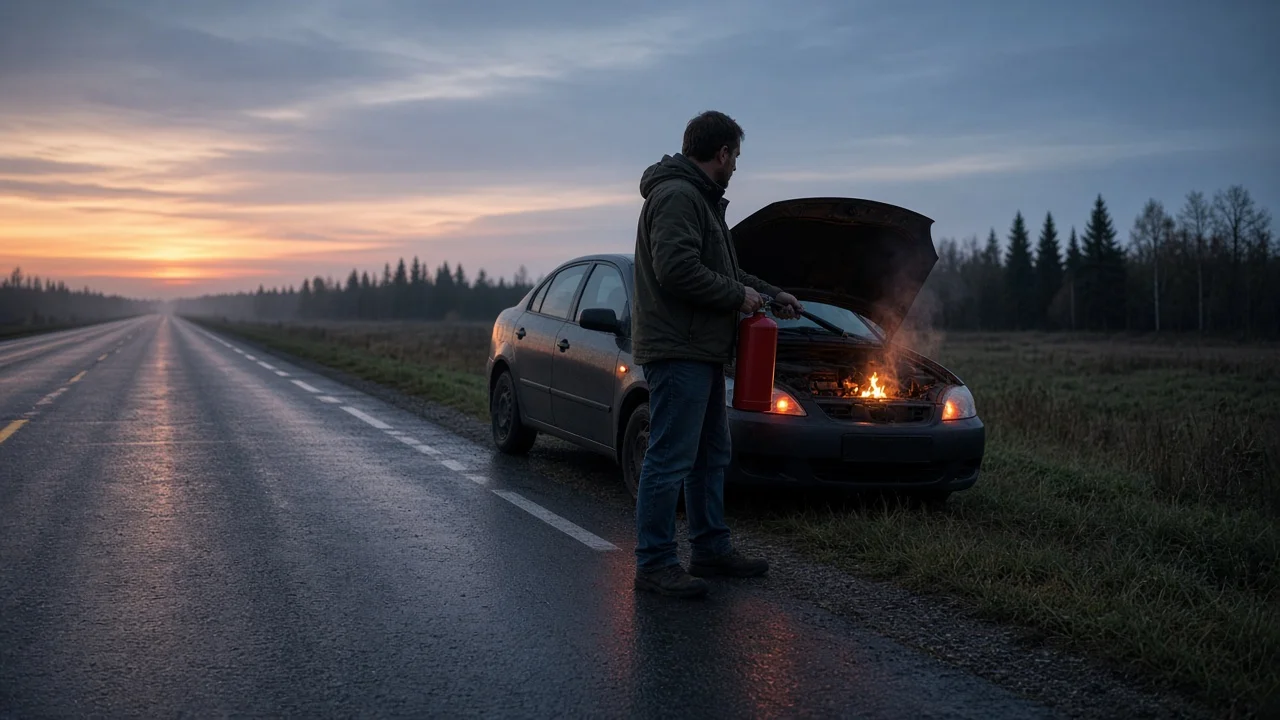
The order of priorities in a vehicle fire is people first, property second. If you notice smoke, flames or a burning smell while driving, signal and pull over to a safe spot, turn off the engine, and get all occupants out. Move well away from the vehicle and out of the path of traffic, then call 911. Do not go back for belongings.
Only once those steps are done does an extinguisher come into the picture. If smoke is coming from under the hood, general fire-safety guidance is not to lift the hood. If the fire is small and you can reach it without opening the hood, aiming the extinguisher through gaps such as the grille or the edges of the hood is the usual approach. If that is not possible, keep your distance and wait for the fire department.
Electric and hybrid vehicles call for extra caution. Fires involving lithium-ion traction batteries can reignite and are generally not something a handheld extinguisher can resolve. Treat a suspected battery fire as a situation to leave, and tell the dispatcher that the vehicle is electric or hybrid so responders can prepare. Specific handling procedures vary by manufacturer and model, so the owner's manual and the vehicle's emergency response guide are the authoritative sources.
Matching the extinguisher to the fire
In the US, portable extinguishers are labeled by the classes of fire they are designed for. Class A covers ordinary combustibles such as paper, cloth and many plastics. Class B covers flammable liquids such as gasoline and oil. Class C covers energized electrical equipment. A vehicle fire can involve all three, which is why multipurpose units labeled ABC, or units labeled at least BC, are commonly suggested for cars. Check the label on any extinguisher you carry, because using one on a class it is not rated for can be ineffective or unsafe.
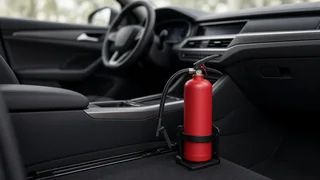
Size, mounting and suitability for a particular vehicle vary. Any extinguisher kept in a car should be secured so it cannot become a projectile in a crash, and its pressure gauge or inspection status should be checked according to the manufacturer's instructions.
Using it: the PASS method
Standard US training uses the acronym PASS, applied while keeping your escape route behind you.
Pull the pin, which breaks the tamper seal. Aim low, at the base of the fire rather than at the flames. Squeeze the handle to release the extinguishing agent. Sweep from side to side across the base of the fire until it appears to be out.
Portable extinguishers empty quickly. If the fire is not clearly going out, or it restarts, stop and move away. Even if the fire seems to be out, keep your distance and let firefighters confirm it, since vehicle fires can rekindle.
What this guide does not cover
No specific product data, test results or model-specific procedures were available for this article, so it does not recommend particular extinguisher brands or sizes, and it does not give figures such as discharge times or ranges. Those details depend on the individual extinguisher and should be read from its label and instructions. For a specific vehicle, especially an electric or hybrid one, the manufacturer's documentation takes precedence over general guidance. Hands-on training from a local fire department or a certified provider is the best way to learn to use an extinguisher before you ever need one.