Choosing a Fire Extinguisher for an Electric Vehicle
The Short Answer
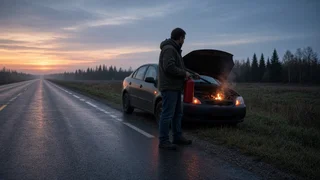
No handheld extinguisher a driver can carry will reliably put out a burning EV traction battery. Once lithium-ion cells enter thermal runaway, a self-sustaining reaction that generates its own heat and flammable gases, the fire can keep going even without outside air. Fire departments may need large amounts of water applied over a long period, and the battery can reignite hours or days later. If the main battery is involved, the right move is to get everyone out, move well away, and call 911.
Carrying an extinguisher in an EV is still worthwhile. Many vehicle fires do not start in the traction battery. They start in cabin materials, tires, wiring, the 12-volt system, or cargo. A compact multipurpose extinguisher can stop those fires early, before they spread to the battery. It can also help you assist at another vehicle's fire. For most US drivers, a securely mounted dry-chemical unit rated for Class A, B and C fires is the practical choice. A clean-agent unit is the alternative if you want less residue and will pay more.
Why EV Battery Fires Are Different
A gasoline fire burns fuel that an extinguisher can smother or interrupt chemically. A lithium-ion battery fire works differently. A damaged or overheated cell releases heat and gases that can push neighboring cells into the same failure, cell by cell, inside a sealed and armored pack under the floor. Extinguishing agent from a portable unit usually cannot reach the burning cells. Even if the visible flames die down, the cells inside may still be heating.
That is why the reader's real question has two parts. One is which extinguisher handles the fires a driver can safely fight. The other is how to recognize a fire that should not be fought at all.
Understanding US Extinguisher Classes
Portable extinguishers sold in the US are labeled by the fire classes they are rated for. The classes relevant to a vehicle are:
Class A: ordinary combustibles such as seat fabric, carpet, plastics, paper and tires. Class B: flammable liquids and gases, including oils, lubricants and fuel in a hybrid or a nearby gas vehicle. Class C: fires involving energized electrical equipment, where the agent must not conduct electricity back to the user. Class D: combustible metals such as magnesium or sodium. These are specialized industrial extinguishers. They are not designed for EV traction battery packs, which contain very little metallic lithium.
A rating label combines numbers and letters. The number before A indicates relative water-equivalent capacity for ordinary combustibles. The number before B indicates relative coverage on a flammable-liquid fire. C has no number and simply confirms the agent is non-conductive. Higher numbers mean more firefighting capacity, and usually a larger, heavier cylinder.
Extinguisher Types Compared
Type | Fire classes typically covered | Strengths | Drawbacks | Best fit; ABC dry chemical (monoammonium phosphate) | A, B, C | Widely available, inexpensive, versatile, effective on most early vehicle fires | Fine powder spreads through the cabin; residue is corrosive to electronics and metal and needs prompt cleanup | Most drivers who want one general-purpose unit; BC dry chemical (sodium bicarbonate) | B, C | Cheaper, effective on liquid and electrical fires | Weak on upholstery, plastics and tires, which are common EV fire materials | Not ideal as the only extinguisher in an EV; Clean agent (halocarbon types such as Halotron) | B, C, and A on larger sizes | Leaves little or no residue, safer for electronics and interiors | Costs more and delivers less firefighting capacity for the same size; agent displaces air in enclosed spaces | Owners who prioritize protecting electronics and interior; Water mist | A, C on units rated for it | Cooling effect, minimal cleanup, non-conductive when rated as such | Bulkier, less common in automotive sizes, limited on liquid fires | Garages more than vehicles; AVD and lithium-battery-marketed units (aqueous vermiculite dispersion and similar) | Varies by product; often aimed at small lithium-ion batteries | Designed to coat and cool small battery fires such as phones, e-bikes and power tools | Effectiveness against a full EV traction battery in thermal runaway is not established; rating and approvals vary widely | Supplement for small devices carried in the car, not a substitute for evacuating an EV
Products marketed as an "EV fire extinguisher" deserve a careful read. Check which recognized fire classes the label actually lists, and which kinds of batteries the maker says it addresses. Marketing that implies a portable unit can stop a traction battery fire should be treated with skepticism. Professional responders treat these fires as long-duration events, even with far more resources than a handheld can provide.
Which Option Fits Your Priorities
Lowest cost and broadest coverage: an ABC dry-chemical unit. Accept that a discharge inside the cabin will mean a thorough cleanup and possible electronics damage. Protecting interior electronics and avoiding powder cleanup: a clean-agent unit, sized as large as you can mount practically. Its capacity per pound is lower. Carrying e-bike, scooter or power-tool batteries: an ABC unit for general fires, plus a product designed for small lithium-ion battery fires if you want extra coverage for those devices. Home charging: a larger extinguisher mounted in the garage near the exit, not near the charger, in addition to the one in the car. A working smoke alarm in the garage matters as much as the extinguisher.
Size, Mounting and Upkeep
Larger extinguishers discharge for longer and cover more area, but they must still fit where you can reach them quickly. Compact automotive sizes are the usual compromise. Choose the largest unit you can mount securely and access without digging through cargo.
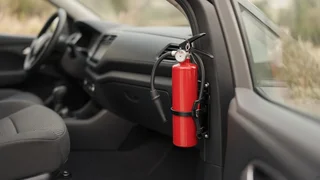
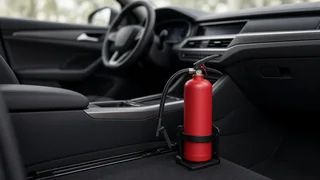
Mount it in a bracket designed for vehicles. A loose cylinder becomes a projectile in a crash and can roll out of reach. Good locations include under or beside a front seat, in the front trunk if it opens easily without power, or in a side compartment of the rear cargo area. Do not store it somewhere that requires the vehicle's electronics to open. Check the pressure gauge regularly. The needle should sit in the green zone. For dry-chemical units, occasionally invert the cylinder and tap it so the powder does not compact from road vibration. Inspect the pin, tamper seal, hose and nozzle for damage. Replace or professionally recharge the unit after any use, even a brief one. Follow the manufacturer's service and replacement guidance. Check the temperature range on the label. Cabin heat in summer and cold in winter can matter for some agents.
When to Use It and When to Walk Away
An extinguisher is for small, early fires with a clear escape route behind you. Signs that the traction battery may be involved include hissing, popping or cracking sounds, white or gray vapor coming from under the vehicle, smoke from the floor area or wheel wells, and fire that seems to reignite after being knocked down. Battery vapor is toxic and can itself be flammable or explosive, even before visible flames appear.
Stop, switch the vehicle off if you can do so quickly, and get every occupant out. Move well away and stay upwind. Do not return for belongings. Call 911 and tell the dispatcher it is an electric vehicle, so responders can plan for a battery fire. Use the extinguisher only on a small fire you can clearly see, such as burning upholstery, an item in the cabin or a tire, and only if the battery shows none of the warning signs above. Aim at the base of the flames and sweep side to side, keeping your back to an exit. Do not open the hood or front trunk on a vehicle that is smoking. Fresh air can intensify the fire. Do not try to cool or puncture the battery pack, and do not touch damaged high-voltage components or orange cabling. After any fire or significant crash, have the vehicle inspected. Keep it away from buildings until it has been checked, because a damaged battery can ignite later.
Bottom Line
Buy a reputable, properly rated ABC extinguisher, or a clean-agent unit if residue is a concern. Mount it securely and keep it serviced. It can catch the ordinary fires that might otherwise spread to the battery. Do not expect any portable extinguisher to defeat a traction battery in thermal runaway. In that situation, your safety depends on recognizing the signs early, getting out, and letting firefighters handle it.