What Is a V Engine Layout? Banks, Crankshaft and Packaging
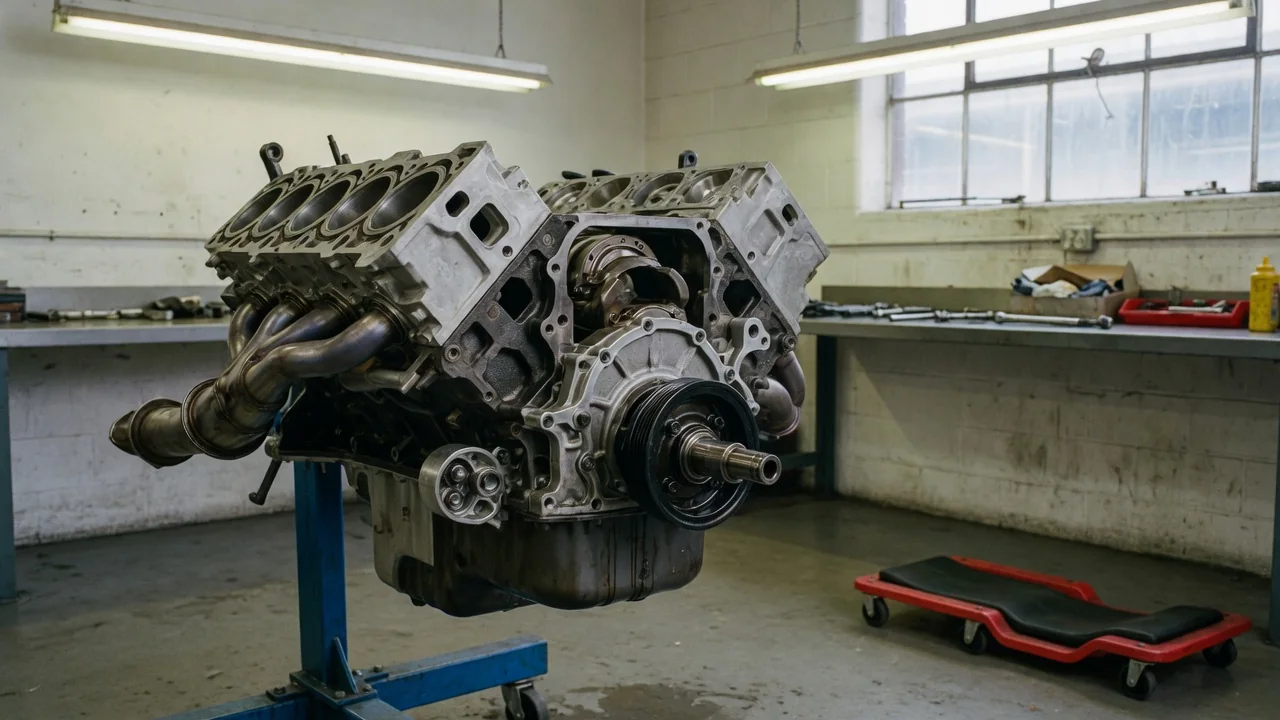
A V engine arranges its cylinders in two rows, called banks, set at an angle to each other so that, viewed from the front, they form the letter V. Both banks drive a single crankshaft at the bottom of the engine. This cylinder layout fits more cylinders into a shorter block than an inline design allows. That shapes how the engine runs, how it is serviced, and where it fits in a vehicle.
Two Banks of Cylinders
In a V engine, the cylinders are divided evenly between two banks. Each bank is essentially a short inline row of cylinders with its own cylinder head, valvetrain components, and exhaust outlet. The banks share one cylinder block, which is cast with the two rows of bores angled away from the engine's centerline. The angle between the banks is called the V angle or bank angle. Common V angles include 60 and 90 degrees, but narrower and wider angles exist. The choice is tied to cylinder count, balance goals, and the space available in the engine bay. Because the cylinders are split, a six-cylinder V engine has two banks of three, and a V8 has two banks of four.
The space between the banks is called the valley. In many designs it holds the intake manifold, which feeds air to the inner side of each cylinder head, while exhaust leaves from the outer sides. In traditional pushrod V engines, a single camshaft sits in the block within the valley and operates the valves in both heads through lifters, pushrods, and rocker arms. Overhead-camshaft V engines instead place camshafts in each cylinder head, so a dual-overhead-cam V engine has four camshafts in total. Some engines reverse the usual arrangement and route exhaust into the valley, a layout often called a hot V, which can shorten the path to turbochargers mounted there.
The two banks are usually not perfectly aligned front to back. One bank sits slightly forward of the other because connecting rods from opposing cylinders share space side by side on the crankshaft, which gives the engine a staggered look from above.
The Shared Crankshaft
Every piston in a V engine turns the same crankshaft. In the most common arrangement, each crankpin, or rod journal, carries two connecting rods side by side: one from a cylinder in the left bank and one from the matching cylinder in the right bank. Sharing crankpins this way gives a V engine roughly half as many crank throws as cylinders, which keeps the crankshaft short. Some designs use split crankpins, where the journal for each rod of a pair is offset by a set angle. This lets engineers adjust the timing between paired cylinders so firing intervals stay even when the bank angle alone would not produce that result.
The bank angle and crankshaft design work together to determine how smoothly the engine runs. Even firing means the crankshaft rotates the same number of degrees between each power stroke. For a four-stroke engine, that interval is 720 degrees divided by the number of cylinders, so an eight-cylinder engine aims for a power stroke every 90 degrees and a six-cylinder engine every 120 degrees. When the bank angle suits that interval, even firing can be achieved with shared crankpins. When it does not, designers use split crankpins or accept some unevenness. Vibration from the moving pistons and rods is a related but separate concern, managed with counterweights, balance shafts, and the choice of V angle.
V8 engines show how crankshaft geometry changes an engine's character. A cross-plane crankshaft places its crankpins at 90-degree intervals when viewed end-on, which supports good overall balance with substantial counterweights but produces an uneven firing pattern within each bank. A flat-plane crankshaft places all crankpins in a single plane, which alternates firing evenly between the banks and can allow a lighter crankshaft, but it leaves more secondary vibration. Neither choice is universally better; each reflects different design priorities.
Vehicle Packaging
The main packaging advantage of a V engine is length. Splitting the cylinders into two banks makes the block roughly half as long as an inline engine with the same number of cylinders, though it is noticeably wider. A shorter engine can free space for the cabin, allow a shorter front overhang, or leave room for crash structures ahead of the engine. It also makes higher cylinder counts practical: an inline eight or inline twelve becomes very long, while V8 and V12 engines remain manageable in a car-sized engine bay. A shorter crankshaft is also stiffer than a long one, which helps limit torsional vibration.
V engines can be mounted longitudinally, with the crankshaft running front to back, which is typical in rear-wheel-drive and many all-wheel-drive layouts. They can also be mounted transversely, with the crankshaft running side to side, which is common in front-wheel-drive vehicles. In a transverse installation, one bank faces the front of the vehicle and the other faces the firewall. The engine's width affects hood height, suspension and steering component placement, and space for accessories. Because each bank has its own exhaust outlet, the exhaust system must collect gases from both sides, which adds pipework beneath the vehicle.
Practical Implications and Limits
For owners, the layout shows up most clearly in maintenance and diagnostics. A V engine has two cylinder heads, two head gaskets, two valve covers, and usually a longer camshaft drive than an inline engine of similar displacement, so some repairs involve more parts and labor. In transverse installations, spark plugs, ignition coils, or injectors on the bank nearest the firewall can be harder to reach, and some jobs may require removing the intake manifold. Diagnostic trouble codes and sensor data often refer to Bank 1 and Bank 2. By common convention, Bank 1 is the side containing cylinder number 1, but cylinder numbering differs among manufacturers, so check the vehicle's service information before replacing an oxygen sensor or chasing a misfire on one side.
It is also important not to overread the layout. The V arrangement does not by itself determine power, fuel economy, reliability, or smoothness. Those depend on displacement, bore and stroke, valvetrain design, induction, tuning, materials, and the specific crankshaft and balance solutions chosen. Two V engines with the same cylinder count can behave very differently, and an inline or horizontally opposed engine may suit a given vehicle better. Treat the V layout as one architectural decision with known trade-offs in length, width, complexity, and access, and rely on the vehicle's own documentation for model-specific procedures and specifications.