How Does Cylinder Count Affect Engine Packaging?
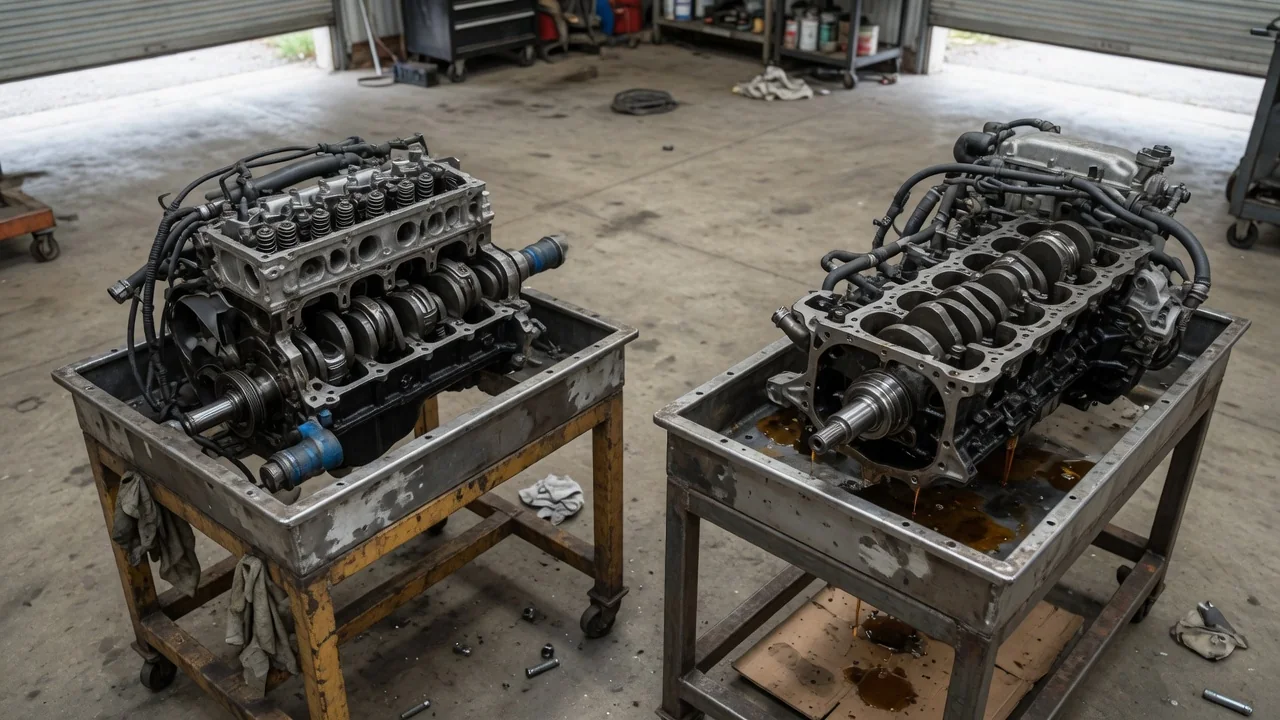
Cylinder count is one of the first decisions that shapes how an engine fits into a vehicle. Adding cylinders changes how long or wide the engine becomes, how much it weighs, and how easily a technician can reach the parts that need regular service. Layout matters as much as the number, because the same count arranged inline, in a V, or flat produces very different shapes. This guide explains the general mechanisms that link engine cylinder count and packaging.
Engine length
In an inline engine, every cylinder sits in a single row, so each additional cylinder adds roughly one bore spacing to the length of the block. Bore spacing is the center-to-center distance between neighboring cylinders. It has to accommodate the bore itself, the wall between cylinders, and usually coolant passages. The crankshaft grows with the block, as do the cylinder head, camshafts, and intake and exhaust manifolds. Beyond the cylinder row, designers must also fit the timing drive at one end and the flywheel or flexplate and transmission bellhousing at the other, so the complete package is always longer than the cylinders alone.
Splitting cylinders into two banks is the main way to control length. A V engine places pairs of cylinders across from each other on shared sections of the crankshaft, so a V6 or V8 can be considerably shorter than an inline engine with the same number of cylinders. The two banks are usually offset slightly front to back so that connecting rods can share crankpins, which adds a little length, but the overall result is a shorter, wider engine. Flat or horizontally opposed engines take the idea further, laying the banks out sideways to create a short, low, but very wide unit.
Orientation then decides which dimension matters most. A transverse engine sits across the vehicle, so its length competes for the space between the front wheels together with the transmission, which usually shares the same axis. That is why long inline engines are rarely mounted transversely, and why compact transverse layouts tend to favor fewer cylinders or a V arrangement. A longitudinal engine points front to back, so its length affects how far the front overhang extends, how much room remains for the cabin, and where the front axle can sit relative to the engine.
Weight
More cylinders generally means more parts. Each cylinder brings a piston, rings, a connecting rod, valves, springs, and related hardware, and the block, crankshaft, and head must grow to hold them. V and flat engines add another penalty: two cylinder heads instead of one, often with separate camshafts, valve covers, and exhaust manifolds for each bank. A longer or more complex timing drive, extra ignition coils, and more fuel injectors add mass as well. For an equal displacement, however, more cylinders means smaller individual pistons and rods, so the increase in weight is not simply proportional to the count.
Cylinder count is only one factor. Block and head material, displacement, cooling requirements, forced induction hardware, and the balance shafts that some engines need can shift total weight as much as the number of cylinders does. An engine with fewer cylinders that relies on a turbocharger, intercooler, and associated plumbing may not save as much weight as its cylinder count suggests. For that reason, the weight of a particular engine should be judged from its actual specifications rather than inferred from how many cylinders it has.
Where the weight sits can matter as much as how much there is. A long engine mounted longitudinally places mass farther forward, sometimes ahead of the front axle, which affects front-to-rear weight distribution. A tall inline engine raises the center of gravity of the package, while a flat engine keeps mass low but spreads it sideways. Engineers tune springs, dampers, and steering to the resulting load, which is one reason why fitting a different engine into the same body often requires related chassis changes.
Access
Service access depends on how many components there are and where the layout puts them. An inline engine places all of its spark plugs or injectors along one cylinder head, typically with the intake on one side and the exhaust on the other, which usually leaves a single clear row of parts to work on. Adding cylinders lengthens that row, and in a tight engine bay the last cylinder can end up close to the firewall or tucked under cowl panels.
V engines double the number of heads and create two separate work areas. In transverse installations, one bank faces the front of the vehicle and the other faces the firewall, so spark plugs, coils, or valve cover gaskets on the rear bank can be much harder to reach. Some procedures on such layouts call for removing the intake manifold or other components first, and the vehicle's service manual is the reliable source for what a specific job requires. The valley between the banks may also hold parts such as intake runners, sensors, or coolant passages that are buried under other assemblies. Flat engines put their cylinder heads low at each side, near the chassis rails, where some work may be easier from below than from above.
More cylinders also means more of the components that are replaced on a schedule or wear over time, such as spark plugs on gasoline engines, ignition coils, injectors, and gaskets. Timing belts or chains on longer or two-bank engines tend to be longer and route around more sprockets and guides, so replacing them may involve more labor. None of this makes a given engine difficult to maintain, but it explains why service effort usually rises with cylinder count and with the complexity of the layout.
Practical implications and limits
For owners and shoppers, packaging consequences show up in places that are not obvious from a spec sheet. A bulky engine can restrict how far the front wheels can turn, constrain hood height and front crash structures, and leave less room for the battery, air intake, or cooling modules. Each vehicle resolves these trade-offs differently, so two cars with the same cylinder count can look and work very differently under the hood. When evaluating a specific model, the owner's manual, factory service information, and a look at the actual engine bay reveal more than the cylinder count alone.
Any general rule has limits. Bore spacing, deck height, and accessory placement vary widely between designs, and manufacturers can offset disadvantages with compact timing drives, exhaust manifolds integrated into the cylinder head, or relocated accessories. Hybrid components, emissions hardware, and turbochargers increasingly share the engine bay, so cylinder count no longer determines the overall package by itself. The mechanisms described here explain tendencies rather than guarantees: more cylinders usually mean more length or width, more parts and mass, and more service points, while the layout decides how those effects are distributed.