How Does Engine Bore Affect Design? Cylinder Size Explained
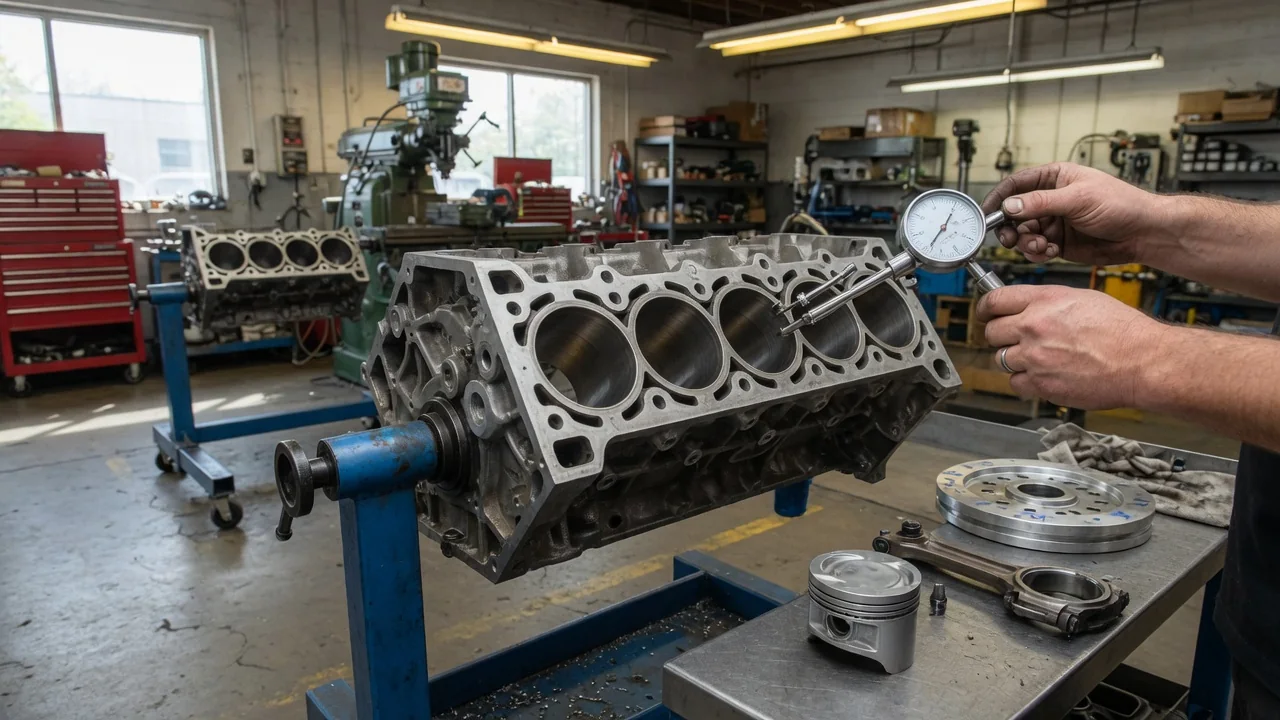
Engine bore is the diameter of each cylinder, and it is one of the first dimensions settled when an engine is laid out. Together with stroke, it sets displacement, but its influence reaches much further. Bore size affects how the piston and valves fit, how the flame spreads during combustion, and how long the block becomes. Knowing what engine bore size means, and how engine bore affects design in these three areas, helps explain why engines of similar displacement can differ so much.
Cylinder diameter
Bore is measured across the cylinder. Displacement per cylinder equals the piston area multiplied by the stroke. Because piston area grows with the square of the bore, a modest increase in diameter adds a meaningful amount of swept volume. Designers can therefore reach the same displacement in two ways: a wide bore with a short stroke, or a narrow bore with a long stroke. The relationship between the two is called the bore-to-stroke ratio. An engine whose bore is larger than its stroke is described as oversquare. One with a longer stroke is undersquare, and one with equal values is square.
This choice has mechanical consequences. A shorter stroke means the piston travels less distance per revolution. That lowers average piston speed at a given rpm and generally allows a higher safe engine speed. A wider piston, however, is heavier and presents a larger area to combustion pressure. This raises the loads on the piston pin, connecting rod and crankshaft bearings. A longer stroke gives the crankshaft a larger throw, which provides more leverage for a given cylinder pressure. This is one reason long-stroke designs are often associated with strong low and mid-range torque, although intake, exhaust and boost design matter at least as much.
Bore also limits how much room exists for valves. The valves sit in the cylinder head above the bore, so a larger diameter leaves space for bigger intake and exhaust valves or for more of them. Greater valve area lets the engine move more air at high rpm, which is why large-bore layouts are common where high-speed breathing is a priority. A smaller bore restricts valve size. Designers often compensate with multiple valves per cylinder, careful port shaping or forced induction.
Combustion chamber
The combustion chamber is formed by the piston crown, the cylinder walls and the underside of the head, so its shape is tied directly to bore. In a wide, shallow chamber, the flame front has farther to travel from the spark plug to the outer edges of the cylinder. Longer flame travel takes more time, and the unburned mixture at the far edges is exposed to rising heat and pressure for longer. That end gas is where knock tends to start. Large-bore gasoline engines therefore generally need careful attention to spark plug placement, chamber shape and charge motion so the mixture burns quickly and evenly.
A smaller bore with a longer stroke tends to produce a more compact chamber with a lower surface-to-volume ratio. Less surface area relative to volume means less heat escapes into the head and piston during combustion, which can help thermal efficiency. A compact shape also gives the flame a shorter path. These traits are part of why many engines designed around fuel economy and emissions favor moderate or undersquare proportions. A wide chamber is not inherently poor, but it usually depends more on supporting features. These include a centrally mounted spark plug, squish or quench areas that push mixture toward the center, and tumble or swirl generated by the intake ports.
Bore size also interacts with compression ratio and with crevice volumes, the small gaps around the piston rings and top land. Mixture trapped in these gaps may not burn completely, which affects emissions. Their relative importance changes with cylinder proportions. For that reason, chamber design, piston shape and ring placement are developed together rather than as separate parts.
Packaging
Outside the cylinder, bore drives the overall size of the block. Bore spacing is the distance between the centers of neighboring cylinders. It must cover the bore itself plus the metal and any coolant passage between cylinders. In an inline engine, bore spacing repeated across all cylinders largely sets the length of the block, and therefore the length of the crankshaft and cylinder head. A larger bore pushes cylinders apart and makes the engine longer. That matters in transverse front-drive installations, where engine length competes with the gearbox for the width of the engine bay. It also matters in V layouts, where bank length and offset influence how the engine fits between the frame rails.
Stroke, in contrast, mostly affects engine height and width. A long stroke requires a taller deck and a larger crankshaft swing. This raises the cylinder head and can complicate hood clearance, or widen the overall package in a V engine. An oversquare engine of the same displacement is often shorter in height but longer in length. Once a block is designed, its bore spacing becomes a fixed constraint. Later versions of the same engine family can usually grow displacement only modestly by enlarging the bore, because the cylinder walls and the cooling passages between them cannot become too thin. Some blocks have cylinders cast without coolant between them, often called siamesed bores. More diameter can fit in that layout, but cooling and head gasket sealing between cylinders become more demanding.
Practical implications and limits
For owners reading a specification sheet, bore and stroke figures give a general hint about an engine's intended character rather than a precise prediction. Oversquare proportions often point toward an engine meant to rev freely. Undersquare proportions often suggest an emphasis on efficiency and low-speed pull. Camshaft profiles, variable valve timing, turbocharging, gearing and engine management can shift that character considerably. Two engines with similar ratios may therefore feel very different on the road. Any conclusion about a particular vehicle should be checked against the manufacturer's documentation.
Bore also matters during repair. When cylinders are worn or damaged, a machinist may bore them slightly oversize and fit matching oversize pistons and rings, or install sleeves to restore the original diameter. How far a cylinder can be enlarged depends on wall thickness, block material and the manufacturer's service limits. Some engines with coated aluminum bores are not intended to be bored in the conventional way. Measuring bore diameter, taper and out-of-round with proper instruments is part of deciding whether a block can be reused. Even a small increase in bore slightly raises displacement and compression, which is worth considering before any rebuild.