What Is Combustion Chamber Shape? Air Motion, Spark Position and Efficiency
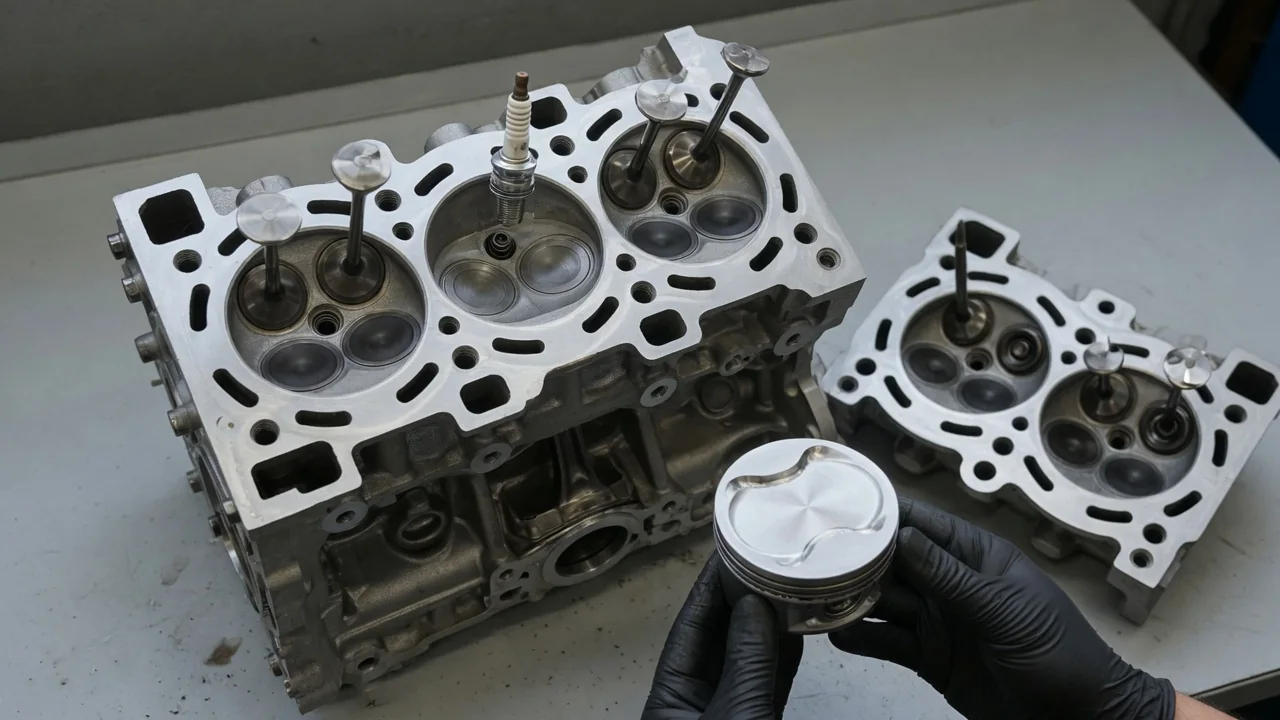
Combustion chamber shape describes the three-dimensional space formed by the cylinder head, the top of the piston, and the valves when the piston reaches the top of its stroke. In engine combustion chamber design, that space is more than a container. It guides how the air-fuel mixture moves, where the flame starts, how far the flame must travel, and how much heat escapes into metal instead of pushing the piston down. Together, these factors influence power, efficiency, and resistance to knock.
Air motion: how the chamber organizes the charge
Air and fuel do not sit still inside the cylinder. The intake ports, valves, piston crown, and chamber walls work together to create organized flow patterns. Swirl is rotation around the cylinder's vertical axis, like water circling a drain. Tumble is an end-over-end rotation across the cylinder, generally associated with pent-roof heads that use multiple valves. Squish happens near the end of the compression stroke, when a flat area of the piston crown closes in on a matching flat area of the head and pushes the trapped mixture sideways, toward the main pocket of the chamber where the flame will burn.
These large-scale motions matter because of what happens to them near top dead center. As the piston compresses the charge, the organized swirl or tumble breaks down into fine, small-scale turbulence. That turbulence wrinkles and stretches the flame front, increasing its surface area and speeding up combustion. A faster burn finishes closer to the ideal point in the crankshaft's rotation and gives the unburned mixture less time to ignite on its own. The trade-off is that more motion also scrubs heat from the walls and can require port shapes that restrict airflow, so designers aim for enough motion rather than as much as possible. In direct-injection engines, the chamber and piston shape also help steer the fuel spray and mixture toward the spark plug.
Spark position: where the flame begins
The location of the spark plug sets the starting point for the flame and therefore the distance it has to travel to reach the far edges of the chamber. A centrally placed plug, typical of pent-roof and many hemispherical-style chambers with four valves per cylinder, lets the flame spread outward in roughly equal distances toward the cylinder walls. An offset plug, more common in older wedge and two-valve layouts, forces the flame to cross a larger share of the bore. Longer flame paths mean longer burn times. Some engines address this with two spark plugs per cylinder, which shortens the distance each flame front must cover.
Spark position is also tied to air motion. The first small flame kernel is fragile. If local flow at the plug gap is too violent, the kernel can be stretched or quenched before it grows; if flow is too weak, early flame growth is slow. The shape of the pocket around the plug helps place it in a region that is well mixed and reasonably stable at the moment of ignition. Designers also think about where combustion will end. The last portion of mixture to burn, called the end gas, is the most likely to knock, so chambers are often arranged so that this mixture sits in a cooler, thin region such as a squish band rather than in a hot, open pocket.
Efficiency: compression, burn speed, and heat loss
Every square inch of chamber surface is a place where combustion heat can leak into the cylinder head and piston instead of doing work. A compact chamber with a low surface-to-volume ratio keeps more of that energy in the gas during expansion. This is one reason chamber design involves compromises: a dome shape can enclose volume efficiently, but raising compression by adding a tall piston dome increases surface area and can create awkward pockets that burn slowly. Pent-roof chambers are widely used partly because they balance compact volume, central plug placement, and room for multiple valves.
Knock resistance has a direct link to efficiency. A chamber that burns quickly and keeps its end gas cool can tolerate a higher compression ratio and more favorable ignition timing before knock appears, and both generally improve thermal efficiency. A consistent burn from one cycle to the next also matters. When combustion speed varies widely between cycles, the engine management system has to calibrate conservatively, which leaves some efficiency unused. Engines designed for lean mixtures or high exhaust gas recirculation rely heavily on chamber shape and turbulence to keep combustion stable under those diluted conditions.
Shape affects emissions as well. Narrow crevices, such as the gap above the top piston ring, and cold wall areas where the flame is extinguished can leave small amounts of fuel unburned, contributing to hydrocarbon emissions. A tight squish clearance helps with knock and turbulence, yet it also creates thin layers near cool metal. Chamber design is therefore a balance between burn speed, heat loss, knock margin, and emissions rather than a single best shape.
Practical implications and limits
For most owners, combustion chamber shape is fixed at the factory and does not change with normal driving. What can change is the effective shape. Carbon deposits on the piston crown and head reduce chamber volume, slightly raise effective compression, and can form hot spots, which may increase the tendency to knock or pre-ignite. Using the fuel grade specified in the owner's manual and following the recommended maintenance schedule helps the engine operate as its designers intended. Engine rebuilding is another case where shape matters: milling the cylinder head, changing pistons, or using a head gasket of different thickness can alter compression ratio and squish clearance, so the engine's service specifications should guide those decisions.
It is also important not to overstate what a chamber label tells you. Terms such as hemi, wedge, and pent-roof describe broad geometric categories, not guaranteed performance. Two engines with the same general chamber type can behave quite differently because of port design, valve timing, fuel injection strategy, cooling, and calibration. Modern engines use knock sensors and electronic control to adjust ignition timing continuously, so real-world results depend on the whole system. For the actual specifications and procedures that apply to a particular engine, the factory repair manual remains the reliable reference.