Burning Biodiesel: Energy Content, Efficiency and Combustion Explained
Biodiesel burns in a diesel engine much like conventional diesel, but it carries somewhat less energy per gallon. That lower energy content, not poorer combustion, is the main reason pure biodiesel can deliver slightly less power and fuel economy. In common low-level blends such as B5 or B20, the difference is small and often hard to notice in everyday driving. How much it matters depends on the blend percentage, fuel quality, operating temperature and whether your engine's manufacturer approves that blend.
What Biodiesel Is
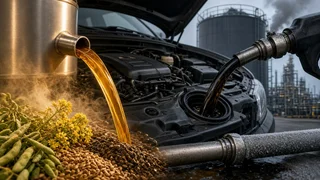
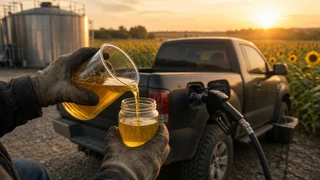
Biodiesel is a renewable fuel made from vegetable oils, animal fats or recycled cooking grease through a chemical process called transesterification. The process converts the oils into fatty acid methyl esters (FAME), which have properties close enough to petroleum diesel to run in compression-ignition engines. It is different from straight vegetable oil, which has not been chemically processed and is not a drop-in diesel fuel. It is also different from renewable diesel, a hydrotreated fuel that is chemically very similar to petroleum diesel.
Blends are labeled with a B followed by the percentage of biodiesel. B100 is pure biodiesel, B20 is 20 percent biodiesel and 80 percent petroleum diesel, and B5 is 5 percent biodiesel. In the US, diesel containing up to 5 percent biodiesel can be sold as ordinary diesel under ASTM D975. Blends from 6 to 20 percent are covered by ASTM D7467, and the pure biodiesel used for blending must meet ASTM D6751.
Energy Content: Why Biodiesel Has Less per Gallon
Biodiesel molecules contain oxygen, while petroleum diesel is made almost entirely of hydrogen and carbon. Oxygen adds weight and volume but no usable heat, because it is already bonded rather than available to be burned. As a result, a gallon of B100 releases less heat energy than a gallon of conventional diesel. The commonly cited gap for pure biodiesel is a high-single-digit percentage, although the exact figure varies with the feedstock and the petroleum diesel used for comparison.
In blends, the energy shortfall scales roughly with the biodiesel share. B20 has a much smaller deficit than B100, and B5 differs so little from regular diesel that most drivers cannot detect it. Feedstock also plays a role, because fuels made from different oils and fats vary somewhat in density and chemistry.
Efficiency vs. Energy Output
Energy content and efficiency are separate ideas. Energy content is how much heat the fuel can release. Thermal efficiency is how well the engine converts that heat into work at the crankshaft. A diesel engine's thermal efficiency is broadly similar on biodiesel and petroleum diesel, because the engine's compression ratio, injection system and combustion design set most of that efficiency.
In practice, changes in power and fuel economy mostly track the difference in energy content. If the fuel carries less energy per gallon and the engine converts it with about the same efficiency, you get slightly fewer miles per gallon. You may also see slightly lower peak power when the injection system is delivering its maximum fuel volume. With low blends, this effect is usually lost among normal variations caused by weather, load, tire pressure and driving style. With B100, it is more likely to show up as a measurable drop.
How Biodiesel Combusts
Several properties make biodiesel behave a little differently inside the cylinder:
Higher cetane number: Cetane measures how readily a diesel fuel ignites under compression. Biodiesel typically has a higher cetane rating than conventional diesel, which can shorten ignition delay and smooth combustion. Built-in oxygen: The oxygen in the fuel helps it burn more completely. This is the main reason biodiesel tends to reduce soot and some other combustion byproducts. Higher viscosity and density: Biodiesel is thicker than petroleum diesel, which affects how the injector atomizes the spray. Modern high-pressure common-rail systems generally handle this well within approved blend levels. Better lubricity: Biodiesel lubricates fuel pumps and injectors well. Even small amounts can improve the lubricity of ultra-low-sulfur diesel, which loses some natural lubricity during refining.
Emissions When Burning Biodiesel
Burning biodiesel generally reduces tailpipe particulate matter, carbon monoxide and unburned hydrocarbons compared with petroleum diesel. The reductions are larger at higher blend levels. Oxides of nitrogen (NOx) are the exception: some engines and test conditions show a small NOx increase with biodiesel, while others show little change. The result depends on engine design and calibration.
On modern diesels equipped with a diesel particulate filter (DPF) and selective catalytic reduction (SCR), the aftertreatment system controls most tailpipe emissions regardless of fuel. Any fuel-related differences at the tailpipe are therefore smaller than on older engines without these systems. Biodiesel's broader climate benefit comes mainly from its renewable feedstock and lifecycle carbon accounting rather than from what happens in the combustion chamber. That benefit varies with the feedstock and how it was produced.
Biodiesel vs. Petroleum Diesel at a Glance
Property | Biodiesel (B100) | Petroleum diesel; Energy per gallon | Somewhat lower | Higher; Cetane number | Typically higher | Typically lower; Oxygen content | Contains oxygen | Essentially none; Lubricity | Strong | Weaker, especially ultra-low-sulfur diesel; Cold-weather flow | Gels at higher temperatures | Better cold flow; Particulates, CO, hydrocarbons | Generally lower | Generally higher; NOx | Similar to slightly higher, engine-dependent | Baseline; Solvent effect on deposits | Can loosen old fuel-system deposits | Minimal
Practical Considerations for Diesel Owners
Check your manufacturer's approval: Many manufacturers approve B5, and many approve B20 for specific engines and model years. Few approve B100. Your owner's manual or the manufacturer's fuel guidance will state the approved limit, which can differ by engine, generation and market. Plan for cold weather: Biodiesel begins to cloud and gel at higher temperatures than petroleum diesel. Higher blends need cold-weather management such as winter blending, additives or lower blend levels. Expect a filter change after switching: Biodiesel acts as a mild solvent and can loosen deposits that built up in a tank used with petroleum diesel. Those deposits can clog fuel filters early on. Avoid long storage: Biodiesel is more prone to oxidation and water absorption than petroleum diesel. It is best used within a reasonable time and stored in clean, sealed containers. Buy quality fuel: Fuel that meets the relevant ASTM specification, ideally from a supplier with a recognized quality certification, reduces the risk of contamination or incomplete processing.
Bottom Line
Biodiesel burns cleanly and ignites readily in a diesel engine, and the engine converts it to work at roughly the same efficiency as conventional diesel. Its main trade-off is lower energy content per gallon, which produces a small drop in fuel economy and peak power that grows with blend percentage. For most owners, approved blends such as B5 and B20 offer better lubricity and lower soot with minimal performance change. Higher blends require attention to cold weather, fuel quality and the engine manufacturer's approved limits.