How Does Engine Stroke Affect Design? Piston Travel, Speed and Torque
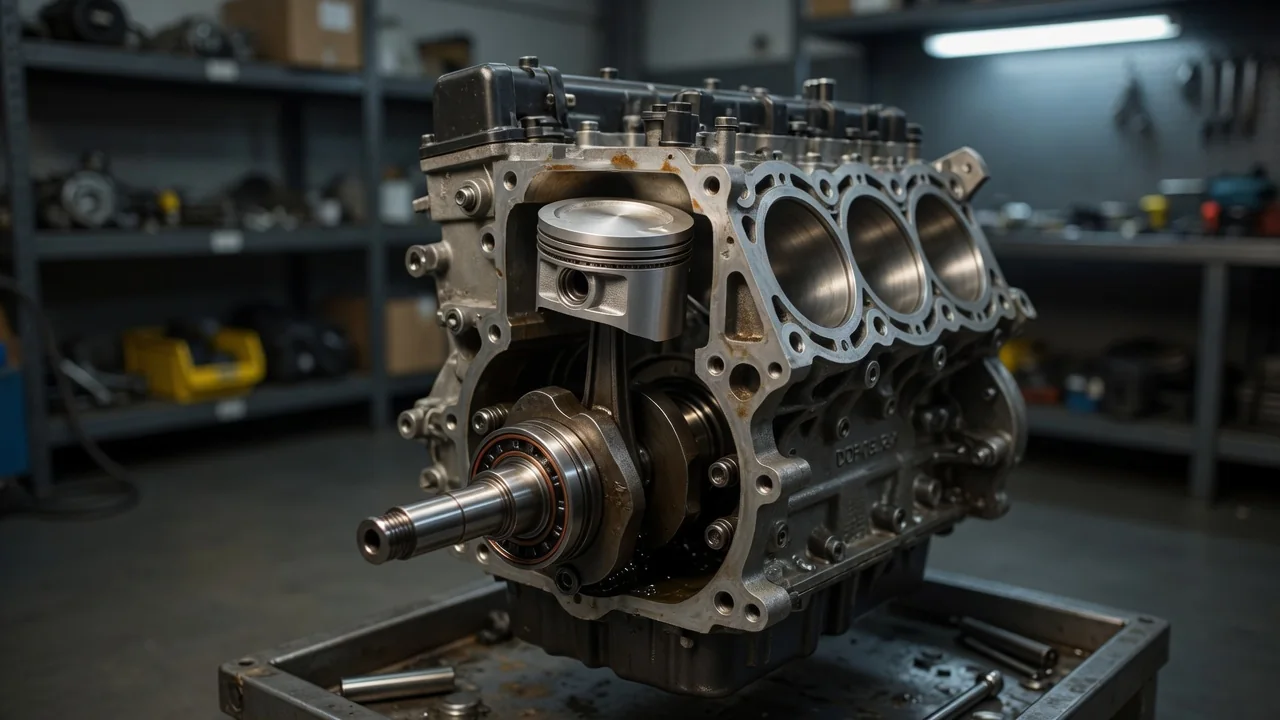
Stroke is one of the most basic dimensions in a piston engine, yet it influences almost everything around it: how tall the block is, how large the cylinders can be, how fast the crankshaft can safely spin and how the engine delivers its pulling power. Understanding engine stroke length and what it means for design helps explain why engines with similar displacement can behave very differently on the road.
Piston Travel: What Stroke Length Means
Stroke is the distance a piston travels inside its cylinder between top dead center, its highest point, and bottom dead center, its lowest point. That distance is set by the crankshaft. Each connecting rod attaches to a crankpin that is offset from the crankshaft's main axis, and the stroke equals twice that offset, often called the crank throw. Stroke works together with bore, the cylinder diameter, to define displacement: the swept volume of one cylinder is the bore area multiplied by the stroke, and total displacement is that figure multiplied by the number of cylinders. Because of this relationship, a designer can reach the same displacement with a small bore and long stroke or with a large bore and short stroke.
The ratio between bore and stroke is a central design decision. When stroke is longer than bore, the engine is called undersquare or long-stroke. When the two are roughly equal, it is described as square, and when bore exceeds stroke, it is oversquare or short-stroke. A longer stroke requires a larger crank throw, which in turn needs more room for the crankshaft to swing and usually a taller block to fit the connecting rod and piston at full travel. Designers also choose connecting rod length relative to stroke. A short rod paired with a long stroke increases the angle of the rod as it swings, which pushes the piston harder against the cylinder wall and can raise friction and wear. Balancing stroke, rod length and deck height is therefore a packaging problem as much as a performance one.
Stroke also shapes the combustion chamber indirectly. With a smaller bore, the chamber tends to be more compact, with less surface area for heat to escape and a shorter path for the flame to travel. With a larger bore, there is more room across the cylinder head for valves, which can improve airflow, but the chamber becomes wider and flatter. Neither layout is automatically better; each carries trade-offs that the rest of the design must address.
Engine Speed and Stroke Length
Stroke has a direct effect on how fast the pistons move. In every crankshaft revolution, each piston travels the length of the stroke twice, once up and once down. Engineers often describe this using mean piston speed, which rises in proportion to both stroke and engine speed. If two engines turn at the same rpm, the one with the longer stroke has pistons covering more distance per second. Since materials, lubrication and bearing designs have practical limits on how fast pistons can travel reliably, a long-stroke engine typically reaches those limits at a lower rpm than a short-stroke engine of similar construction.
The forces involved grow quickly with speed. The piston, rings, pin and upper part of the connecting rod must be accelerated and stopped twice per revolution, and the inertial loads increase with stroke and rise sharply as rpm climbs. A short stroke reduces these loads at any given speed, which is one reason high-revving designs tend toward oversquare proportions. Breathing matters too. At high rpm the engine needs to move large volumes of air in very little time, and the bigger bore of a short-stroke layout leaves more space for larger valves. A long-stroke engine with a narrower bore has less room for valve area, so its airflow can become a constraint as speed increases, even before mechanical limits are reached.
Torque Context: Leverage Versus Displacement
A common explanation says long-stroke engines make more torque because the longer crank throw acts as a bigger lever. The leverage part is true, but it is only half the picture. Torque at the crankshaft comes from combustion pressure acting on the piston crown, and the force on the piston depends on its area. If displacement stays the same, a longer stroke means a smaller bore and a smaller piston, so the force is lower while the lever is longer. These effects largely offset each other. In general terms, the torque an engine can produce is governed mainly by its displacement and by how effectively it fills and burns each cylinder charge, which engineers express as mean effective pressure, rather than by stroke alone.
Stroke still influences where torque appears in the rev range. Because long-stroke engines are usually limited in rpm and valve area, their designers often tune camshafts, intake runners and exhaust systems to fill the cylinders well at low and moderate speeds. The result is frequently strong pulling power early in the rev range. Short-stroke engines can tolerate higher rpm, and since power equals torque multiplied by engine speed, they can generate high power by revving further rather than by producing more torque per revolution. So stroke affects the character of torque delivery mostly through the design choices it encourages, not through leverage on its own.
Practical Implications and Limits
For an owner reading a specification sheet, bore and stroke figures offer useful clues but not firm conclusions. A long-stroke layout hints at an engine likely tuned for low-speed flexibility and efficiency, while a short-stroke layout suggests room for higher rpm. Physical packaging can follow from the same numbers: tall blocks may affect hood height and engine bay clearance, while wide-bore designs can make V and horizontally opposed engines broader. Diesel engines commonly use long-stroke proportions, reflecting their emphasis on low-speed operation and efficiency rather than high rpm.
Changing stroke after the fact is a significant modification. Aftermarket stroker crankshafts increase displacement, but they alter rod angles, piston position at top dead center, compression ratio and clearances between moving parts and the block. Pistons, rods and sometimes the block itself may need changes to accommodate the new geometry. Any such work should be checked against the factory service manual and the parts supplier's specifications, since tolerances and limits vary by engine family and cannot be generalized.
It is also important not to overstate stroke's role. Variable valve timing, turbocharging, direct injection, intake design and engine management calibration can reshape an engine's behavior far more than a modest change in bore-to-stroke ratio. Two engines with nearly identical dimensions can feel quite different because of these systems, and a long-stroke engine can be engineered to rev freely while a short-stroke engine can be tuned for low-speed torque. Stroke sets the starting conditions for a design; the rest of the engine determines how those conditions are used.