What Is an Undersquare Engine? Long-Stroke Design Explained
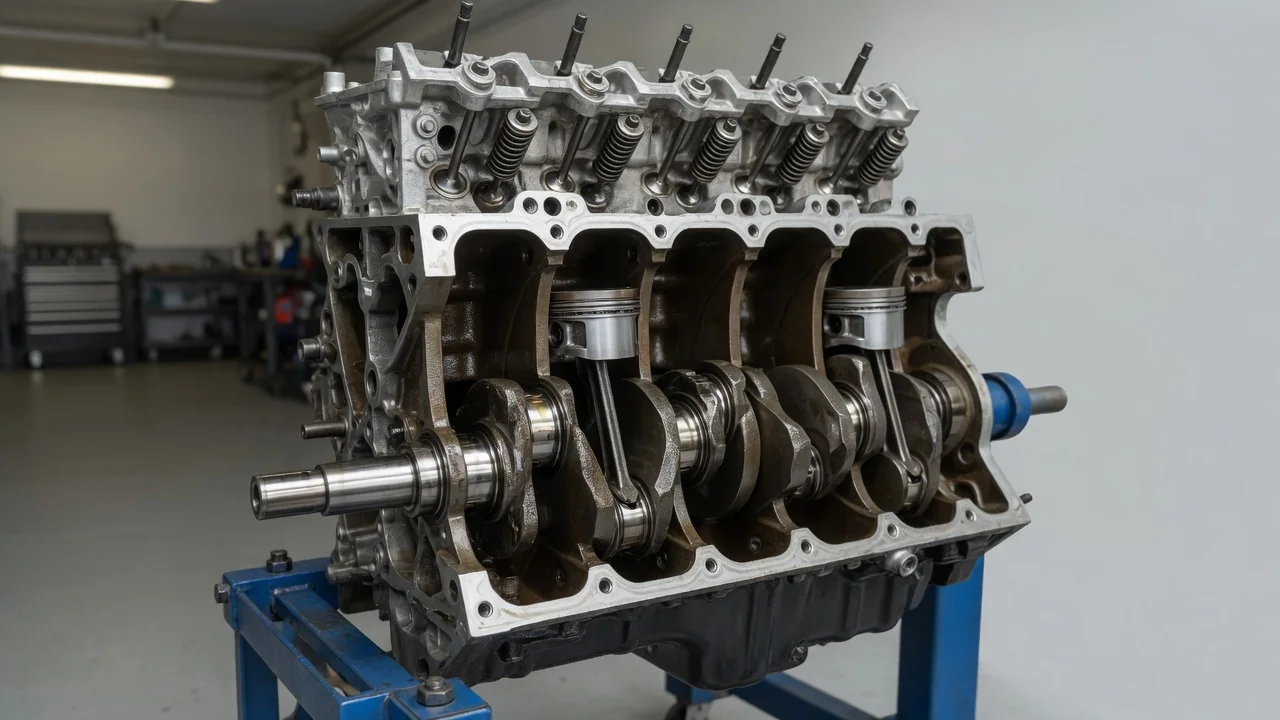
An undersquare engine is a piston engine whose stroke is longer than its bore. The stroke is the distance each piston travels from the top to the bottom of the cylinder, and the bore is the cylinder's diameter. Engineers also call this a long-stroke design. The bore-to-stroke relationship affects how fast the pistons move, how the combustion chamber is shaped, and how freely the engine can breathe at high rpm. This guide explains the geometry, the role of piston speed, and the tradeoffs of choosing a longer stroke.
Long-stroke geometry
Every cylinder has two basic dimensions. The bore is the inside diameter of the cylinder. The stroke is the distance the piston moves between top dead center and bottom dead center. Dividing the bore by the stroke gives the bore-to-stroke ratio. If the two are equal, the engine is called square, with a ratio of 1.0. If the bore is larger than the stroke, the ratio is above 1.0 and the engine is oversquare, or short-stroke. If the stroke is larger than the bore, the ratio falls below 1.0 and the engine is undersquare. So for an undersquare engine, the stroke figure is larger than the bore figure.
The crankshaft sets the stroke. The crank throw is the distance from the centerline of the crankshaft's main journals to the centerline of the crankpin, and it equals half the stroke. A longer stroke therefore needs a crank with a larger throw. The crankpin then sweeps a larger circle, which takes more room inside the crankcase, and the block usually has to be taller so the piston stays within the bore at both ends of its travel. Connecting rod length also matters. The ratio of rod length to stroke determines how sharply the rod angles away from the cylinder axis as the crank turns. A narrower bore means a smaller piston crown and a more compact combustion chamber for a given cylinder volume. Displacement equals bore area multiplied by stroke, so many combinations of bore and stroke can produce the same displacement. An undersquare layout gets its volume more from length than from width.
Piston speed
A piston does not move at a constant speed. It stops completely at top and bottom dead center, accelerates hard away from each end, and reaches its highest velocity partway through the stroke. Because of this, engineers often compare engines using mean piston speed. It equals twice the stroke multiplied by the crankshaft's revolutions per second, because the piston travels the full stroke down and back up during every revolution. The relationship is linear. At the same rpm, an engine with a longer stroke has a proportionally higher mean piston speed. If two engines run at the same rpm and one has a stroke 20 percent longer, its pistons cover 20 percent more distance in the same time.
Piston speed matters because it relates closely to the loads and wear inside an engine. Faster movement creates larger inertial forces on the pistons, wrist pins, connecting rods and bearings, especially when the piston reverses direction at each end of the stroke. These forces increase in proportion to stroke and with the square of rpm, so they rise steeply as engine speed goes up. Higher piston speed also increases friction between the piston rings and the cylinder walls. For these reasons, designers of long-stroke engines generally limit maximum rpm to keep piston speed and reciprocating loads within what the materials and lubrication can handle over the engine's intended life. The longer stroke itself, not any single part, is what makes high rpm more demanding in an undersquare design.
Design tradeoffs
Long-stroke geometry has several general advantages. A narrower bore produces a compact combustion chamber with less surface area relative to its volume, so less heat escapes into the cylinder head and piston crown during combustion. This can improve thermal efficiency. The flame front also has a shorter distance to travel across a smaller bore. That can support quicker, more complete combustion and may reduce the tendency to knock, which gives designers more room to use higher compression ratios. In inline engines, smaller bores also let the cylinders sit closer together, which can shorten the block.
The main limitation is breathing at high rpm. A smaller bore leaves less room in the cylinder head for intake and exhaust valves, which limits how much air the engine can move when it spins fast. Together with the higher piston speed described above, this tends to cap the practical rpm range. As a result, peak power potential is usually lower than in a short-stroke engine of similar displacement. Long-stroke engines often do their best work in the low and middle rpm range, where airflow demands are lower and the efficiency benefits of the chamber shape matter most.
There are also packaging and mechanical costs. A taller block and a larger crank throw can make the engine taller overall, which can limit where the engine fits and how low it can sit in the chassis. Pairing a long stroke with a relatively short connecting rod increases the rod angle. This pushes the piston harder against the cylinder wall, which adds friction and wear. None of these factors decides the design on its own. Engineers weigh them against cost, emissions targets, fuel economy goals and the vehicle's intended use.
Practical implications and limits
For a car owner, knowing that an engine is undersquare gives a useful hint about its likely character, but it does not describe the engine fully. Long-stroke engines are often tuned for strong pulling power at everyday driving speeds and for efficiency, rather than for the highest possible redline. In normal driving, such an engine may feel responsive without needing to be revved hard, and the manufacturer's rev limit typically reflects the mechanical limits involved. Respecting that limit and following the recommended oil specification and service intervals in the owner's manual matter for any engine. With a long stroke, the piston rings and cylinder walls also work at higher sliding speeds for a given rpm.
The bore-to-stroke ratio is also limited as a predictor of how an engine behaves. Turbocharging, variable valve timing, intake and exhaust design, multi-valve cylinder heads, gearing and engine management software can all shift where an engine makes its torque and power. Sometimes they outweigh the effect of the basic geometry. Torque in particular depends heavily on displacement and on how effectively each cylinder is filled, not on stroke alone. To check a specific engine, look for its bore and stroke, which are often listed in the technical specifications section of the owner's manual or in the manufacturer's official data. Divide the bore by the stroke to see whether the engine is undersquare, square or oversquare. Treat that number as one piece of the picture, and base any conclusions about a particular vehicle on its documented specifications.