What Is an Oversquare Engine? Bore, Stroke and Design Trade-Offs
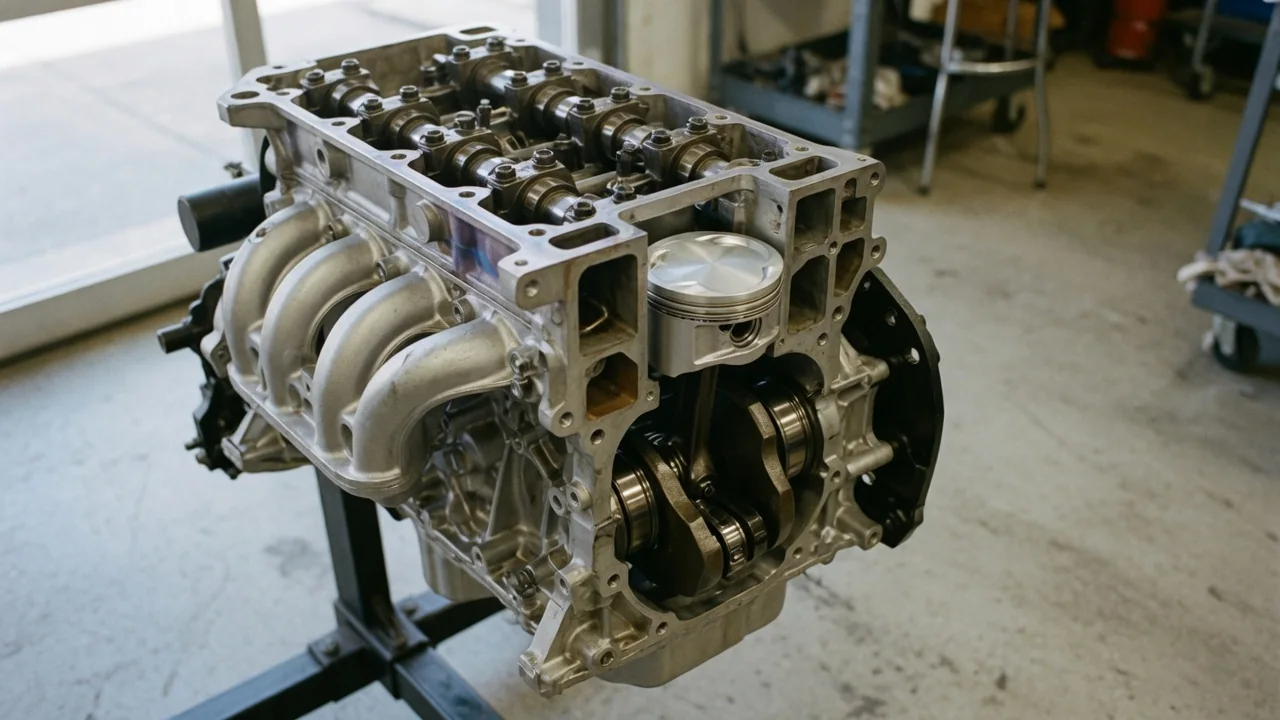
An oversquare engine is a piston engine whose cylinder bore is wider than its piston stroke is long. That one proportion affects how fast an engine can safely spin, how freely it breathes and how efficiently it burns fuel. This article explains how the bore-to-stroke ratio is defined, why engineers choose an oversquare layout and where the approach runs into limits.
Understanding the Bore-to-Stroke Ratio
Two measurements define the shape of every cylinder. The bore is the diameter of the cylinder. The stroke is the distance the piston travels from top dead center to bottom dead center. The crankshaft sets the stroke, which equals twice the offset of the crankpin from the main bearing centerline. Dividing bore by stroke gives the bore-to-stroke ratio. A result greater than 1.0 means the engine is oversquare. Exactly 1.0 is called square. Below 1.0 is undersquare, often called a long-stroke design. Some sources express the ratio the other way around, as stroke divided by bore, so check which convention a spec sheet uses before drawing conclusions.
A hypothetical cylinder with a 90 mm bore and an 80 mm stroke has a ratio of 1.125, which makes it oversquare. Displacement depends on both dimensions: cylinder area times stroke, multiplied by the number of cylinders. Engines of the same displacement can therefore have very different proportions. A wide, short cylinder and a narrow, tall cylinder can sweep the same volume and still behave quite differently. The ratio says nothing about engine size on its own. It describes geometry, and that geometry shapes the trade-offs covered below.
Design Goals of an Oversquare Layout
The main reason to shorten the stroke is to control piston speed. Each crankshaft revolution moves the piston up and down once, so its average speed is proportional to stroke multiplied by engine speed. Mean piston speed is widely used as a guide to mechanical stress, friction and wear on the rings and cylinder walls. For a given piston-speed limit, a shorter stroke lets the crankshaft turn faster. Power is torque multiplied by rotational speed. So if an engine can rev higher while still filling its cylinders well, it can make more power from the same displacement.
A wider bore also leaves more room in the roof of the combustion chamber for valves. Larger intake and exhaust valves, or more of them, give the gases more area to flow through. As engine speed rises, each intake and exhaust event gets less time, so flow area becomes a limiting factor. A large bore helps the engine keep breathing well as rpm climbs. Together with lower piston speed, this is why oversquare proportions are strongly associated with high-revving, power-oriented designs.
Packaging can be another motivation. A shorter stroke needs a smaller crank throw, which can reduce block height and the space the connecting rods sweep through. That can help lower an engine or fit it under a low hood line. The result depends on the whole design, including rod length and deck height, so this is a tendency rather than a guarantee.
Limits of the Oversquare Approach
The wide cylinder that helps breathing also creates combustion problems. Near top dead center, a large-bore, short-stroke chamber is relatively flat and has a lot of surface area for its volume. More surface area means more heat lost to the cylinder head and piston crown instead of being turned into work, which can reduce thermal efficiency. The flame also has farther to travel from the spark plug to the edge of the chamber. A longer burn gives the unburned mixture at the edges more time to ignite on its own, which is knock. A very wide bore can therefore limit the compression ratio or ignition timing the engine can tolerate.
Flat chambers with large crevice and quench regions can also make it harder to burn all of the fuel, which complicates control of unburned hydrocarbon emissions. On the mechanical side, a larger piston is generally heavier. Inertia forces rise with the square of engine speed, so the high rpm an oversquare engine is built for puts heavy loads on pistons, pins, rods and bearings. In an inline engine, wide bores also spread the cylinders farther apart, which makes the block longer for a given cylinder count.
Oversquare engines are often described as weak at low rpm, but the reason is more nuanced than crank leverage. Torque per unit of displacement depends mainly on how well the cylinder fills and how efficiently the charge burns. Engines built for high rpm usually have camshaft timing, port sizes and intake tuning optimized for high-speed flow. That tuning, along with combustion characteristics, tends to shape the torque curve more than stroke length alone.
Practical Implications and Limits
For a driver or owner, the bore-to-stroke ratio is a clue to an engine's intended character, not a verdict on its quality. A strongly oversquare engine was usually designed with high engine speeds in mind. An undersquare engine more often reflects priorities such as efficiency, emissions or compact length. Modern technologies such as variable valve timing, direct fuel injection and turbocharging can change the torque curve and knock resistance substantially. Two engines with similar ratios can therefore feel very different on the road, and judging an engine by its ratio alone is unreliable.
When reading specifications, treat the ratio as one piece of context. Read it alongside displacement, compression ratio, valve arrangement, induction type and the published torque and power curves. The ratio cannot be changed in normal service. Changing it requires a different crankshaft, connecting rods or cylinder bore, which means rebuilding the engine and affects many other components. Everyday ownership questions, such as oil specification, service intervals and safe operating speed, should come from the owner's manual for the specific vehicle, not from cylinder proportions. The manufacturer's redline and recommended practices already account for the engine's geometry.