Why Do Some Engines Have an Odd Number of Cylinders?
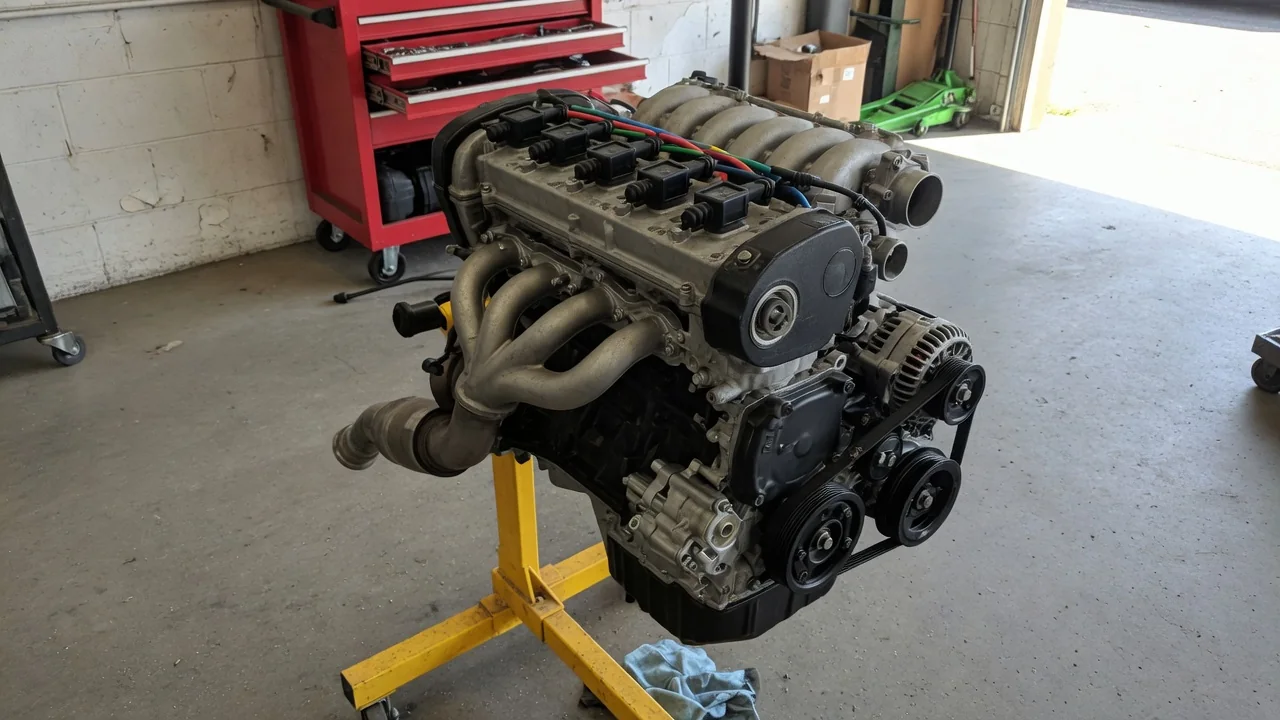
Most engines people picture have four, six, or eight cylinders, so a three- or five-cylinder engine can look like an odd choice. It is not a quirk. Engineers choose a cylinder count by weighing how the engine shakes, how much room it needs, how evenly its power pulses arrive, and how it sounds. Odd counts solve some of those problems neatly and create others. Here is how the three and five cylinder engine layout works and why designers use it.
Balance
Every running engine produces shaking forces as pistons and connecting rods speed up, stop, and reverse direction. Engineers split these into primary forces, which repeat once per crankshaft revolution, and secondary forces, which repeat twice per revolution and come from the angle of the connecting rod. They also look at rocking couples. Even when the forces cancel overall, cylinders spaced along the crankshaft can push one end of the engine up while the other end goes down, making the block rock from end to end.
An inline-three typically uses crankpins spaced 120 degrees apart. In that arrangement the primary and secondary forces cancel each other, which a conventional inline-four cannot do with its secondary forces. What the three cannot cancel is a rocking couple, because its outer cylinders sit at opposite ends of the crankshaft and move out of step. Designers manage this with crankshaft counterweights, a balance shaft, carefully tuned engine mounts, or a combination of these. An inline-five, with crankpins spaced 72 degrees apart, also cancels its primary and secondary forces but leaves rocking couples, especially a secondary one, that must be handled in similar ways.
Balance also covers how evenly torque reaches the crankshaft. A four-stroke engine needs two revolutions, or 720 degrees, to fire every cylinder once. A three fires every 240 degrees and a five every 144 degrees, so both have even firing intervals. Because each useful power stroke lasts roughly 180 degrees of rotation or less, a three leaves short gaps between pulses, which can feel lumpy at idle, while a five overlaps its pulses and delivers torque more continuously than a four. Odd counts are not inherently unbalanced; they trade one set of compromises for another.
Packaging
Cylinder count is often driven by displacement targets. Each cylinder tends to work best within a certain size range. Too small, and it loses a larger share of energy to heat transfer and friction relative to the work it does; too large, and combustion, piston speed, and reciprocating weight become harder to manage. If a designer wants a small engine, splitting the displacement among three cylinders rather than four keeps each cylinder closer to an efficient size. Fewer cylinders also mean fewer pistons, rings, valves, and bearings, which reduces internal friction and parts count. That logic pairs naturally with turbocharging, which lets a smaller engine produce output once expected from a larger one.
Length matters as much as displacement. An inline-three is short and light, which helps in compact vehicles where the engine sits sideways between the front wheels. An inline-five fills a gap: it offers more displacement and smoother torque delivery than a four while staying noticeably shorter than an inline-six, which is often too long to mount transversely. A five also avoids the second cylinder head, extra camshafts, and wider footprint of a V configuration.
Modular design adds another reason. Some manufacturers build engine families around a common cylinder size, bore spacing, and shared components, then add or remove cylinders to create different displacements. In that kind of program, a three or a five can appear simply because it is one cylinder short of or one beyond a four, sharing tooling and parts with its siblings.
Sound
An engine's basic sound is set largely by how often its cylinders fire. In a four-stroke engine each cylinder fires once every two revolutions, so the firing frequency equals half the cylinder count multiplied by engine speed. A four fires twice per revolution and a six three times, both whole numbers. A three fires one and a half times per revolution and a five two and a half times, so their dominant tone falls on a half-order of crankshaft speed.
That half-order character, combined with the rocking motion described earlier and the way exhaust pulses are spaced in the manifold, gives odd-cylinder engines a recognizable voice. Threes are often described as thrummy or slightly off-beat, especially at low engine speeds, while fives are known for a warbling tone that some listeners compare to half of a V10, which is essentially two five-cylinder banks. These are general tendencies rather than fixed traits. Exhaust design, intake tuning, turbochargers, mufflers, and cabin insulation strongly shape what any particular vehicle actually sounds like from the driver's seat.
Practical Implications and Limits
For owners, the most noticeable effect of an odd cylinder count usually shows up at idle and low speeds. A three-cylinder engine may transmit a faint rhythmic shake through the steering wheel, seats, or pedals that a comparable four does not, and how much reaches the cabin depends heavily on the mounts and balancing hardware chosen for that vehicle. Because engine mounts absorb so much of this motion, worn or collapsed mounts can make an odd-cylinder engine feel rougher than it did when new. If vibration increases over time, the mounts are a reasonable place to start a diagnosis, alongside ignition and fuel system checks.
Fewer cylinders also change how faults feel. When one cylinder misfires in a three, a third of the engine's power strokes are missing, so the roughness is usually obvious and hard to ignore. In maintenance terms, a three has fewer spark plugs, coils, and injectors than a four, but many small engines rely on turbocharging, direct injection, and balance shafts, which bring their own service needs. The owner's manual and the manufacturer's service information, not the cylinder count, should guide maintenance intervals and procedures.
The limits of these generalizations matter. Cylinder count is one design choice among many, and crankshaft design, flywheel mass, mount tuning, engine management, and exhaust layout can make a well-engineered three smoother than a poorly isolated four, or the reverse. Use these mechanisms to understand why an engine behaves the way it does, but judge any particular vehicle by how it actually drives and by its documented specifications.