Why Do Some Engines Have Balance Shafts?
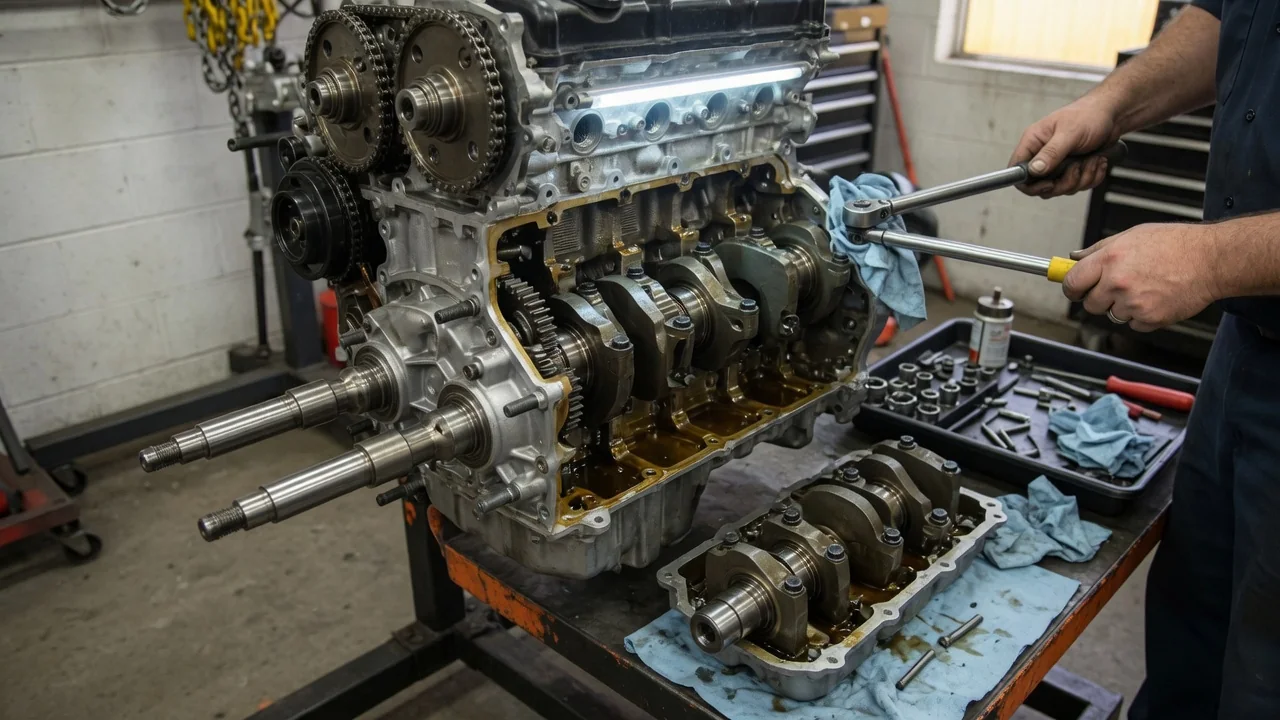
Balance shafts are weighted shafts that spin inside some engines for one reason: to cancel shaking forces that the crankshaft and its counterweights cannot cancel on their own. Whether an engine needs them depends mainly on its cylinder layout, its size, and how smooth the manufacturer wants it to feel. This guide explains the engine balance shaft purpose, the forces involved, how the shafts are driven and timed, and what their presence means for service and everyday ownership.
Vibration forces: what balance shafts cancel
Every piston stops, reverses direction, and accelerates again twice per crankshaft revolution. Moving that mass back and forth creates inertia forces that push and pull on the engine block. Counterweights on the crankshaft can offset the rotating mass and part of the reciprocating force, but they cannot cancel everything. Engineers usually describe the leftovers in two groups: primary forces, which repeat once per crankshaft revolution, and secondary forces, which repeat twice per revolution. Some layouts also produce rocking couples, where forces at opposite ends of the engine try to tip it end to end.
The inline-four is the classic case. Its primary forces cancel because two pistons rise while the other two fall. The secondary forces do not cancel. Because the connecting rod swings at an angle, a piston moves faster through the top half of its stroke than through the bottom half. The upward and downward inertia forces therefore do not match, and the leftover is a vertical shake at twice crankshaft speed. This force grows with piston mass, stroke length, and the square of engine speed, so it becomes more noticeable in larger four-cylinder engines and at high rpm. A pair of balance shafts spinning in opposite directions at twice crankshaft speed can cancel it: their weights pull together vertically against the shake while their sideways pulls cancel each other out.
Other layouts have different leftovers. An inline-three, and some V6 designs depending on their bank angle and crankshaft arrangement, produce a rocking couple at crankshaft speed. A single balance shaft turning at crankshaft speed, with weights placed toward each end, can counter that motion. By contrast, an inline-six is inherently balanced for primary and secondary forces and couples, which is why that layout typically does not need balance shafts at all.
Shaft drive: how balance shafts are turned and timed
Balance shafts are driven from the crankshaft, most commonly by a chain, a gear train, or a toothed belt. The speed ratio is fixed by the force being cancelled: shafts targeting secondary forces turn at twice crankshaft speed, while a shaft targeting a primary rocking couple turns at crankshaft speed. When two shafts must counter-rotate, often only one is driven directly and the second is geared to the first so that it spins the opposite way. Depending on the design, the shafts may sit in the block beside the crankshaft, higher up in the block, or in a separate module bolted beneath the crankshaft inside the oil pan, sometimes combined with the oil pump.
Timing matters as much as speed. The weights must reach their peak position at exactly the right moment relative to piston movement, so assembly relies on alignment marks, locking pins, or specific tooling. If the shafts are installed out of phase, they stop cancelling vibration and can add to it instead. The shafts also depend on engine oil for their bearings, and shafts running at twice crankshaft speed place real demands on those bearings and on the oil supply.
None of this comes free. Balance shafts add weight, parts, friction, and potential noise sources, and they absorb a small share of the engine's output. Engineers weigh those costs against the smoothness gained. In smaller engines, the secondary forces may be modest enough that well-tuned engine mounts handle them, which is one reason many four-cylinder engines are built without balance shafts.
Service: maintaining a balance shaft system
Maintenance requirements depend on the drive type, so the manufacturer's service information is the authority for any specific engine. Belt-driven balance shafts usually have a scheduled replacement interval, and the balance belt is commonly replaced alongside the timing belt. Chain drives generally have no fixed replacement interval, but their tensioners and guides can wear over time. Gear drives tend to need little routine attention beyond clean oil changed on schedule.
Several symptoms can point toward the balance shaft system. A new vibration at certain engine speeds after timing work suggests the shafts may have been installed out of phase. Rattling or whining from the lower part of the engine can indicate a worn chain, tensioner, or bearing. In designs where the shaft bearings share the main oil supply, excessive bearing wear can contribute to low oil pressure. These symptoms are not unique to balance shafts, though. Worn engine mounts, misfires, and accessory drive problems can feel or sound similar, so proper diagnosis should come before replacing parts.
Some owners and shops remove or disconnect balance shafts to reduce friction or eliminate a possible failure point. The trade-off is the return of the vibration the shafts were designed to cancel, which places added stress on mounts, brackets, and accessories and affects comfort. Where the shafts share oil passages with the rest of the engine, an improper removal can also affect lubrication. Because the engine and its mounts were developed with the shafts in place, removal is a modification with consequences rather than a simple simplification.
Practical implications and limits
Balance shafts address inertia forces from moving parts, not the pulses of torque created by combustion. An engine with few cylinders still delivers power in distinct firing events, and that unevenness is most noticeable at idle and low rpm. Flywheels, dual-mass flywheels where fitted, and engine mounts are what smooth out those pulses. As a result, an engine with balance shafts can feel noticeably more refined than one without, yet it will not necessarily feel like a layout with more cylinders and more overlapping power strokes.
For owners, the main practical effect shows up during maintenance. An engine with balance shafts may have more components to inspect or replace during timing work, more alignment steps to follow, and more labor involved in reaching the drive. Before ordering timing parts or planning a repair, it helps to confirm from the engine documentation whether balance shafts are fitted and how they are driven, since parts kits and procedures differ accordingly.
Layout alone does not decide whether a particular engine uses balance shafts. Two engines with the same cylinder arrangement can differ because of displacement, intended use, mount design, and the manufacturer's priorities, so the absence of balance shafts is not a defect. The mechanisms described here are general principles; exact intervals, procedures, and diagnostic steps for any specific engine come from its manufacturer's service information.