Why Do Engines Use Counterweights on the Crankshaft?
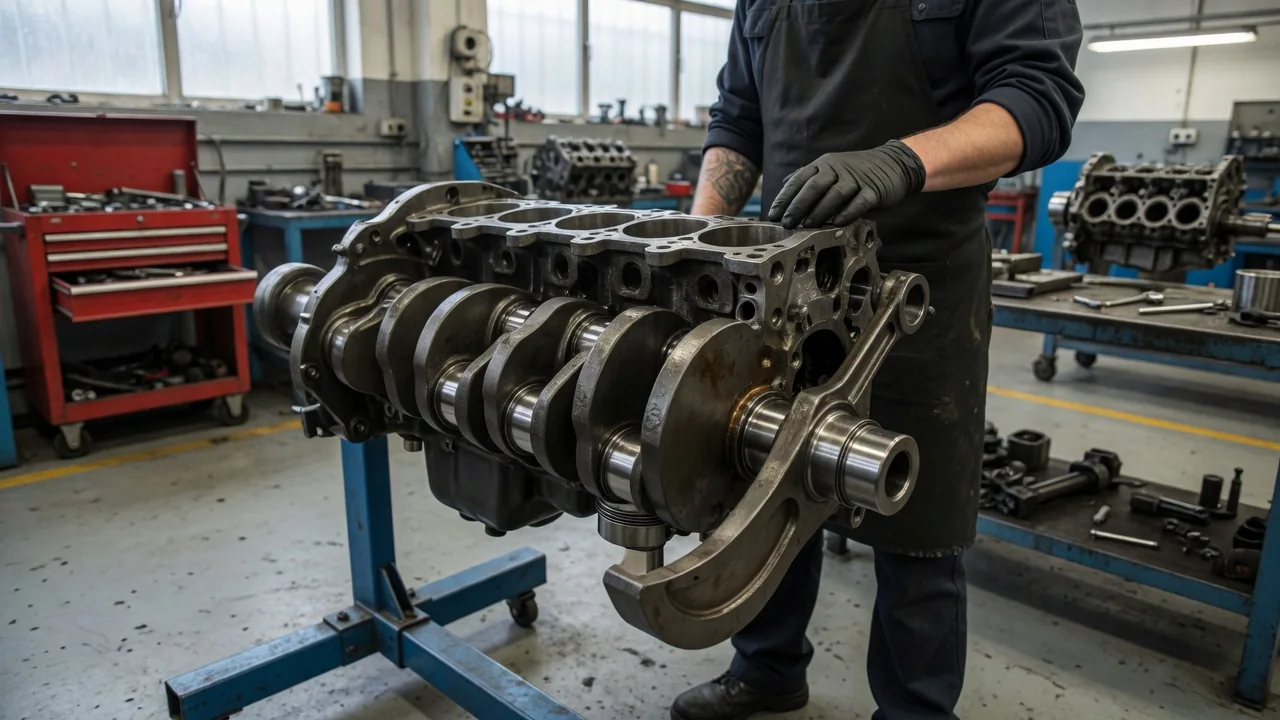
A crankshaft turns the up-and-down motion of the pistons into rotation, but its shape makes it naturally lopsided. The crankpins, where the connecting rods attach, sit off the shaft's centerline, so every revolution tries to fling that offset mass outward. So why do engines use counterweights on the crankshaft? The heavy lobes opposite each crankpin cancel much of that outward pull. The crankshaft counterweight purpose comes down to three linked ideas: rotating mass, balance, and vibration.
Rotating mass
Any mass that spins around an axis but is not centered on it produces a centrifugal force pointing outward from that axis. On a crankshaft, the crankpin and the portions of the crank webs that support it are offset by a distance called the crank throw, which is half the piston stroke. The big end of each connecting rod rides on that pin, so a share of the rod's mass also travels in a circle. Together these parts form the rotating mass of each throw. The force they generate increases with the mass, with the throw radius, and with the square of rotational speed. Doubling engine speed therefore roughly quadruples the outward pull, which is why an imbalance that seems trivial at idle can become significant at high rpm.
A counterweight is simply mass placed on the opposite side of the main bearing axis from the crankpin. When it rotates, it produces its own centrifugal force in the opposite direction. If the product of mass and distance from the axis on the counterweight side matches that of the crankpin side, the two forces cancel and the net force on the main bearings drops toward zero. Designers can achieve the same effect with a smaller weight placed farther from the axis or a larger weight placed closer, which is why counterweight shapes vary with the space available inside the crankcase, the spacing of the cylinders, and the clearance needed for pistons and rods.
Balance
Engine balance involves more than the parts that spin. Each piston, its wrist pin, and the small end of the connecting rod move in a straight line, accelerating and stopping twice per revolution. This reciprocating mass creates shaking forces along the cylinder axis. A counterweight rotates, so it can cancel rotating mass in every direction, but it can only offset reciprocating mass along one direction at a time. Adding counterweight to fight reciprocating forces in line with the cylinder simultaneously creates a new force at right angles to it. Engineers therefore choose a balance factor, a decision about how much of the reciprocating mass the counterweights should address, accepting a compromise between shaking in one plane and shaking in another.
Balance also has a static and a dynamic side. A crankshaft is statically balanced when it has no tendency to roll toward a heavy spot while resting on its main journals. Dynamic balance considers where along the shaft the masses sit. Because each throw lies at a different position along the crank's length, forces that cancel overall can still form rocking couples that try to wobble the shaft end to end. Counterweights placed at or near the throws reduce those couples and also reduce the bending loads the crankshaft itself must carry between main bearings. During manufacture, crankshafts are commonly spun on balancing machines and corrected by drilling or machining material from the counterweights until the remaining imbalance falls within tolerance.
Not every engine places all of its balancing mass on the crankshaft. In some designs, part of the correction sits on the flywheel or flexplate and on the front damper, an arrangement usually called external balance, while internally balanced engines keep the correction within the crankshaft itself. In V engines where two connecting rods share one crankpin, balancers commonly attach calibrated bobweights to the journals to represent the rod and piston mass before spinning the crank. Some forces cannot be addressed by crankshaft counterweights at all. The secondary forces of a typical inline four-cylinder engine, which occur at twice crankshaft speed, are one example, and engines designed to reduce them may use separate balance shafts.
Vibration
Whatever imbalance remains becomes vibration. Unbalanced forces push the crankshaft against its main bearings, the bearings push against the block, and the block passes that motion into the engine mounts and the vehicle structure. Occupants perceive it as shake through the floor, steering wheel, or seats, and as noise. Because the force rises with the square of speed, poor balance tends to show up more clearly as engine speed increases, often within particular rpm bands where the excitation lines up with natural frequencies of the mounts, exhaust system, or body panels.
Inside the engine, vibration is also a durability issue. Repeated unbalanced loads concentrate on the main bearings, raising bearing pressure and wear, and they flex the crankshaft and block with each revolution. Over many cycles, that flexing contributes to fatigue in the crankshaft and in components bolted to the engine. Counterweights reduce these loads at their source. They should not be confused with the torsional, or harmonic, damper. Torsional vibration is the crankshaft twisting slightly along its length as each cylinder fires, and counterweights do little to control it. The damper on the front of the crank exists for that separate job, even though on some engines it also carries balancing mass.
Practical implications and limits
For owners, counterweights matter mostly when the rotating assembly is changed. Installing pistons, rods, or a flywheel that weigh differently from the originals can upset the factory balance, so engine builders typically rebalance the assembly after such changes. On an externally balanced engine, a replacement flywheel, flexplate, or damper must carry the correct balance mass for that engine. A part intended for an internally balanced version may look interchangeable while introducing a new vibration. Service information for the specific engine is the reliable reference for which arrangement applies.
Counterweights also carry trade-offs. They add mass and rotational inertia, which can slow how quickly an engine gains revs, and they must clear pistons, rods, and the oil pan, which limits their size. Some designs use partial counterweighting to save weight or space, accepting higher bearing loads that the bearings and block are sized to handle. Counterweights also cannot correct problems that have nothing to do with balance, such as a misfire, worn engine mounts, a failing damper, or driveline faults, all of which can produce shaking that feels similar. When an engine develops a new vibration without any change to its internal parts, those causes are generally worth checking first, since a crankshaft's balance does not normally change in service unless parts are altered or damaged.