What Is an Axle Bearing? Function, Loads and Warning Noises
An axle bearing is the component that lets a wheel or axle shaft turn smoothly while holding it in the correct position relative to the rest of the vehicle. Knowing what an axle bearing is, and what a car axle bearing's function is in everyday driving, helps owners make sense of repair descriptions and recognize early warning signs. This guide explains how these bearings support rotation, how they carry load, why worn ones make noise, and what that means in practice.
Rotating support
Every wheel needs a support that lets it spin freely while keeping it precisely located. A bearing does this by placing rolling elements, either balls or rollers, between an inner ring and an outer ring called races. Instead of two metal surfaces sliding against each other, the elements roll, which keeps friction and heat low even at highway speeds. A lubricant reduces wear on the contact surfaces. Depending on the design, that lubricant is grease sealed inside the bearing or, on many solid rear axles, gear oil that reaches the bearing from the differential housing. Seals keep the lubricant in and keep water, road dirt and grit out, because contamination is one of the main enemies of any rolling bearing.
The term axle bearing is used loosely. On many rear-wheel-drive vehicles with a solid rear axle, it refers to the bearing near the outer end of the axle tube that supports the axle shaft. On front-wheel-drive vehicles and on many independent suspensions, the comparable job is done by a wheel bearing or hub bearing assembly mounted in the steering knuckle or suspension carrier. The principle is the same, but which part a shop or parts listing means depends on the vehicle's design, so the service information for the specific vehicle is the reliable reference.
Common designs include ball bearings, tapered roller bearings and cylindrical roller bearings. Tapered roller bearings are often installed in pairs and, in serviceable designs, may require a specific preload adjustment. Many modern hub assemblies combine the bearing, hub flange and mounting points into one sealed, pre-adjusted unit that is replaced as a whole rather than repacked or adjusted.
Load
An axle bearing carries two basic kinds of force. Radial load acts perpendicular to the axle, mainly the weight of the vehicle pressing down on the wheel, plus the extra weight transferred to the front or rear during braking and acceleration. Axial load, also called thrust load, acts along the axle's centerline. It comes largely from cornering, when side forces at the tire try to push the wheel inward or pull it outward. The bearing's internal geometry determines how well it handles each type. Tapered roller bearings and angular contact ball bearings are well suited to combined radial and axial loads, which is why they are widely used at the wheel end.
How the load path is arranged also matters. In a semi-floating axle, common on passenger cars and light trucks with solid rear axles, the axle shaft both transmits drive torque and supports the vehicle's weight at the wheel end, with the bearing riding directly on the shaft. In a full-floating axle, typical of heavier-duty trucks, the hub rides on bearings mounted on the axle housing itself. The shaft then transmits torque only and can usually be removed without the wheel coming off. Separating the weight-carrying job from the torque-carrying job is a key reason full-floating designs are favored for heavy loads and towing.
Bearing life depends heavily on how those loads are applied. Sustained heavy loading, frequent towing near a vehicle's limits, hard impacts from potholes or curbs, and incorrect installation all increase stress on the races and rolling elements. Water that gets past a damaged seal can degrade the lubricant and start corrosion, which shortens life even under ordinary loads.
Noise
A healthy bearing is essentially silent. As the races and rolling elements wear, pit or flake, their surfaces become rough, and each roller or ball passing over the damage creates a vibration that is heard as a hum, growl or rumble. A typical characteristic is that the sound rises and falls with road speed rather than engine speed, and it often continues whether the driver is accelerating, cruising or coasting.
Because cornering shifts weight from one side of the vehicle to the other, a worn bearing may become louder or quieter during gentle, steady turns. A noise that grows when weight moves onto one side can point toward the bearing on that side, but this is a clue rather than proof, since sound travels through the body and suspension in ways that can mislead. As wear advances, the noise may turn into grinding, and vibration may be felt through the steering wheel, floor or seat. Severe wear can also allow noticeable play at the wheel.
Several other components produce similar sounds. Uneven or cupped tire wear and aggressive tread patterns can create a speed-related drone. Differential gear noise often changes between acceleration and deceleration. A worn outer constant velocity joint tends to click during tight turns, and brake parts can scrape or squeal. For that reason, listening alone rarely settles the question.
Practical implications and limits
Bearing deterioration usually progresses rather than stabilizing. Continuing to drive with a failing bearing can lead to excessive heat, growing play, damage to the hub, axle shaft or mounting surfaces, and uneven tire and brake wear. Many hub assemblies also carry the wheel speed sensor or its tone ring, so bearing play or damage can trigger an ABS or traction control warning light. In severe cases, a badly failed bearing can compromise wheel retention and vehicle control, which is why a persistent wheel-end noise deserves prompt inspection rather than waiting.
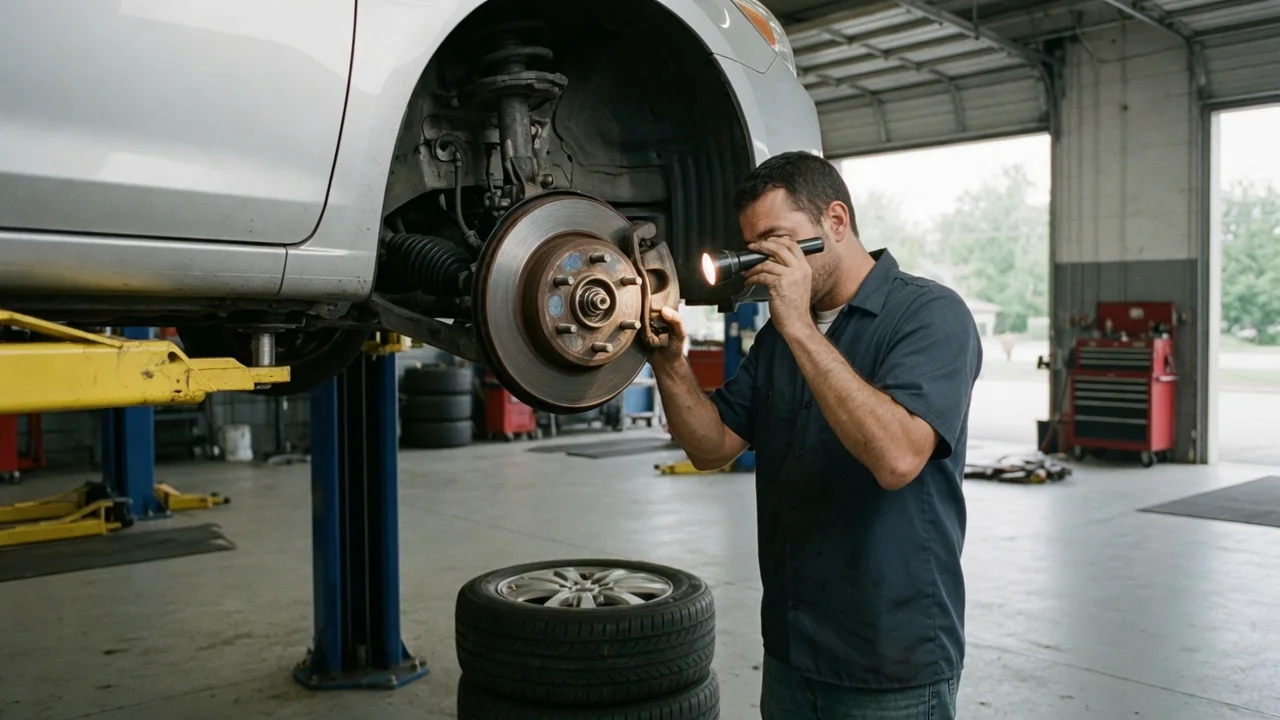
Inspection typically involves supporting the vehicle safely, checking for play by rocking the wheel, and spinning it by hand to feel for roughness. Play can also come from worn suspension or steering joints, so the source has to be isolated, and acceptable limits vary by design. Replacement procedures differ widely: some bearings are pressed into the knuckle or onto the shaft and need a hydraulic press and adapters, while bolt-on hub units are simpler. Axle nut and fastener torque values are vehicle-specific, and incorrect tightening can shorten the life of a new bearing, so the manufacturer's service manual should guide the work.
There is no universal replacement interval for axle bearings. Their service life depends on the design, the loads the vehicle carries, road and weather conditions, and the quality of installation. Whether to replace the opposite side at the same time is a judgment based on its condition and on the vehicle maker's guidance. The symptoms described here are general patterns, and confirming a bearing problem requires a hands-on inspection of the specific vehicle.