What Is a Narrow-Angle V Engine? Bank Angle, Head Layout and Packaging
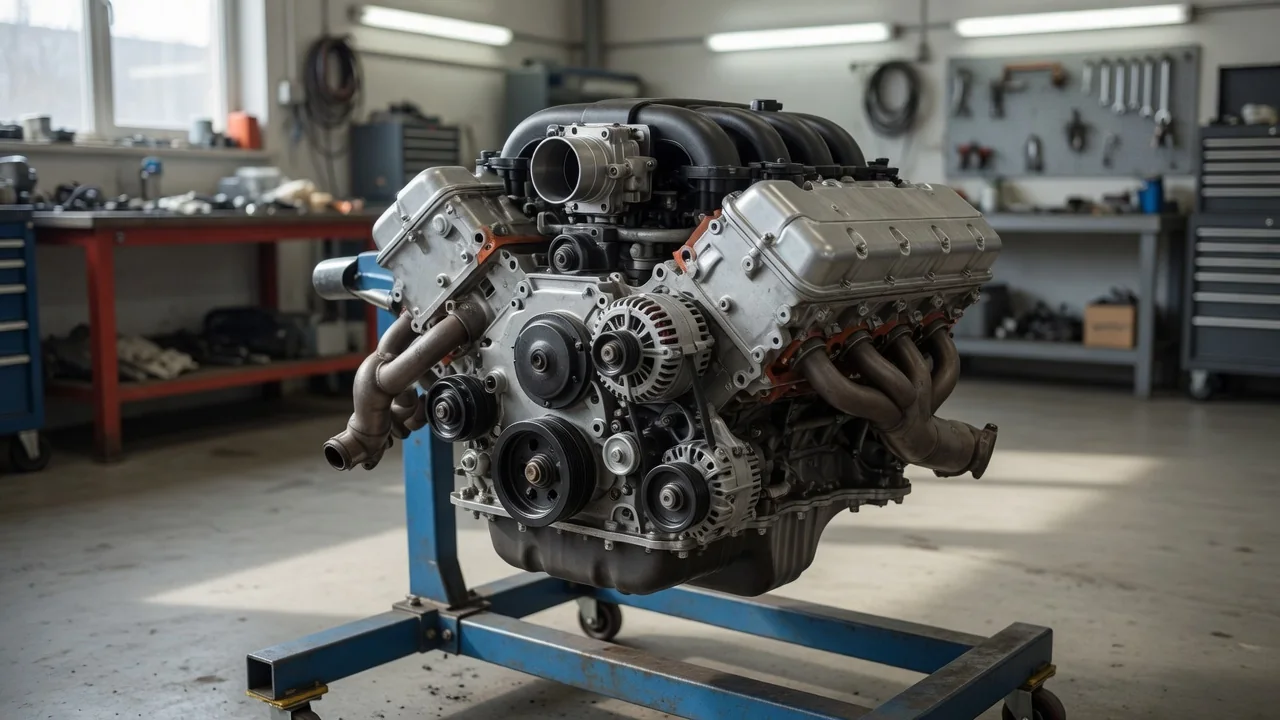
A narrow-angle V engine is a V-type piston engine whose two cylinder banks sit much closer together than in a conventional V6 or V8. There is no wide valley between the banks. Instead, the cylinders are staggered in a tight zigzag inside one compact block. Narrow-angle V engine design rests on three linked ideas: the bank angle itself, how the cylinder head is arranged, and why the layout saves space.
Bank Angle: How Narrow Is Narrow?
In any V engine, the bank angle is the angle between the centerlines of the two rows of cylinders, measured around the crankshaft axis. Conventional V engines commonly use angles such as 60 or 90 degrees. Those angles are chosen largely for balance, firing intervals and room for intake hardware in the valley between the banks. A narrow-angle V uses a far smaller angle, generally in the range of roughly 10 to 20 degrees. At that point the banks are so close that there is no real valley. Seen from above, the bores alternate slightly to one side and then the other, forming a staggered pattern rather than two clearly separate rows.
With such a small angle, the cylinder bores cannot all point straight at the crankshaft centerline without crowding one another. Designers often offset the cylinder axes from the crank centerline. That lets the bores pack tightly while the connecting rods still reach their crankpins cleanly. The crankshaft is also designed around the small angle. Many wider V engines rely on the bank angle to help set the firing interval. A narrow-angle engine instead uses the positions of its crankpins to keep firing events evenly spaced.
Bank angle also affects smoothness. Wide V layouts can use the angle between banks to help cancel certain forces. With only a few degrees separating the banks, a narrow-angle engine behaves in many respects like an inline engine whose single row has been folded into a slight zigzag. Its inherent balance therefore depends mainly on cylinder count and crankshaft design, not on any balancing benefit from the bank angle.
Cylinder Head Layout: One Head for Two Banks
The defining feature of most narrow-angle V engines is a single cylinder head that covers both banks. In a conventional V engine, each bank has its own head, its own camshafts and its own head gasket. When the banks are only a few degrees apart, the combustion chambers of both rows sit close enough together to share one casting with one deck surface. This reduces the number of major parts and simplifies the overall structure, but it forces some unusual geometry inside the engine.
The head deck is a single flat plane, while the two cylinder rows tilt slightly in opposite directions. As a result, each bore meets the deck at a small angle instead of perfectly square. Designers commonly shape the piston crowns to match that slope, so combustion chamber volume and shape stay consistent from cylinder to cylinder. The valvetrain must also serve both banks from one head. In simpler arrangements, one camshaft can work the intake valves for both rows and a second camshaft can work the exhaust valves. Designs with more valves per cylinder may divide intake and exhaust duties between the camshafts in more complex ways, specific to that engine.
A shared head also means shared porting. Intake ports usually enter from one side of the head and exhaust ports leave from the other. That makes the ports serving one bank inherently longer than those serving the other. Designers manage these differences through port shape, cam timing and manifold tuning, so that cylinders on both banks breathe as evenly as practical.
Packaging: Why Designers Choose a Narrow V
Packaging is the main reason narrow-angle V engines exist. An inline engine is narrow but long, because every cylinder sits in one row along the crankshaft. A conventional V engine is short but wide, because its banks spread apart. A narrow-angle V sits between these extremes. Staggering the cylinders makes the block noticeably shorter than an inline engine with the same cylinder count, while keeping it far narrower than a typical wide-angle V.
That combination matters most in transverse layouts, where the engine sits sideways between the front wheels. There, engine length competes directly with the transmission, steering components and crash structure for space. In some applications, a compact narrow-angle six can fit in an engine bay sized for an inline four. That makes it possible to offer more cylinders without redesigning the front of the vehicle. A single head also needs only one set of camshaft drive components, which can simplify the timing system and accessory layout compared with an engine that must drive two separate heads.
The same principle can be extended. Two narrow-angle banks can be arranged in a wider V around a common crankshaft, producing very compact engines with high cylinder counts. Those configurations go beyond the basic layout described here, but they rely on the same staggered bores and shared heads.
Practical Implications and Limits
For owners, the main practical effect is that a narrow-angle V engine follows the service conventions of neither an inline nor a conventional V engine. Procedures for timing work, head removal, gasket replacement and valve adjustment are specific to the design. Major parts are rarely interchangeable with other engine layouts. Compact packaging also places components close together, so routine jobs can be harder to reach than the engine's modest outside dimensions suggest. The vehicle's own repair manual remains the authority for torque values, timing marks and procedures.
The layout also has engineering limits. In a staggered block, each bore sits close to its neighbors, leaving little room to enlarge it. That limits how much displacement can grow within a given block. Different port lengths between banks make cylinder-to-cylinder variation harder to eliminate completely. Concentrating every combustion chamber in one compact head also places heavy demands on its cooling passages. None of these are defects in themselves. They are trade-offs accepted in exchange for space savings, and how well a particular engine manages them depends on its specific design.
Finally, the term describes geometry, not character. Whether a narrow-angle V engine feels smooth, responsive or economical depends on its cylinder count, crankshaft, valvetrain, fuel system and calibration. Knowing the layout explains why the engine looks and is serviced the way it is. Performance and reliability should still be judged from information about the exact engine in question.