What Is an Inline Engine Layout?
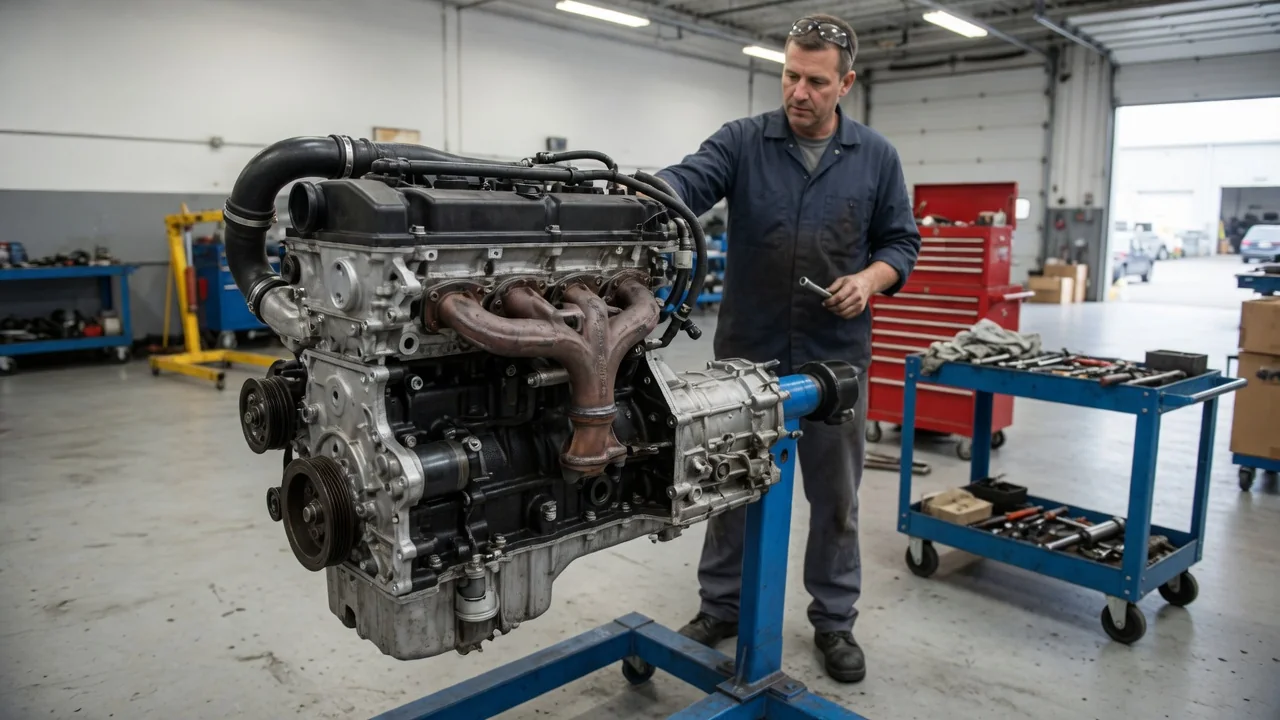
An inline engine layout places all of an engine's cylinders in a single straight row, sharing one crankshaft, one cylinder block and one cylinder head. It is also called a straight engine, and it is one of the most widespread configurations in passenger cars. Understanding the inline car engine layout helps explain why many engines look the way they do under the hood, how they fit into different vehicles and what that means for routine maintenance.
Cylinder Arrangement
In an inline engine, the cylinders stand side by side along the length of the crankshaft, usually upright or tilted at a modest angle. Each piston connects to its own crank throw, and the throws are spaced so that the cylinders fire at regular intervals. A four-stroke engine completes its full cycle over two crankshaft revolutions, or 720 degrees, so an inline-four can fire every 180 degrees and an inline-six every 120 degrees. Inline engines are commonly built with three, four, five or six cylinders, and they are often named by that count, such as I4 or straight-six. Longer rows exist in some heavy-duty and older designs, but overall length becomes a practical constraint as cylinders are added.
The single-row arrangement means there is only one cylinder head, typically carrying the valves, the camshaft or camshafts, and the intake and exhaust ports. Intake air usually enters from one side of the head and exhaust leaves from the other, which allows a relatively simple intake manifold and a single exhaust manifold. V and flat layouts split their cylinders across two banks with two heads, so for the same cylinder count an inline design needs fewer major castings and, on overhead-cam engines, fewer camshafts and related valvetrain components.
Balance depends heavily on cylinder count. An inline-six is known for being inherently balanced in both primary and secondary forces, so it can run smoothly without extra balancing hardware. An inline-four has balanced primary forces but produces a secondary vibration at twice crankshaft speed, which some designs counter with balance shafts, particularly at larger displacements. An inline-three produces a rocking motion along its length that engineers address through counterweights, balance shafts or mounting design. These are general tendencies of the layout; how smooth a specific engine feels also depends on its mounts, crankshaft design and calibration.
Packaging
Packaging describes how an engine fits within the space available in a vehicle. An inline engine is narrow but comparatively long and tall. Its length grows with every cylinder added, while its width stays roughly constant because all cylinders share one row. Height is set by the stroke, the block deck and the cylinder head on top, which can affect hood line and front-end structure design. To reduce installed height, some engines are mounted tilted to one side, a practice often described as canting or slanting the engine.
Orientation matters as much as size. Short inline engines with three or four cylinders fit well when mounted transversely, meaning sideways across the engine bay, which is the common arrangement for front-wheel-drive cars because the engine, transmission and differential can sit together between the front wheels. A longer inline-six is harder to fit sideways, since the engine and transmission together must fit between the wheel wells, so six-cylinder inline engines are more often mounted longitudinally, front to back, in rear-wheel-drive or all-wheel-drive platforms. Transverse inline-sixes have been built, but they demand careful space planning.
The narrow profile leaves room along the sides of the block for accessories, intake plumbing, turbochargers and steering components. In longitudinal installations, that side space can ease routing of intake and exhaust parts, while the engine's length can push it back toward the firewall or forward over the front axle, influencing weight distribution. Each manufacturer weighs these factors differently, so the layout defines possibilities rather than fixed outcomes.
Service Access
From a maintenance standpoint, the single cylinder head is often the inline layout's main advantage. Spark plugs or injectors, ignition coils, the valve cover and the camshaft drive are generally grouped along the top of the engine, so many routine tasks begin by removing a cover and working from above. There is one valve cover gasket to replace rather than two, and on overhead-cam designs the timing belt or chain drives camshafts in a single head instead of being routed to two separate banks.
Access still depends on installation. In a transverse engine bay, the side of the engine facing the firewall can be tight, and components mounted there, such as an exhaust manifold, sensors or intake parts, may require removing other items first. With a longitudinal inline engine, the rearmost cylinders and the back of the head can sit close to the firewall or under the cowl, which can make rear spark plugs, coils or valve cover fasteners awkward to reach. Belt-driven accessories at the front of the engine are usually reachable, but clearance between the engine, body and radiator varies by vehicle.
Because these details change from one installation to another, the inline configuration only indicates what is likely to be accessible. The correct procedure, any required special tools and the parts that must come off first are defined by the service manual for the specific engine and vehicle.
Practical Implications and Limits
For owners, the inline layout is a useful starting point for interpreting a vehicle's specifications and repair expectations. Knowing an engine is an I4 or a straight-six suggests a single head, one bank of valvetrain parts and certain balance characteristics, which helps when reading parts listings, judging which components serve all cylinders or understanding why a particular engine may use balance shafts. It also explains why cylinder numbering usually runs in a simple sequence from one end of the engine to the other, although the starting end and the firing order are set by each manufacturer and should be confirmed in the documentation.
The layout does not by itself determine power, fuel economy, reliability or repair cost. Those depend on displacement, induction, materials, cooling design, maintenance history and how the engine is installed in a given vehicle. A compact inline engine placed in a crowded bay can be harder to work on than a larger engine with generous clearance. Treat the inline description as general architecture: it explains the mechanical logic of the engine, while torque values, fluid capacities, service intervals and access steps should come from the official information for that exact model.