What Is a Stamped Car Body Panel? Forming, Tooling and Surface Quality
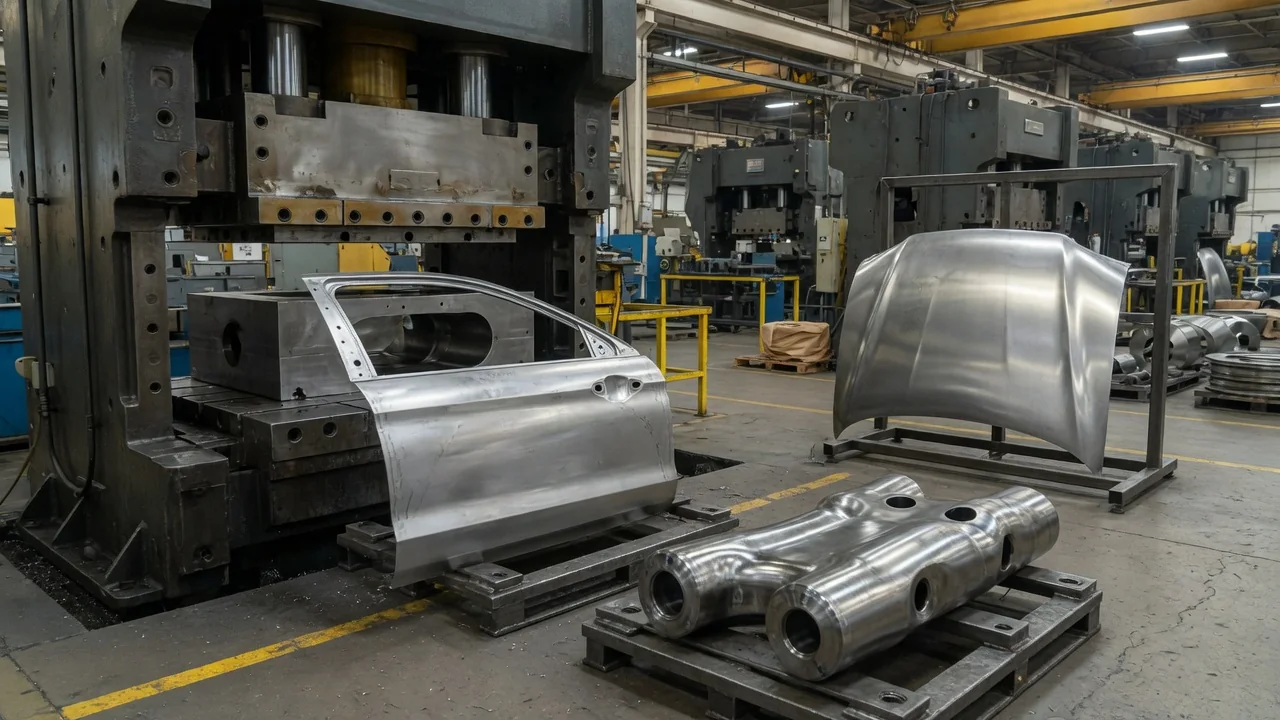
A stamped car body panel is a part formed from flat sheet metal by pressing it between shaped dies in a large press. Doors, hoods, fenders, roof skins, quarter panels and many hidden reinforcements are made this way. Automotive panel stamping turns coil steel or aluminum into precise three-dimensional shapes at high volume. The result determines how panels fit, how paint looks and how damage can be repaired. This guide explains how forming, tooling and surface quality work together.
Sheet forming
Stamping starts with metal supplied in large coils. The coil is straightened and cut into blanks. These are flat pieces sized and shaped so the finished part has enough material, with as little scrap as practical. Some blanks are simple rectangles and others are contoured. Some are tailor-welded blanks, which join sheets of different thickness or grade so that stronger metal sits only where the finished part needs it.
The key operation for most outer panels is the draw. A binder, also called a blankholder, clamps the blank around its edges while a punch pushes the center of the sheet into a die cavity. The metal stretches and flows inward to take the shape of the tools, and controlling that flow is the central challenge. If the binder holds too loosely, excess metal bunches up and wrinkles. If it holds too tightly, the sheet thins locally and can split. Draw beads are raised ridges on the binder surface that add controlled restraint so the material feeds evenly. Engineers commonly use forming limit analysis and computer simulation to predict where strain will concentrate before a die is machined.
After the draw, the part usually passes through further operations. These include trimming away the excess binder area, piercing holes, bending flanges and sometimes a restrike to sharpen feature lines. Every formed part also springs back slightly when released from the die, because the elastic portion of the deformation recovers. Higher-strength steels and aluminum alloys tend to show more springback than mild steel, so die shapes are often compensated to overbend the part. Certain structural parts, such as some pillars and rails, are made by hot stamping. In that process a heated boron-alloyed blank is formed and quenched in the die to reach very high strength. Outer skin panels are generally cold stamped.
Tooling
A stamping die set is a matched pair of tools, an upper and a lower half, mounted in a press. For a large exterior panel, a die line typically contains several dies in sequence, such as draw, trim, flange, pierce and restrike stations. Automation moves the part between them, either in a tandem line of separate presses or in a transfer press. Smaller brackets and reinforcements are often produced in progressive dies, where a strip of metal advances through multiple stations and the part is separated at the end. Die bodies for large panels are commonly cast iron or cast steel. Hardened tool-steel inserts are fitted in areas that cut, bend or see heavy wear, and surface treatments or coatings may be added to reduce galling and extend tool life.
A die costs far more to build than any single part it makes, which is why stamping suits high-volume production. The design starts from the part surface and then adds addenda, the extra geometry around the part that lets the metal be drawn smoothly, along with binder surfaces and draw beads. After machining, the die goes through tryout. Toolmakers run test panels and check them for splits, wrinkles and dimensional accuracy. They then adjust the tool by grinding, polishing and spotting. Spotting means checking contact between the die halves with a marking compound and correcting high or low areas. Several rounds may be needed before panels meet requirements consistently. During production, cutting edges dull, polished surfaces wear and trapped debris can mark every panel that follows, so dies need ongoing maintenance.
Surface quality
Exterior panels are held to a much stricter appearance standard than hidden parts. Visible outer surfaces are often called Class A surfaces, meaning light must reflect off them smoothly and continuously. A panel can be dimensionally correct and still be rejected if a shallow low spot or ripple distorts reflections once the car is painted. Paint and clearcoat do not hide such defects, and a glossy finish tends to make them easier to see.
Typical stamping-related surface defects include low or high spots and waviness in large flat areas. Skid or impact lines can appear where metal slid over a die radius. Trapped particles cause dings, and heavily stretched regions can show surface strain marks. Large, relatively flat panels such as roofs and hoods can be especially sensitive, because they have little curvature to give them stiffness. Some outer panels are designed to stretch enough during the draw to work-harden the metal, which gives a firmer feel and helps resist small dents.
Inspection methods aim to reveal what paint would expose. One common practice is stoning, where an abrasive stone is drawn lightly across the panel so high spots are scuffed and low spots stay untouched. Panels may also be viewed under highlight lighting or after applying a reflective oil. Measuring equipment and checking fixtures confirm shape and trim edges. Problems found this way are traced back to the die, the material or the press settings rather than corrected panel by panel.
Practical implications and limits
For owners and repairers, knowing that a panel is stamped explains several everyday realities. Body lines, flanges and hem edges were created in specific dies, so a crease that crosses a feature line is usually harder to restore by hand than damage in an open area. Outer skins on doors and hoods are commonly hemmed, meaning folded over the edge of an inner panel, and they are often bonded as well. That construction affects whether a skin can be replaced on its own or the complete assembly should be changed. Metal that was stretched and work-hardened during forming also responds differently to straightening than fresh sheet.
Material choice matters too. Aluminum panels and many high-strength steel parts behave differently from mild steel during repair and may have restrictions on heating, sectioning or welding. Each vehicle manufacturer sets those limits, so the repair information for the specific vehicle is the authority, not general rules of thumb. The same caution applies to hot-stamped structural parts, which are generally not intended to be straightened or heated.
Replacement panels show the effect of tooling directly. Panels supplied through the vehicle manufacturer are intended to match the original shape and feature lines. A part produced on different tools may vary in fit, gap or reflection, depending on how well its dies were developed. Inspecting a replacement panel under good light before paint, and test-fitting it against neighboring panels, is a practical way to catch shape problems early. Stamping also explains some design limits. Very deep shapes, sharp corners and abrupt contours are difficult to form from one sheet, which is why some parts are made from several stampings joined together.