What Is Springback in Car Sheet Metal?
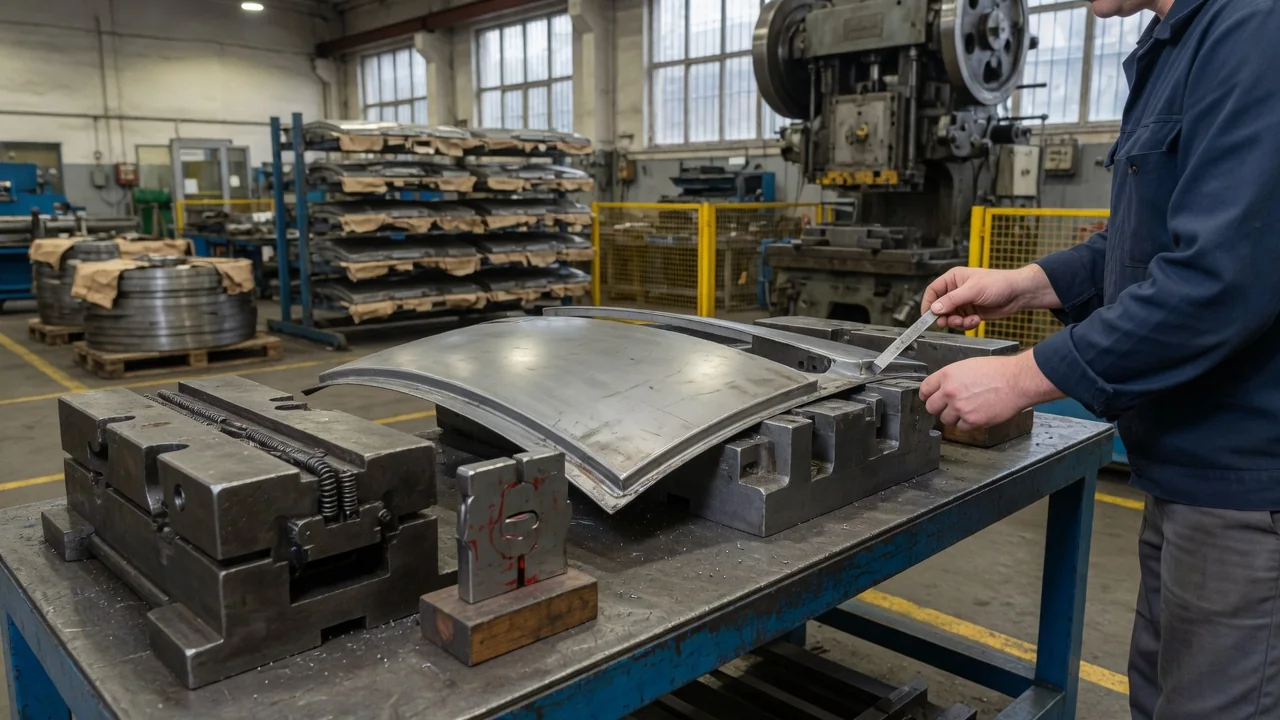
Springback is the tendency of formed sheet metal to partially return toward its original shape once the forming load is removed. In car body manufacturing and repair, it explains why a stamped fender, door skin or bracket rarely comes out of the die exactly matching the tool surface. Understanding automotive metal springback helps make sense of how stamping dies are designed, why body panels are checked so carefully for fit, and why reshaping damaged metal takes more than one push.
Elastic recovery
When sheet metal is bent or stretched, the deformation has two components. Part of it is plastic: the metal's crystal structure permanently rearranges, and that part of the new shape stays. Part of it is elastic: the atoms are displaced but not permanently rearranged, much like a compressed spring. While the punch and die hold the metal, both components are locked in place. Once the tool opens, the elastic portion recovers, and the part relaxes by some amount toward its flat starting condition. That relaxation is springback.
In a simple bend, the outer fibers of the sheet are in tension and the inner fibers are in compression, with stresses that vary across the thickness. After unloading, these stresses partially balance out, leaving residual stress locked inside the part and a bend angle that has opened up compared with the tool. In more complex stampings the effect shows up in several ways: flanges open, walls curl, long rails twist, and gently curved surfaces such as roofs and hoods may flatten slightly or lose some of their crown.
The amount of springback depends largely on the relationship between a material's strength and its stiffness. A metal that must be loaded to a high stress before it yields stores more elastic energy at the end of forming, so it recovers more. This is why high-strength and advanced high-strength steels, increasingly used in body structures for crash performance and weight reduction, are known for pronounced springback. Aluminum alloys are also challenging because their elastic modulus is roughly one-third that of steel, which means more elastic strain at a given stress. Sheet thickness, bend radius relative to thickness, part geometry and how much the metal is stretched during forming all influence the final result as well.
Tool compensation
Because springback cannot be eliminated, stamping engineers design tooling to anticipate it. The most basic approach is overbending: the die forms the metal past the target angle or shape so that, after it relaxes, the part settles where the design intended. For complex panels, this idea is extended to the entire tool surface. The die geometry is deliberately distorted, a process often called die compensation or surface morphing, so the formed part springs back into its correct shape rather than away from it.
Modern compensation typically begins in forming simulation software, where finite element analysis predicts how the blank will stretch, thin and recover. The predicted deviation is used to adjust the tool surface, and the cycle is repeated until the predicted part falls within tolerance. Simulation accuracy depends heavily on how well the material model represents the actual sheet, so physical tryout remains part of the process. During tryout, measured parts are compared against the design data, and the dies are reworked where the real metal behaves differently from the model.
Process changes can also reduce springback instead of only compensating for it. Adding more stretch to the sheet with draw beads or higher binder force makes the deformation more uniformly plastic through the thickness, which leaves less elastic recovery. Restrike or calibration operations, tighter forming radii where the design allows, bottoming or coining a bend, and stiffening features such as ribs, darts or embossments can all help lock a shape in place. Each of these choices involves trade-offs with tool cost, material thinning, splitting risk and surface appearance.
Panel fit
Springback matters to the finished car because body panels must meet each other with consistent gaps and flush alignment. A door outer that has lost a little curvature, a fender flange that has opened slightly, or a hood whose edges sit differently from its center can produce visible gaps, uneven reflections, wind noise or sealing problems. Even a small angular deviation at a flange can become noticeable misalignment at a panel's edge, because the error grows with distance from the bend.
Not all springback is resolved at the press. Many closure panels are made by hemming an outer skin over an inner panel, and the hemming process introduces its own elastic recovery and potential edge roll-in. Assembly in welding fixtures can also force slightly out-of-shape parts into position; once the clamps release, residual stresses can redistribute and shift the assembly. For this reason, manufacturers generally inspect parts and assemblies with checking fixtures and dimensional measurement, and fit targets may account for how panels behave after joining, painting and installation.
The interaction between neighboring parts is why panel fit is treated as a system rather than a property of one stamping. A fender that is within its own tolerance may still look wrong next to a door with an opposite deviation, so dimensional engineering looks at how variation stacks up across the whole body.
Practical implications and limits
For owners and repairers, springback explains several everyday observations. A replacement panel may need adjustment at its mounting points to match surrounding panels, because each stamping carries its own small variation and the body it attaches to has its own history. Fit on a given vehicle is the combined result of manufacturing tolerances, prior repairs and any structural damage, so a gap problem is not automatically a defect in the new part.
In collision repair, the same elastic behavior works against straightening. Damaged metal that is pushed or pulled back toward shape will partially rebound when the force is released, which is why technicians often overpull slightly, relieve stress in the surrounding area and measure repeatedly rather than relying on a single correction. High-strength steels in structural areas add another limit: repair procedures for these materials vary by manufacturer, and some parts are intended to be replaced rather than reshaped or heated. The vehicle maker's published repair information is the appropriate reference for any specific car.
Finally, springback is a general physical mechanism, not a measure of quality on its own. How strongly it appears depends on the specific alloy, thickness, geometry and process, none of which can be judged reliably by looking at a finished panel. Knowing the principle helps explain why fit and repair results vary, but diagnosing a particular gap, wave or misalignment still requires measurement and the relevant service documentation.