How Is a Car Body Panel Trimmed After Stamping?
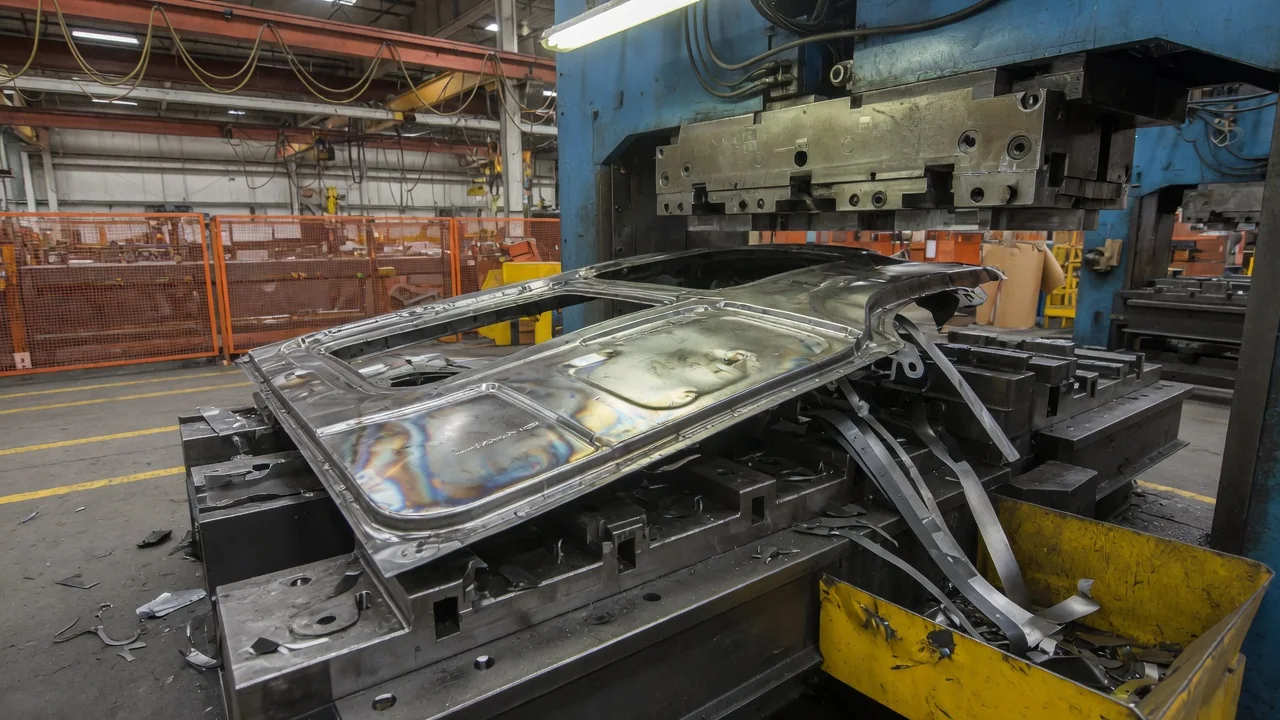
A car body panel isn't ready to install when it leaves the draw die. The forming press gives the sheet its shape, but the panel still has extra metal around it, solid areas where holes belong, and raw edges that need work. Trimming turns that rough shape into a usable part. This article explains how a stamped panel's edges are trimmed, how holes are punched, and which finishing steps prepare the panel for assembly.
Excess material: why it exists and how it is cut away
The excess material is there on purpose. A stamping blank is cut larger than the finished panel because the forming die needs something to hold. During the draw operation, a binder or blank holder clamps the outer area of the sheet. Draw beads in that area add resistance, so the metal flows into the die cavity at a controlled rate instead of wrinkling or tearing. Die designers also add surfaces called addendum, which extend the part's shape past its final edge so the metal forms smoothly. All of this material is needed during forming, but none of it belongs on the finished panel.
In high-volume production, the excess is usually removed in a trim die in the next press station. The formed panel sits on a lower die section shaped to match it, and pressure pads clamp it in place. As the press closes, hardened upper trim steels move past the lower cutting edges with only a small clearance between them. This shears the sheet along the trim line. The cut is not a clean slice. The metal deforms, partly shears, and then fractures, which produces a characteristic edge profile. Scrap cutters built into the die chop the removed strip into smaller pieces that drop down chutes for recycling. Some edges run at a steep angle to the press stroke. For those, cam-driven slides turn the press's vertical motion into an angled cut. A complex panel may need several trim stations to reach its whole perimeter.
Mechanical die trimming is not the only method. Laser trimming is common for press-hardened (hot-stamped) steel parts, because their very high strength after forming makes conventional trim steels wear quickly or perform poorly. Lasers also suit prototype and low-volume work, where building dedicated trim dies may not make economic sense. Aluminum panels can be die-trimmed too, but clearances and cutting conditions need close attention to avoid slivers and poor edges.
Hole punching: piercing openings in the panel
Almost every body panel needs holes. Fasteners, clips, and wiring pass through them. Water drains through them. Welding and assembly fixtures use locating holes to position the panel, and larger openings make room for components such as handles or lamps. These holes are made by piercing. A punch drives through the sheet into a matching die button below it, and the punched-out disc, called a slug, falls away through the die. A stripper plate holds the panel down so the punch can pull back without lifting the part. Piercing often happens in the same die as trimming, which is why many production dies are described as trim-and-pierce tools.
Most precise holes are pierced after forming, not in the flat blank. Metal stretches and moves during the draw, so a hole cut in the blank could end up out of position or distorted. Piercing after forming places each hole relative to the panel's actual shape, which matters most for locating holes that later act as reference points in the body shop. A punch works best when it strikes roughly perpendicular to the surface, so holes on sloped or vertical walls are usually made with cam piercing units. Typical piercing problems include slugs pulled back up by the punch, which can dent or mark the panel, burrs that grow as punches wear, and holes that drift out of tolerance. Die maintenance and inspection are designed to catch these problems.
Finish: flanging, restriking, and edge quality
Trimming and piercing are usually followed by forming steps that finish the panel's geometry. Flanging bends trimmed edges into mounting flanges, welding flanges, or stiffening returns. On outer panels such as doors, hoods, and lids, flanges are prepared for hemming, in which the outer skin's edge is folded over an inner panel to join the two. Restrike operations re-form areas to sharpen feature lines and correct springback, which is the metal's tendency to partly return to its original shape after forming. These steps run in a tandem line of presses or in a transfer press. The number and order of stations depend on the part.
Edge quality is a key part of finishing. A sheared edge has a slightly rounded rollover zone, a smooth burnished band, a rougher fracture zone, and usually some burr. A large burr can cut workers, damage seals, and interfere with how mating parts fit. A rough or damaged edge also matters for any edge that is later flanged or stretched. High-strength steels in particular can crack at a poor cut edge when they are bent further. In mass production, edge quality is controlled mainly through die clearance and sharpening schedules rather than manual deburring. Finished panels are checked with fixtures, optical scanning, or coordinate measurement, and visually for splits, slivers, and burrs.
Trimming also affects corrosion protection. Much body sheet is zinc-coated, and a cut edge exposes the base steel along its thickness. The zinc next to the edge can give some sacrificial protection, but the factory relies on later steps to seal and cover these edges. Those steps include electrocoating, seam sealers, hem adhesives, and paint.
Practical implications and limits
For owners and repairers, trimming accuracy shows up as fit. Panel gaps, flush alignment, and whether bolts and clips line up all depend on where edges were cut and holes were pierced. A replacement panel made with different tooling may differ slightly in flange length or hole position. That is why fitting a panel sometimes takes adjustment, and why repairers test-fit parts before final installation. A shop cannot reproduce production die trimming with hand tools. Grinding or cutting a panel to make it fit also removes the factory coating along the new edge.
The same applies to repair work. When a damaged panel is sectioned, the new cut edges have none of the factory sealing and coating that the original trimmed edges received. Manufacturer repair information usually explains where cuts are allowed, how to restore corrosion protection, and whether certain high-strength parts may be sectioned or heated at all.
This article describes the general process, not any particular vehicle. Whether a panel is die-trimmed or laser-trimmed, which holes are pierced at which stage, and how many finishing stations it passes through all vary with the manufacturer, the material, and the production volume. For a specific car, the factory body repair manual is the authority.