What Is Hot Stamping in Car Manufacturing?
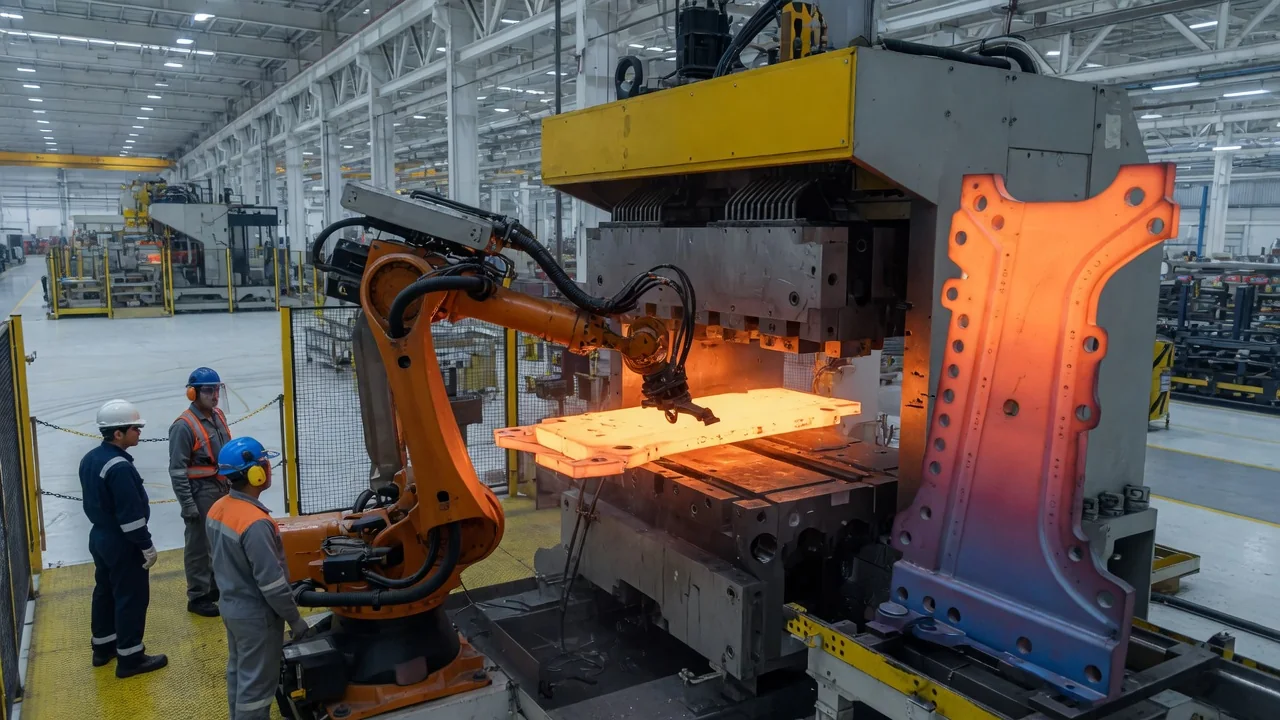
Anyone asking what is hot stamping in car manufacturing is really asking how automakers build a rigid safety cage without adding excessive weight. Hot stamping, also called press hardening, shapes steel while it is red hot and then cools it rapidly inside the die, producing structural parts far stronger than conventional cold-formed panels.
Heating and forming
The process begins with a flat steel blank, usually a boron-alloyed grade chosen because it responds well to heat treatment. The blank travels through a furnace until its internal structure changes and the metal becomes soft and highly formable. A transfer system then moves the glowing sheet quickly into a press, because any delay lets the steel cool in open air and lose the properties the process depends on. Timing between furnace and press is therefore tightly controlled on the production line.
Once the press closes, the die does two jobs at once. It shapes the soft steel into its final geometry, and cooling channels running through the tooling pull heat out of the part while it remains clamped. That rapid quench hardens the steel and locks the shape in place, so the part springs back very little after release. Because the finished piece is too hard to trim easily with ordinary tooling, holes and edges are often cut afterward by laser.
Why strength matters
Strength matters most in the parts that surround occupants. Components such as A-pillars, B-pillars, roof rails, rocker reinforcements, door intrusion beams and bumper beams are common candidates for press hardening, although the exact mix differs from one vehicle to another. These parts are meant to resist deformation in a collision, holding the passenger compartment open while crush zones at the front and rear absorb energy. A pillar that bends too readily would let impact forces reach the cabin.
Higher strength also lets engineers use thinner material for the same level of protection. Thinner sections reduce body weight, which helps fuel economy in combustion vehicles and driving range in electric ones, where the structure must also shield a heavy battery pack. Some parts are deliberately made with softer zones, created by controlling how different areas are heated or cooled, so one section stays rigid while another can fold in a planned way. How a manufacturer applies this tailoring depends on the specific body design.
Repair restrictions
The same heat treatment that gives these parts their strength makes them sensitive to heat during collision repair. Warming a press-hardened component with a torch to pull it back into shape can undo the hardened structure, leaving metal that looks sound but no longer performs as designed. For that reason, body repair guidance from manufacturers generally treats a kinked or bent hot-stamped part as something to replace rather than straighten, and it often limits where heat may be applied nearby.
Joining methods are restricted as well. Manufacturers specify where a part may be sectioned, if at all, and which attachment techniques are acceptable, since conventional welding can soften the surrounding zone. Approved methods might include particular spot welding settings, brazing, structural adhesive or rivets, depending on the vehicle. The hardness of the steel also wears out ordinary drill bits and cutting tools quickly. Because these rules vary by model and even by location on the body, repairers need the vehicle-specific body repair information before starting.
Everyday Use and Observations
In daily driving, hot-stamped parts are invisible. They sit beneath paint, exterior panels and interior trim, and nothing about how a car rides or sounds reveals which pieces were press hardened. The slim windshield pillars on some modern vehicles are one indirect clue, since very strong steel allows a narrower section that improves outward visibility. Otherwise, the benefit shows up only in crash test performance and in how well the cabin holds its shape during a serious impact.
Owners who want to know more can sometimes find a body structure diagram in manufacturer literature, where steel grades are shown in different colors and the ultra-high-strength areas stand out around the door openings and roof. These diagrams differ considerably between models and generations, so one vehicle's layout says little about another's. After a collision, the practical observation is on the repair estimate, where structural parts listed for replacement rather than repair often reflect these material restrictions rather than an overly cautious shop.
Limits and Next Steps
Hot stamping is not used for every panel because it has real drawbacks. Furnaces consume significant energy, cycle times are longer than in cold stamping since each part must cool in the die, and the tooling with its internal cooling passages is costly to build and maintain. Hardened steel also has limited ability to stretch before cracking, which is why it suits parts meant to resist intrusion rather than those designed to crumple. Many blanks need a protective coating to prevent scale forming in the furnace.
For most drivers, the useful next step is simply knowing the material exists and matters after an accident. When structural damage is involved, it is reasonable to ask the repair facility whether it follows the manufacturer's body repair procedures and has the equipment those procedures call for. Buyers of a previously damaged vehicle may want an inspection that looks specifically at pillars, rockers and rails. Details such as which parts are press hardened should always be confirmed for the specific vehicle rather than assumed.