What Is a Body Dolly Tool? Backing Support, Hammer Work and Surface Basics
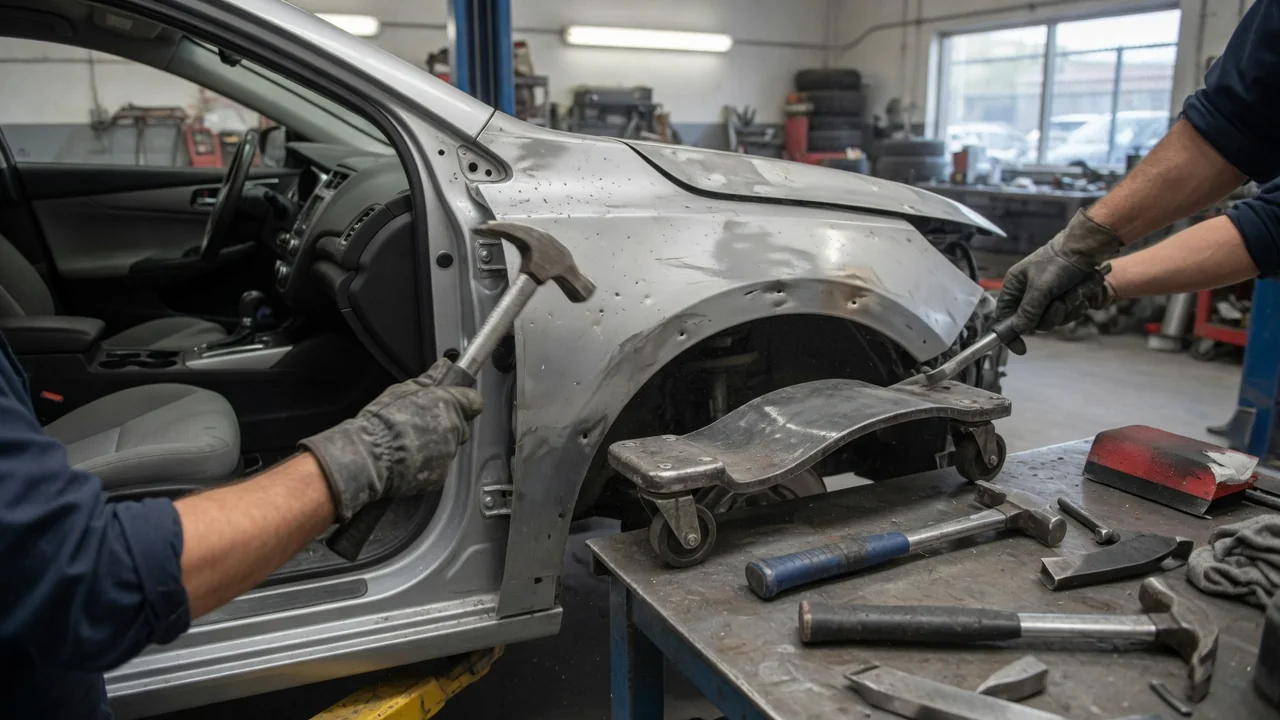
A body dolly is a hand-held block of hardened steel held behind a sheet-metal panel while a body hammer strikes the outside. It is sometimes called a backing dolly or anvil dolly, and it works as a small portable anvil. It gives the hammer something to work against so dents can be raised, ridges lowered and contours restored. If you are starting car body dolly metal work on a classic, knowing what the tool does helps you avoid making damage worse.
Backing support
The main job of a dolly is to supply mass and resistance on the hidden side of a panel. Thin automotive sheet metal flexes and springs back when it is struck without support, so most of the hammer's energy is lost to vibration. With a dolly pressed against the back, the panel is held between two hard surfaces, and the force goes into reshaping the metal instead of bouncing it. Because the dolly is held by hand rather than fixed to a bench, it also reacts to each blow. It rebounds slightly, pushes back against the metal, and can be moved to follow the work across the panel.
Dollies come in a range of shapes because car panels have many different contours. Common types include the general-purpose or rail dolly, heel and toe dollies with flat and gently curved faces, wedge dollies for tight spaces and flanges, and rounded egg or comma shapes for compound curves. A basic rule is to choose a face that matches the original contour of the panel, or one with slightly less curvature. A face with too much crown concentrates force on a small spot and can leave dimples. A face that is too flat can push a curved panel toward flatness and change its shape.
Hand pressure is part of the backing support. Firm pressure holds the dolly tight to the metal and resists the hammer more strongly. Lighter pressure lets the dolly bounce and gives a softer effect. A dolly can also be used alone, bumping a low area outward from behind before any hammering begins, which roughs out the general shape.
Hammer work
There are two basic techniques. The first is hammer-on-dolly. Here the hammer lands directly over the dolly, so the sheet is squeezed between the two steel faces. Light, controlled blows smooth small irregularities and bring metal level. Heavier or repeated blows thin the metal and spread it outward, which means the panel is being stretched. Some stretching is useful for raising a shallow low spot, but too much leaves excess metal. That excess has nowhere to go and can make the panel bulge or pop in and out, a condition often called oil canning.
The second technique is hammer-off-dolly. The dolly is held under a low area while the hammer strikes a nearby high area, such as the ridge at the edge of a dent. The hammer pushes the high metal down, and the reaction of the dolly lifts the low metal up. Because the sheet is not trapped between two hard faces at the point of impact, this approach moves metal back into place with much less stretching. For that reason it is often the preferred method for the main straightening work on a damaged panel.
A common working sequence is to rough out the damage first, then use off-dolly blows to bring highs and lows closer together, and save on-dolly work for final smoothing, often called planishing. Pick a hammer face whose crown suits the area being worked, and let the hammer rebound naturally rather than driving it into the metal. Many controlled light blows usually give more predictable results than a few hard ones.
Surface
The condition of the dolly's working faces directly affects the panel. During on-dolly work the sheet is pressed hard against the dolly, so any nick, gouge, weld spatter or embedded grit can transfer as a mark into the metal. For this reason dolly faces are usually kept smooth and polished. Dressing out damage with fine abrasives, wiping away debris before use and storing dollies so they do not knock against other tools or rust all help keep the surface in usable condition.
The panel surface matters as well. Undercoating, sound deadener, seam sealer, heavy rust or old body filler can prevent the dolly or hammer from making clean contact with the metal and make the results hard to judge. Exposing bare metal on the working side, and where practical on the back, lets you see and feel what is happening. Running a flat hand over the area, or lightly stroking it with a body file, shows high spots as bright marks and low spots as untouched areas. That pattern indicates where the next dolly placement and hammer blows should go.
A well-matched dolly and hammer with clean faces can bring a panel close to its original contour and reduce the amount of filler needed before paint. Whether a panel can be finished without any filler depends on the damage, the condition of the metal and the skill of the person doing the work.
Practical implications and limits
A dolly only works where you can reach behind the panel. Inner panels, reinforcement braces, boxed sections and double-skinned areas such as some door edges, roof rails and quarter panels can block access. In those spots, restorers may remove interior trim or inner panels, use body spoons or long pick tools that reach into narrow gaps, or turn to stud-welding and pulling methods that work from the outside. Access varies greatly between vehicles, so check how a particular panel is built before choosing a method.
A dolly also cannot fix every kind of damage. Metal that has already been stretched by an impact or by too much on-dolly hammering usually needs shrinking, for example with controlled heat or a shrinking disc, before it will sit flat. Sharp creases from heavy collision damage may need pulling or sectioning, and metal badly thinned by rust can tear or weaken further under the hammer, which often makes repair panels or patch sections the better choice. Panel thickness and alloy differ from one vehicle to another, and aluminum panels mark and stretch differently from steel. Factory service information for a specific car is the right reference for its construction details.
In everyday use, results come from practice more than from the tool itself. Working on a scrap panel first is a low-risk way to learn how hand pressure, blow strength and dolly position change the metal. Eye and hearing protection are sensible during hammering, and gloves help with sharp edges on damaged sheet metal. Understood this way, a body dolly is a simple tool whose effect depends on how carefully it is chosen, placed and maintained.