What Is a Composite Leaf Spring? Layers, Load Response and Uses
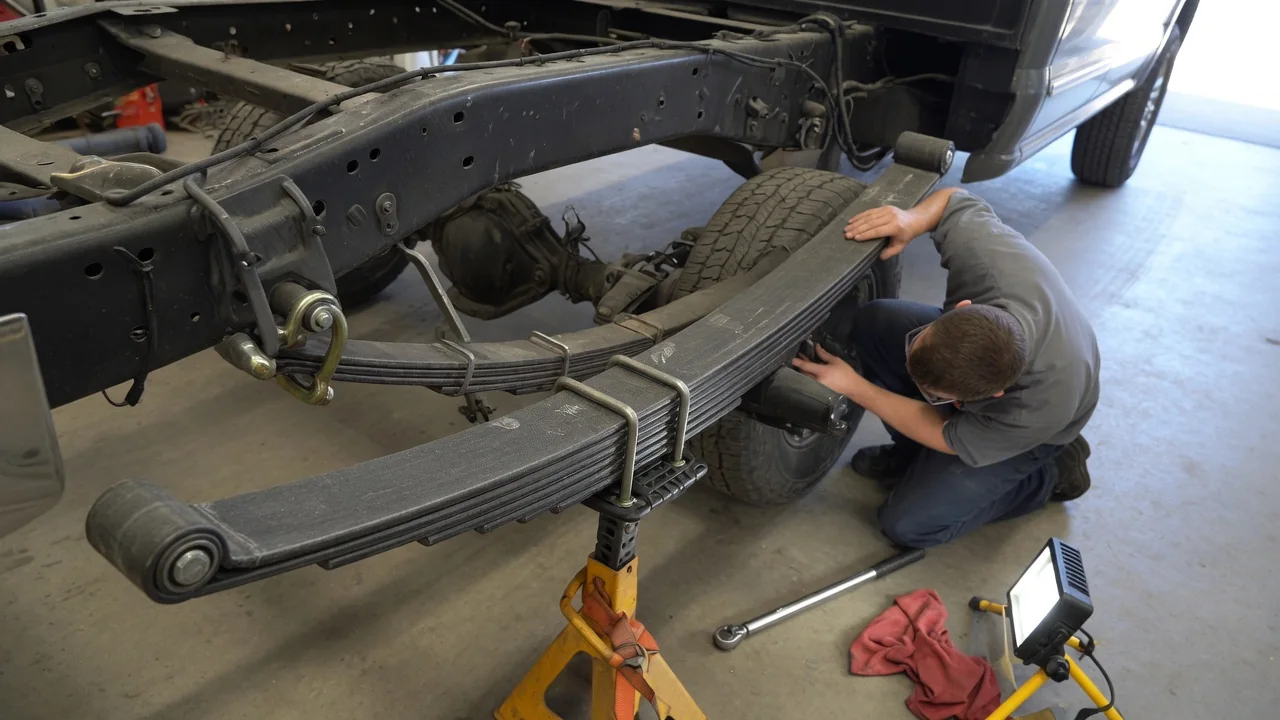
A composite leaf spring is a suspension spring made from fiber-reinforced polymer instead of stacked steel leaves. It does the same basic job as a conventional leaf spring: it locates the axle, carries vehicle weight, and flexes to absorb road inputs. The difference is in how the material is built and how it behaves under load. This guide explains what an automotive composite leaf spring is made of, how it responds to loads, where it is used, and what that means for owners.
Material Layers: Fibers, Resin, and Fittings
Most composite leaf springs are built from glass fibers embedded in a thermoset resin matrix, commonly an epoxy or a similar polymer system. The fibers carry most of the load. The resin holds them in position, transfers stress between them, and protects them from abrasion and moisture. Glass fiber is the usual choice because it combines good strength and flexibility at a reasonable cost. Carbon fiber is stiffer and lighter but considerably more expensive, so it appears less often in production suspension springs.
The spring is formed by stacking many thin layers, or plies, and curing them under heat and pressure, often in a mold that sets the final arch. In the main body, most fibers run lengthwise along the spring, because that is the direction of the bending stresses. Designers may add plies at other angles near the surface or around mounting areas to improve resistance to twisting, splitting, and local clamp loads. Unlike a multi-leaf steel pack, a composite spring is frequently a single leaf whose thickness and width vary along its length. That shape spreads stress more evenly instead of concentrating it at the center clamp.
The ends need a way to attach to shackles and hangers. Depending on the design, eyes may be molded into the composite, or separate metal end fittings may be bonded or clamped to the spring. Around the axle seat, a clamp or saddle spreads the clamping force so the laminate is not crushed. Many springs also carry an outer protective coating or wrap that shields the fibers from stone impacts, ultraviolet light, and road chemicals. These interface parts are as important to the assembly as the laminate itself.
Load Response: How a Composite Spring Bends and Recovers
When weight is applied, a leaf spring bends between its mounting points. One face of the spring is stretched in tension while the opposite face is compressed. A plane near the middle of the thickness, called the neutral axis, sees little of either. In a composite spring, the lengthwise fibers resist this stretching and compressing, which is why fiber orientation matters so much. Because the layers are bonded together by resin, bending also tries to make them slide past one another. This interlaminar shear, carried by the resin between plies, is a key design limit for composite springs and one reason laminate quality and the curing process are tightly controlled.
Glass-fiber composites are much less stiff than spring steel for the same thickness, but they can tolerate more strain before damage and are far less dense. In practical terms, a composite spring is usually thicker than a steel leaf of similar rate, yet it can store a comparable amount of energy at a fraction of the weight. A lighter spring also lowers unsprung mass, which generally helps the wheel follow the road surface. A single composite leaf avoids the rubbing between stacked steel leaves, so it has little interleaf friction. Any damping comes mainly from the resin itself and from the shock absorbers, which remain responsible for controlling suspension motion.
Repeated loading is where composites are often attractive. Fiber-reinforced polymers generally resist fatigue well and do not rust, although the resin can be affected by heat, moisture, and some chemicals over time. Damage also tends to develop differently than in steel. Instead of a crack growing until a leaf snaps, a composite may show matrix cracking, broken surface fibers, or separation between layers. How visible and gradual that process is depends on the specific design, so it should not be assumed that every composite spring gives the same warning.
Applications in Vehicles and Trailers
Composite leaf springs are used where designers want the packaging and axle-location benefits of a leaf spring with less weight. Light commercial vans and pickup trucks are common candidates, because their rear suspensions already rely on leaf springs and weight saved in the chassis can go toward payload or efficiency. Some passenger cars use a composite leaf mounted across the vehicle rather than lengthwise. In that layout, a single transverse spring can take the place of a pair of coil springs and may also contribute to roll resistance.
Beyond cars and light trucks, composite springs appear in trailers, specialty and off-road vehicles, and heavier commercial and rail equipment, where corrosion resistance and reduced maintenance can matter as much as weight. Aftermarket suppliers also offer composite replacement or helper springs for some applications. Whether a particular vehicle uses a composite spring, and which design it uses, varies by manufacturer, model, and configuration. The vehicle's service information is the reliable reference, not assumptions based on vehicle type.
Practical Implications and Limits for Owners
Composite springs require different handling than steel. They should not be heated, welded, drilled, ground, or cut, and they should not be used as a jacking or lifting point unless the manufacturer allows it. Mounting hardware matters: clamp bolts, U-bolts, and saddles are typically specified with particular torque values and sometimes as one-time-use parts, because overtightening can crush the laminate and undertightening can let it shift. Following the vehicle's repair manual for removal and installation is the correct approach.
During inspection, look beyond ride height. Chipped or worn protective coating, deep gouges from road debris, cracks in the resin, whitened areas, or separated layers can all indicate damage worth evaluating. Spills of battery acid or strong solvents should be cleaned off promptly. Repairs to the laminate itself are generally not a do-it-yourself job; a damaged composite spring is normally replaced rather than patched, and the manufacturer's criteria decide what condition is acceptable.
Load limits still apply. A composite spring is designed for a defined rate and capacity, and loading a vehicle beyond its ratings can damage it just as it can damage steel. Swapping between steel and composite springs, or adding spacers and helper springs, changes ride height, load capacity, and handling and may require different mounting parts, so it should only be done with components approved for that vehicle. Within those limits, a composite leaf spring is simply a lighter, corrosion-resistant way to do a leaf spring's job.