Why Did Older Cars Use Leaf Springs?
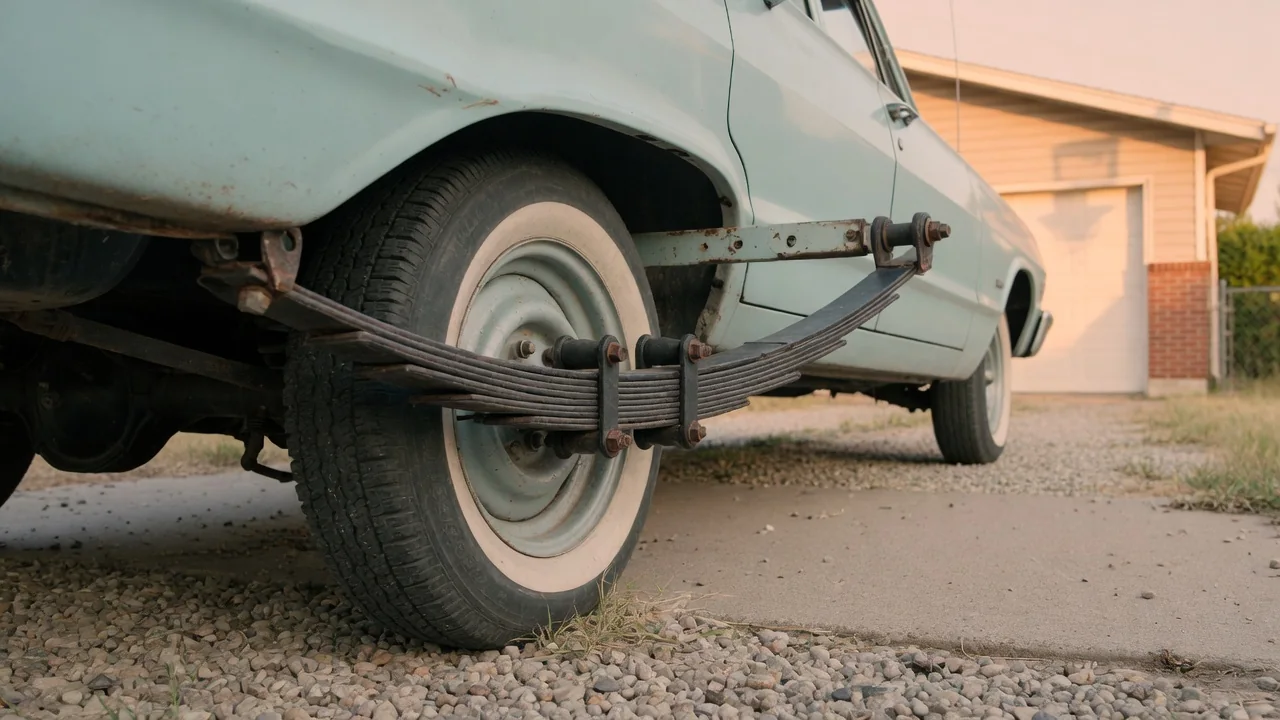
People who ask why did older cars use leaf springs are usually looking at a classic sedan or pickup and noticing how little hardware sits under it. The short answer is that one stack of curved steel could carry the weight, cushion the ride, and hold the axle in position, which kept early suspension construction simple, strong, and affordable to build.
Spring shape
A leaf spring is a long, flat strip of spring steel formed into a gentle arc. The most familiar layout is the semi-elliptical spring, which looks like a shallow bow with its ends attached to the frame and its center clamped to the axle. Several strips of decreasing length are usually stacked together, with the longest, called the main leaf, rolled into a loop or eye at each end. When a wheel hits a bump, the arc flattens slightly and then recovers, absorbing the impact.
That shape came straight from horse-drawn carriages, so early automakers already had the tooling, the suppliers, and the know-how to make it. Stacking leaves also let engineers tune stiffness by adding or removing strips without redesigning anything else. Looking under an older vehicle, you may see anything from a couple of leaves on a light car to a thick pack on a heavy truck. Some designs mounted a single spring crosswise instead of two lengthwise, so the arrangement varies considerably between makes and eras.
Axle support
The strongest reason for the design's long life is that a leaf spring does more than spring. Because it is bolted firmly to the axle and anchored to the frame at both ends, it also locates the axle front to back and side to side. A coil spring can only push up and down, so it needs separate control arms, links, or rods to keep the axle from wandering. With leaves, those extra parts were unnecessary, which meant fewer components to manufacture, fit, and maintain.
On a typical rear-wheel-drive car of the period, the springs also resisted the twisting force the axle produces under acceleration and braking, and they spread the vehicle's load across two widely spaced points on each frame rail. Underneath, you can usually spot U-bolts clamping the axle to the spring pack, a fixed mount at one end, and a swinging shackle at the other that lets the spring lengthen as it flattens. Whether the axle sits above or below the spring differs by vehicle and affects ride height.
Ongoing applications
Leaf springs never disappeared; they simply moved to the jobs where their strengths matter most. Many pickup trucks, cargo vans, heavy commercial vehicles, and trailers still carry them at the rear, because a spring pack handles heavy and changing loads well and spreads that weight along the frame. Some packs include extra helper leaves that only come into contact when the vehicle is loaded, giving a softer ride when empty and more support when hauling or towing.
Passenger cars largely moved to coil springs, struts, and independent suspension as buyers came to expect a smoother ride and sharper handling, and as unibody construction changed how loads are fed into the body. The leaf concept has also evolved, with some vehicles using a single tapered leaf or a composite spring mounted crosswise rather than a traditional steel stack. Which arrangement a particular model uses depends on the manufacturer, the model year, and the intended duty, so a visual check or the service information is the reliable guide.
Everyday Use and Observations
On the road, a leaf-sprung vehicle tends to feel firm and a little busy when lightly loaded, then settles down with weight on board. Part of this comes from the leaves rubbing against each other as they flex, which provides some natural damping but also adds stiffness over small bumps. Under hard acceleration, an older car may show the axle winding up and releasing, felt as a shudder or hop from the rear. These traits were accepted trade-offs when durability and low cost mattered more than refinement.
Age shows up in ways an owner can often notice. A vehicle that sits lower at the back, or leans to one side, may have springs that have lost some of their arch. Squeaks over bumps often point to dry or worn contact between leaves or tired bushings in the spring eyes and shackles. Rust between the leaves, a cracked or shifted leaf, and loose clamps are also visible signs. How quickly these develop depends heavily on climate, load history, and the original design.
Limits and Next Steps
The same simplicity that made leaf springs attractive also set their limits. Because the spring both carries the load and locates the axle, engineers cannot tune ride comfort and axle control independently, and a solid axle on leaves ties the two wheels together so a bump on one side disturbs the other. The assembly is heavy, adds unsprung weight, and takes up length under the vehicle. Coil and link systems separate those duties, which is why they eventually took over on most cars.
For anyone owning or shopping for a leaf-sprung classic or truck, a careful look underneath is a sensible starting point, comparing ride height side to side and checking the leaves, mounts, and bushings for obvious damage or corrosion. Suspected sagging or broken leaves deserve a professional inspection, since springs store considerable energy and support the vehicle's weight, making this unsuitable work for improvised methods. Replacement parts, load ratings, and correct ride height are specific to each vehicle, so confirm them against information for that exact model.