What Is a Car's Frontal-Pressure Zone?
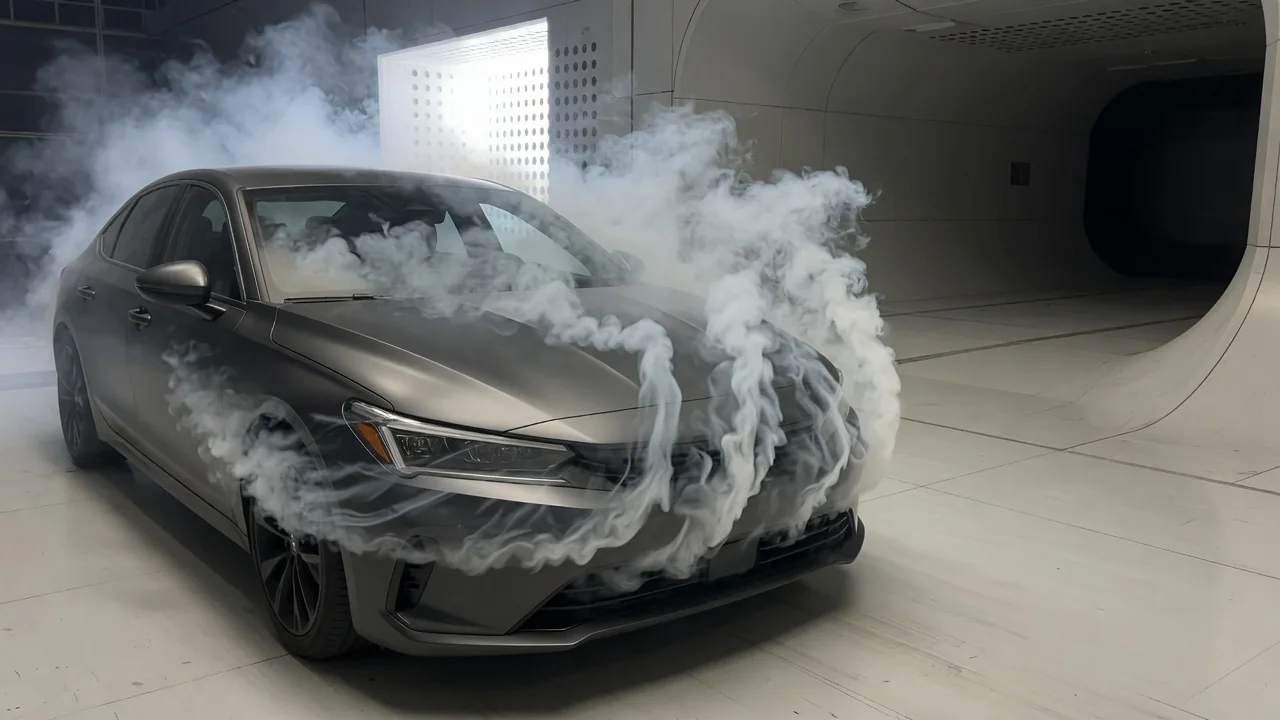
A car's frontal-pressure zone is the area at the nose of the vehicle where oncoming air slows down, piles up, and pushes on the body with more force than the surrounding atmosphere. This is where the air first meets the car. It affects three things owners notice indirectly: how air reaches the radiator and cabin, how hard the powertrain works at speed, and how changes to the front end affect the vehicle.
Impact airflow
When a car moves forward, the air directly ahead cannot pass through the bumper, so it has to slow down and turn. Somewhere on the front face, usually near the bumper or grille, there is a point where the air's speed relative to the car drops to almost zero. Aerodynamicists call this the stagnation point. At that point, the energy of the moving air turns into pressure, so local pressure reaches its highest value anywhere on the vehicle. A broader area of raised pressure forms around that point, and that area is what people usually mean by the front air pressure zone of a car. The term describes the effect rather than serving as a strict engineering label, but the physics behind it is well established.
The pressure rise depends on dynamic pressure, which is proportional to air density and to the square of speed. Doubling road speed therefore roughly quadruples the pressure available at the nose. The shape of the front end decides how that pressure is spread out. A tall, flat front face spreads high pressure over a wide area. A rounded or sloped nose lets the air split earlier and turn more smoothly over the hood, under the bumper and around the corners. As air speeds up around those curved edges, its pressure falls, sometimes below the surrounding air pressure. The front of a car therefore typically has a central high-pressure area surrounded by bands of lower pressure where the flow speeds up again. A second, smaller high-pressure area commonly forms at the base of the windshield, where air flowing up the hood meets the steeply angled glass.
Cooling intake
The frontal-pressure zone is useful because it supplies free pressure that can push air through the vehicle. Grille openings and lower bumper intakes are generally placed in or near this area. The raised pressure in front of the heat exchangers then drives air through the radiator, the air-conditioning condenser and, where fitted, intercoolers or other coolers. What actually moves the air is the pressure difference between the intake side and the exit side. Air leaving the radiator needs a lower-pressure place to go, such as the underbody, the wheel areas or, on some designs, vents in the hood. The cabin ventilation intake is often placed at the cowl just below the windshield for a similar reason, since that area tends to see raised pressure at speed.
Heat exchangers resist airflow, so not all the air that arrives at the grille passes through them. Some of it spills around the core instead. Engineers use seals, shrouds and ducting to keep air from bypassing the radiator. Because ram pressure grows with the square of speed, it is weak in slow traffic and at idle. In those conditions, electric or engine-driven cooling fans supply the airflow the car needs. Many modern vehicles also use active grille shutters, which close the openings when little cooling is needed and open them when more heat must be removed. How much opening a vehicle needs depends on its powertrain, climate and typical use, so intake layouts vary widely between designs.
Drag
Aerodynamic drag on a passenger car comes mostly from pressure differences rather than from friction along the surface. High pressure on forward-facing surfaces pushes the car backward. Low pressure in the turbulent air trailing behind the vehicle, called the wake, also pulls it backward. The frontal-pressure zone is one contributor to the overall drag, but it is not the whole story. On a well-shaped front end, the low-pressure bands where air speeds up around rounded edges partly offset the high pressure at the stagnation area. As a result, the front contributes less drag than its peak pressure might suggest. Sharp edges that cause the airflow to break away from the body lose that benefit and can noticeably add drag.
Air that passes through the cooling system also adds resistance, often called cooling drag. The air loses momentum as it squeezes through the heat-exchanger cores, and it then exits into areas where it can disturb the flow under the car or around the wheels. This is the main reason for grille shutters and careful duct design: they let engineers supply only the airflow the engine or battery system needs. Drag force is commonly calculated by multiplying dynamic pressure by a drag coefficient and the car's frontal area. Since dynamic pressure grows with the square of speed, the power needed to overcome drag grows roughly with the cube of speed. That is why front-end aerodynamics matters most on the highway.
Practical implications and limits
For owners, the most direct effect concerns anything mounted on or in front of the nose. Accessories such as brush guards, auxiliary light bars, winter grille covers or large front license plate brackets change where pressure builds and how much air reaches the openings. Covering part of the grille reduces the air available to the radiator and condenser. That can mean higher operating temperatures or weaker air conditioning in hot weather, while towing, or on long climbs. Insects, leaves and other debris trapped between the condenser and radiator have a similar effect, so keeping that area clear is a sensible part of routine cleaning. Whether a specific modification causes a measurable problem depends on the vehicle. Only the manufacturer's guidance or actual testing can answer that.
The concept also has limits. The frontal-pressure zone is not a fixed outline on the bumper. Its size and position shift with speed, ride height, the car's pitch, and crosswinds that make the air approach at an angle. Two cars with similar-looking noses can behave differently because small details change the airflow, such as how rounded the edges are, where the intakes sit and how well the underbody is sealed. General principles explain why grilles are placed where they are and why front-end shape matters. They cannot predict cooling margins or fuel-economy effects for an individual model. Those figures come from wind-tunnel testing, computer simulation and road validation during development.