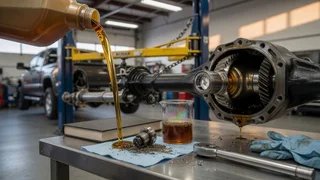
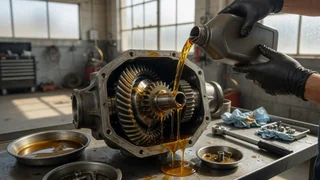
Valvoline 75W-140 Gear Oil: What to Check Before You Buy
The short answer
Valvoline 75W-140 gear oil is a heavy-viscosity lubricant for hypoid differentials and axles, mainly in trucks and vehicles that tow, haul or run hot. It suits your vehicle if your owner's manual or axle tag calls for SAE 75W-140 and an API GL-5 rated oil. Two conditions change the answer most often. If you have a clutch-type limited-slip differential, you need to confirm the oil includes friction modifier or add one. If your manual specifies a lighter grade such as 75W-90, or the component is a manual transmission or transfer case, 75W-140 is usually the wrong choice.
What 75W-140 means
Gear oil grades follow a separate SAE scale from engine oil, so the numbers are not directly comparable to motor oil ratings. The 75W part describes cold-temperature performance: the oil stays fluid enough to protect gears during cold starts. The 140 part describes thickness at operating temperature. A 140-grade oil keeps a thicker protective film than a 90-grade oil when the differential is hot, which is why it is specified for heavy loads, towing and high ambient temperatures.
The trade-off is that a thicker oil creates more internal drag. In a vehicle designed for a lighter grade, switching to 75W-140 can slightly reduce efficiency and may not improve protection in normal driving.
Which Valvoline product you are likely looking at
Valvoline's 75W-140 gear oil is commonly sold as a full synthetic product in its gear oil range. Product names, packaging and formulations can change over time and differ between retailers, so read the label on the specific bottle rather than relying on a listing photo or an older review. The label is where you confirm the viscosity grade, the API service category, any OEM approvals and whether limited-slip friction modifier is included.
Checks before you buy
Check | What to look for | Why it matters; Required grade | Owner's manual, service information or axle tag lists 75W-140 | Using a different grade than specified is the most common mistake; Service rating | API GL-5 on the label | GL-5 is the standard for hypoid gears in most differentials; Limited-slip type | Clutch-type LSD, gear-type (helical), locker or open differential | Clutch-type units typically need friction modifier; Friction modifier | Label states it is suitable for limited-slip, or plan to add a separate modifier | Missing modifier can cause chatter in clutch-type differentials; OEM requirement | Any manufacturer specification number listed in your manual | Some vehicles call for a specific approval, not just a grade; Quantity | Fill capacity for your axle from the manual, front and rear separately | Capacities vary by axle model, not just by vehicle; Vehicle details | Model year, trim, axle code and drivetrain | The same model can use different axles and fluids across versions
Confirm the specification for your exact vehicle
Fluid requirements are tied to the axle, not just the vehicle name. A truck model may use one axle in one model year and another later, or a different axle depending on trim, engine, towing package or gear ratio. Front and rear differentials on the same 4x4 often take different oils. Check the owner's manual for your model year, look for an axle code on the door-jamb sticker or a tag bolted to the differential cover, and match the fluid to that axle. If sources disagree, follow the manufacturer's information for your specific build.
Limited-slip differentials
A clutch-type limited-slip differential uses friction plates that need a specific frictional behavior to engage smoothly. Without the right additive, they can chatter or groan during tight turns, such as in parking lots. Some gear oils include friction modifier already; others require you to add it separately. Some manufacturers specify their own additive in a set amount.
Gear-type limited-slip units, electronic lockers and open differentials generally do not need added friction modifier. If you are unsure which type you have, the build sheet, axle code or a dealer parts department can identify it.
When 75W-140 is not the right choice
Your manual specifies 75W-90, 80W-90 or another grade for normal service. The component is a manual transmission, many of which require GL-4 or a dedicated transmission fluid to protect brass synchronizers. The component is a transfer case, which often uses automatic transmission fluid or a specific transfer case fluid. The front differential calls for a lighter oil than the rear. The manufacturer requires a specific approved fluid that the bottle does not list.
Switching from 75W-90 to 75W-140
Some owners consider moving up to 75W-140 for towing or hot climates. Some manufacturers allow or recommend the heavier grade for severe-duty use, while others do not. Check whether your manual lists 75W-140 as an option for towing or severe service. If it does not, the heavier oil is unlikely to bring a meaningful benefit and adds drag. If it does, follow any change interval the manual sets for severe service.
Practical buying tips
Buy enough to fill each axle completely, plus a small margin for spills. Check that bottles are sealed and the labels are intact, especially from third-party marketplace sellers. Pick up a new differential cover gasket or a suitable sealant, and a fill-plug washer if your axle uses one. A simple hand pump or squeeze-bottle adapter makes filling through the fill plug much easier. If a separate friction modifier is required, buy it at the same time so the job is not delayed. Keep the receipt and note the date and mileage of the change for warranty records.
How often to change it
Follow the interval in your owner's manual. Many manufacturers list a shorter interval for severe service, which typically includes frequent towing, heavy loads, off-road driving or water crossings. If a differential has been submerged, inspect the fluid for a milky appearance, which indicates water contamination and calls for a change regardless of mileage.
Bottom line
Valvoline 75W-140 gear oil is a reasonable choice when your axle is specified for SAE 75W-140 GL-5 oil. Before buying, confirm the grade for your exact model year and axle, check whether your differential is a clutch-type limited-slip that needs friction modifier, and buy enough for the correct fill capacity. If your manual calls for a lighter grade or a different fluid type, choose that instead.