Valvoline 85W-140 Gear Oil: What to Check Before You Buy
Valvoline 85W-140 gear oil is a good choice only if the equipment you are servicing calls for an 85W-140 viscosity grade and the matching performance category. In most cases that means a heavy-duty or older differential that needs API GL-5 hypoid gear oil. If your owner's manual or service information specifies a different grade, such as 75W-90 or 80W-90, or a different fluid type altogether, such as automatic transmission fluid or a GL-4 manual transmission oil, this is not the right product, whatever brand is on the bottle. The rest of this guide explains how to confirm the fit and what to check on the label before you buy.
The short answer: when 85W-140 makes sense
85W-140 is one of the thickest common gear oil grades. It is typically specified for differentials and final drives that carry heavy loads or run hot, such as some heavy-duty pickup and commercial truck axles, older rear-wheel-drive vehicles, trailers with gear-driven components, and certain agricultural or industrial equipment. Most modern passenger cars and light trucks are designed around thinner grades, and many newer axles require synthetic fluid. Two conditions change the answer most often:
The manufacturer specifies a different viscosity grade. Follow the specification, not the general idea that thicker oil protects better. The gear set needs a particular additive or approval, such as limited-slip friction modifier, a GL-4 rating for synchronized manual gearboxes, or a manufacturer-specific fluid approval.
What "85W-140" actually means
Gear oil viscosity grades follow the SAE J306 standard, which is separate from the engine oil grading system. An 85W-140 gear oil is therefore not comparable to a 140-weight engine oil. The two numbers describe the oil's behavior at different temperatures.
85W: the low-temperature rating. The "W" stands for winter. A higher number before the W means the oil is thicker when cold and flows more slowly at startup in low temperatures. 140: the high-temperature rating. It describes how thick the oil stays at operating temperature. A higher number means a thicker oil film under heat and load.
Compared with 75W-90 or 80W-90, an 85W-140 oil is noticeably thicker both cold and hot. In heavily loaded, hot-running axles that helps maintain film strength. The trade-off is slower cold-weather flow, more drag, and potentially lower efficiency. If you operate in very cold climates, check whether your equipment's documentation lists a temperature range for this grade or an alternative grade for cold conditions.
Start with equipment identification
Gear oil requirements are tied to the specific axle or gearbox, not just the vehicle name. Two trucks of the same model can use different axles depending on model year, market, trim, towing package, or powertrain. Before you buy, identify exactly what you are filling.
Owner's manual or service manual: the most direct source for the lubricant specification, fill quantity, and service interval. Axle tag or stamping: many differentials carry a metal tag under a cover bolt or a cast or stamped code identifying the axle model and gear ratio. Some tags also indicate a limited-slip unit. VIN-based lookup: a dealer parts counter or a parts catalog can often decode the build configuration from the vehicle identification number. Equipment data plate: for tractors, trailers, and industrial gearboxes, the data plate and operator's manual usually list the required lubricant. Fill plug or cover markings: some housings are labeled with fluid type or a limited-slip warning.
If the sources disagree, for example a generic catalog suggests 80W-90 while your service manual lists 85W-140 for heavy-duty use, follow the documentation for your exact configuration and operating conditions. If you cannot resolve the difference, a dealer service department for your make is the practical tiebreaker.
What to check on the bottle
Valvoline has sold gear oils under more than one product line, and formulations, labels, and approvals can change over time. Read the label of the specific bottle you are buying rather than assuming all Valvoline 85W-140 products are identical. These are the points that matter:
What to check | Why it matters | What to look for; Viscosity grade | Must match the specified grade | "SAE 85W-140" printed on the label; API service category | Determines extreme-pressure additive level | GL-5 is the usual requirement for hypoid differentials; confirm against your manual; Limited-slip compatibility | Clutch-type limited-slip units may need friction modifier | Label wording such as "limited-slip" or "LS", or instructions to add a separate friction modifier; Base oil type | Affects cold flow, heat tolerance, and sometimes manufacturer approval | Conventional, synthetic blend, or full synthetic, as stated on the label; Manufacturer approvals | Some axles require a specific approved fluid | OEM specification numbers listed on the label that match those in your service information; Quantity per container | Helps you buy enough for one service | Container size compared with your axle's fill capacity
GL-5 vs. GL-4: avoid the most common mismatch
API GL-5 oils contain a high level of extreme-pressure additives designed for hypoid gears, which slide against each other under heavy load in most rear differentials. Some older manual transmissions and transaxles with brass or bronze synchronizers are specified for GL-4 instead. In those units, a GL-5 oil may affect shifting feel or, depending on formulation, be less compatible with yellow metals. Some products are labeled as meeting both GL-4 and GL-5. If your manual calls for GL-4 only, confirm the label explicitly covers GL-4 before using it. An 85W-140 grade is rarely specified for synchronized passenger-car manual gearboxes in any case, so if you are servicing a manual transmission, double-check that 85W-140 is really what is called for.
Limited-slip differentials
Clutch-type limited-slip differentials rely on friction plates that can chatter or grab during tight turns if the oil lacks the right friction characteristics. Some gear oils include a limited-slip friction modifier already. Others require a separate additive, and some manufacturers require their own additive. Check three things: whether your axle is limited-slip (axle tag, build sheet, or a label near the fill plug), what your service manual says about friction modifier, and whether the specific bottle states limited-slip compatibility. Gear-type or locking differentials may have different requirements, so do not assume all traction-enhancing axles need the same treatment.
Conventional or synthetic?
If your manufacturer specifies synthetic gear oil, use synthetic. Some axles, particularly in newer vehicles, are filled with synthetic at the factory, and service intervals or warranty terms may assume it. Where conventional 85W-140 is permitted, a synthetic of the same grade and service category generally offers better cold-temperature flow and heat resistance, which can be useful for heavy towing or wide temperature swings. It usually costs more. Conventional oil remains a reasonable choice when it meets the specification and the equipment runs in moderate conditions on a normal service schedule.
Fill quantity: buy enough for one service
Fill quantity varies widely between axles, and it can change with housing size, ring gear diameter, and whether the axle is front or rear. Look up the capacity for your exact axle in the service information. If you are servicing both front and rear differentials on a four-wheel-drive vehicle, check whether they share the same fluid specification. They often do not, and a transfer case usually takes a different fluid entirely. Buying one extra container is a practical hedge against spills and against capacities that turn out slightly higher than expected.
Level check basics
Most conventional differentials do not have a dipstick. The usual method is to check level at the fill plug, though some designs differ, so confirm the procedure for your axle.
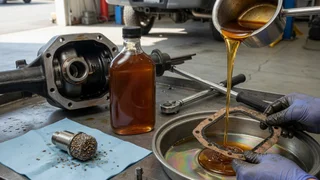
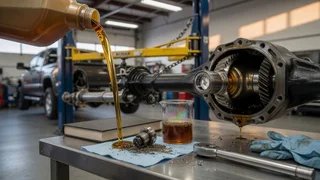
Park on level ground so the reading reflects the true level. Loosen the fill plug before the drain plug. If the fill plug is seized, you will not be stuck with an empty axle you cannot refill. On many axles, the correct level is at or just below the bottom edge of the fill hole. Some manufacturers specify a measured distance below the hole instead. If oil is low, look for leaks at the pinion seal, axle seals, or cover gasket before simply topping up. Note the oil's condition. A strong burnt smell, a milky appearance (which suggests water contamination), or heavy metallic paste on a magnetic drain plug are reasons to change the oil and investigate further.
Service interval
Gear oil intervals come from the vehicle or equipment manufacturer and often have separate normal and severe-service schedules. Severe service commonly includes frequent towing, hauling near maximum capacity, off-road use, and driving through water deep enough to reach the axle vents or seals. If an axle has been submerged, many manufacturers recommend checking the oil for water contamination regardless of mileage. A new or rebuilt differential may also have a break-in oil change requirement. Check the instructions that came with the gear set or rebuild.
Manufacturer approval and warranty
For vehicles still under warranty, using a fluid that meets the specified grade, service category, and any listed approval is what matters. The brand itself generally does not. If your service information lists a specific OEM fluid specification number, check that the bottle states it meets that specification. Keep receipts and note the product name and date of service, so you can show that the correct fluid was used if a driveline claim ever comes up.
Quick buying checklist
Confirm the axle or gearbox model for your exact model year, trim, and powertrain. Confirm the manufacturer specifies SAE 85W-140 for your operating conditions. Match the API service category (usually GL-5 for hypoid differentials; GL-4 where required). Check limited-slip requirements and whether a separate friction modifier is needed. Decide between conventional and synthetic based on the specification and how you use the vehicle. Check the fill quantity and buy enough containers, plus a margin. Have a new cover gasket or sealant and any crush washers your plugs require. Note the service interval and whether your use counts as severe service.
Common mistakes to avoid
Choosing 85W-140 because thicker seems safer when the manual calls for a lighter grade. Using gear oil in a transfer case or transmission that requires ATF or a dedicated fluid. Skipping friction modifier in a limited-slip axle that needs it, then mistaking the resulting chatter for a mechanical fault. Assuming front and rear axles take the same oil without checking. Draining before confirming the fill plug can be removed. Topping up repeatedly without fixing a leaking seal.