Rear Axle Shaft Diagram: Identify the Shaft and Its Parts
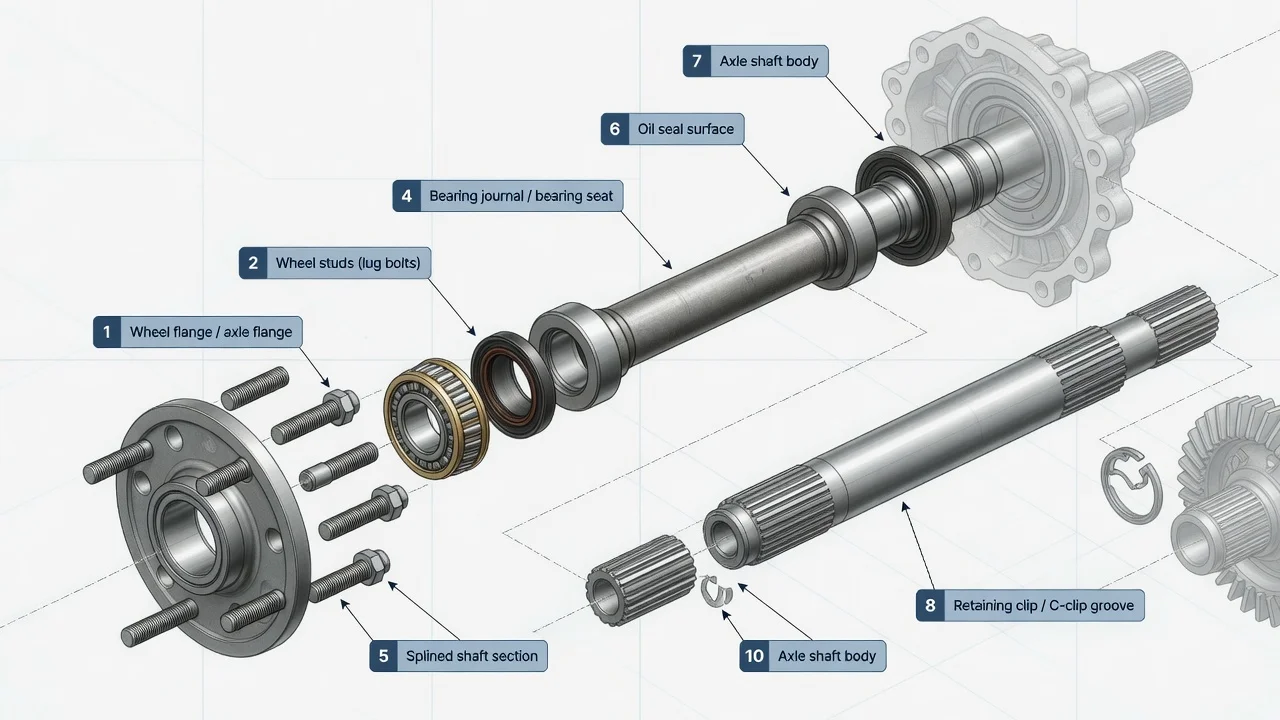
A rear axle shaft diagram shows the steel shaft that links the differential to a rear wheel, along with the bearing, seal and retention hardware around it. A diagram is easier to read once you know which axle design your vehicle uses, because the same part names can refer to different parts. This guide walks through each section of the shaft, explains what it does, and shows how to match a diagram to your own vehicle.
What a rear axle shaft diagram shows
On a rear-wheel-drive or four-wheel-drive vehicle with a solid rear axle, each side has one axle shaft running inside the axle housing tube. A typical diagram draws the shaft horizontally. The differential sits at one end and the wheel mounting flange at the other. The bearing and seal appear near the outer end, where the shaft exits the housing. Most diagrams label the same core pieces, even though the shapes differ between manufacturers.
Diagrams usually label these rear axle shaft parts: the inner splined end, the shaft body, the bearing journal, the wheel bearing, the axle seal, a retention device (a C-clip or a bearing retainer plate), and the outer flange with its wheel studs. Exploded views may also show the brake backing plate, gaskets, retainer bolts and, on some designs, a separate hub. Not every vehicle uses every item, so a diagram for a different axle can mislead you.
Parts of the rear axle shaft from end to end
The inner end has external splines that slide into the differential side gear. These splines carry rotation from the differential to the shaft. On C-clip axles, a groove near the tip holds a small C-shaped clip inside the differential. The tip itself, sometimes called the button end, may butt against a cross shaft or spacer.
The shaft body is the long, solid section between the two ends. It is usually plain, though some diagrams show a change in diameter near the outer end. Close to the flange is the bearing journal, a precisely machined surface where the wheel bearing rides or is pressed on. Just inboard of the bearing, the axle seal keeps gear oil inside the housing. On some designs the seal lip runs directly on the shaft; on others the seal is built into a sealed bearing.
The outer end forms the flange, a round plate with wheel studs pressed through it. The brake drum or rotor and the wheel mount to this flange. On bearing-retained axles, a retainer plate and a press-fit collar sit just behind the flange, and bolts hold the plate to the end of the axle housing.
How the axle shaft transmits power and supports weight
Power reaches the wheels in a chain. The driveshaft turns the pinion gear, the pinion turns the ring gear, and the differential splits that rotation between the two side gears. Each side gear drives an axle shaft through its splines, and the shaft turns the flange, the brake drum or rotor, and the wheel. The differential lets the two shafts turn at different speeds in corners while still delivering torque to both.
Depending on the design, the shaft may also carry part of the vehicle's weight. In the most common passenger car and light truck layout, the outer bearing sits between the shaft and the housing. That means the shaft supports the wheel load as well as the driving torque. This is why the bearing journal and the area around it are critical, and why a worn bearing can damage the shaft surface it rides on.
Axle designs that change the diagram
Semi-floating axles are used on most cars, SUVs and half-ton pickups with a solid rear axle. They come in two retention styles. A C-clip axle is held in place by the clip inside the differential. Its bearing and seal are pressed into the housing, and the shaft journal serves as the bearing's inner race. A bearing-retained axle has the bearing pressed onto the shaft and is held in by the retainer plate at the housing end, so it uses no clip. The two styles look similar from the wheel side, which is why the exact axle identification matters.
Full-floating axles are common on heavier-duty trucks. Here the hub rides on two bearings mounted on a spindle that is part of the housing. The axle shaft only transmits torque and bolts to the outside of the hub, so it can often be removed with the wheel still on the vehicle. A diagram for this design shows hub bearings, a spindle nut and an axle flange gasket rather than a bearing mounted on the shaft.
Vehicles with independent rear suspension use half shafts with constant-velocity or universal joints between the differential and the wheel hubs, so a solid-axle diagram does not apply to them. Front-wheel-drive vehicles have no rear drive shafts at all; their rear wheels ride on non-driven spindles or hub assemblies. Operating conditions such as towing, off-road use or a lifted suspension do not change which parts are present, but they can affect how quickly the bearing, seal and splines wear.
Identifying your shaft and checking it
Start with your vehicle configuration rather than a generic picture. Three sources identify the axle model and ratio: the VIN, the axle tag or stamped code on the differential housing or cover, and the original build information. Matching those to a parts catalog or service manual gives you the correct diagram. There is also a quick visual clue. A full-floating axle shows a protruding hub with a ring of bolts at the center of the wheel. A semi-floating axle has only the lug nuts holding the wheel to the flange.
Several signs are worth checking during an inspection. Gear oil on the inside of the wheel, on the brake backing plate, or on the brake shoes or pads often points to a leaking axle seal. A growl or hum that changes with road speed can indicate a worn wheel bearing. Clunks, a wobbling wheel, or a flange that moves in and out noticeably deserve prompt attention. Review the service history for earlier bearing, seal or differential work, and follow your vehicle's maintenance schedule for gear oil service.
If you are buying parts, confirm the retention style before ordering. A C-clip shaft comes out after you open the differential cover and remove the pinion cross shaft and clip. A bearing-retained shaft comes out after you unbolt the retainer plate. Ordering the wrong bearing or seal for your retention style is a common and avoidable mistake.
Limitations and when to get professional help
A diagram helps you name parts, but it does not give you the correct bearing part numbers, bolt torque values, end play limits or gear oil type for your axle. Those come from the manufacturer specifications for your exact model and year, and they can differ even between axles that look alike. Some limited-slip differentials also need a friction modifier, so check the requirement before refilling.
Pressing a bearing and retaining collar onto a shaft requires a hydraulic press and the right adapters. Improvised methods can lead to early failure. A broken shaft, a damaged clip groove or a failed retainer can let the shaft and wheel move outward, which is a serious safety risk. If you notice that kind of movement, loud bearing noise, or oil reaching the brakes, have a qualified technician inspect the axle before driving further.