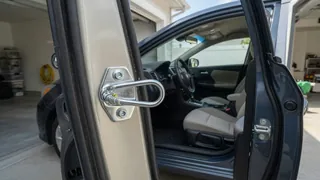
What is a car door striker
A car door striker is the metal anchor point mounted on the vehicle body that the door latch engages when you close the door. Drivers often notice it as a U-shaped loop or bolt-like pin in the door opening, but its role goes beyond holding the panel shut. When the latch assembly clicks over this stationary striker plate, the door is pulled tight against the weather seal and secured. Recognizing this small component helps you understand why closing effort changes, why wind noise appears, or why a door that looks aligned may still refuse to latch cleanly. The terms striker, striker plate, lock striker, and latch striker describe the same anchoring side of the closure system.
Meaning
In automotive body openings, the car door striker is the fixed counterpart to the latch mechanism housed inside the door. The striker is usually secured to the B-pillar for a front door or the C-pillar for a rear door, and it can take the form of a wire loop, a formed plate, or a hardened pin. Unlike the movable latch that contains the release pawl and actuator, the striker has no moving parts. Its job is to give the rotating latch claw something rigid to capture, so the door cannot swing open under normal driving loads.
People sometimes confuse the striker with the complete lock assembly, but the distinction matters. The lock striker is only the stationary anchor, while the latch is the spring-loaded mechanism that wraps around it. When a replacement is described as a car door latch striker, it means the fixed body-side bracket and its mounting hardware, not the internal door latch. A worn striker plate can still produce lock-related symptoms, but replacing it is generally simpler than opening the door cavity to service the latch itself.
How it works
Closing a door is a two-stage event. The latch first touches the striker and the rotating fork begins to turn. As the fork continues around the striker pin, the detent lever drops into the primary catch, locking the fork closed. That engagement pulls the door inward and compresses the weather seal around the opening. The striker and latch must therefore share the right position, height, and depth. If the striker is too far outboard, the latch may only reach the secondary catch, leaving the door slightly ajar.
The striker also carries load while driving. Body flex, cornering forces, and the pressure of occupants leaning against the panel all pass through the latch-to-striker interface. That is why the striker plate is mounted with substantial bolts or a welded backing plate and often allows some adjustment. A striker pin that has shifted changes the relationship between the door, the hinges, and the seal. The result can be a slam that feels hard, a rattle over bumps, or a handle that releases poorly.
Key differences
The latch and the striker are not interchangeable names for the same part, even though they work as a pair. The latch contains the release levers, internal springs, and often the power lock actuator inside the door. The striker plate is a passive body-side bracket in the door opening. A lock striker refers to the stationary anchor that receives the latch, while a door striker pin or striker bolt describes its loop or shaft form. Understanding this difference helps when ordering parts or describing a noise.
Compared with the hinges, the striker is serviceable on the opposite edge of the door. Hinges control the swing arc and carry much of the panel's weight, while the striker controls the closed position and sealing pressure. The door strut, if present, only checks opening travel. Together these body-opening components define how the door hangs and how firmly it seats. When alignment is correct, the door should close with moderate effort and rest flush without the latch dragging across the striker.
Understanding a problem
A door that pops open, rattles over rough pavement, or requires an unusual slam often points to a striker issue, but the striker itself is rarely the only possible cause. A loose striker bolt can let the stationary pin move, while a worn striker plate can develop grooves that make release feel notchy. However, hinge sag can lower the door until the latch barely reaches the striker, and a torn weather seal can change closing effort. Check the striker for looseness, scoring, or visible movement before adjusting anything.
If the door closes but the dome light flickers or the ajar warning appears, the latch may be resting on the secondary catch rather than reaching the primary position. This can follow a collision repair, a shifted striker, or a failing latch spring. Moving the striker changes the closed height and depth of the door, and an incorrect adjustment can create wind noise or make the release handle bind. Because a fault code for a door ajar circuit only tells you that the switch state is wrong, it is evidence to interpret, not proof that the striker or latch has failed.