How to Fit Bulky Packaging Into a Small Car
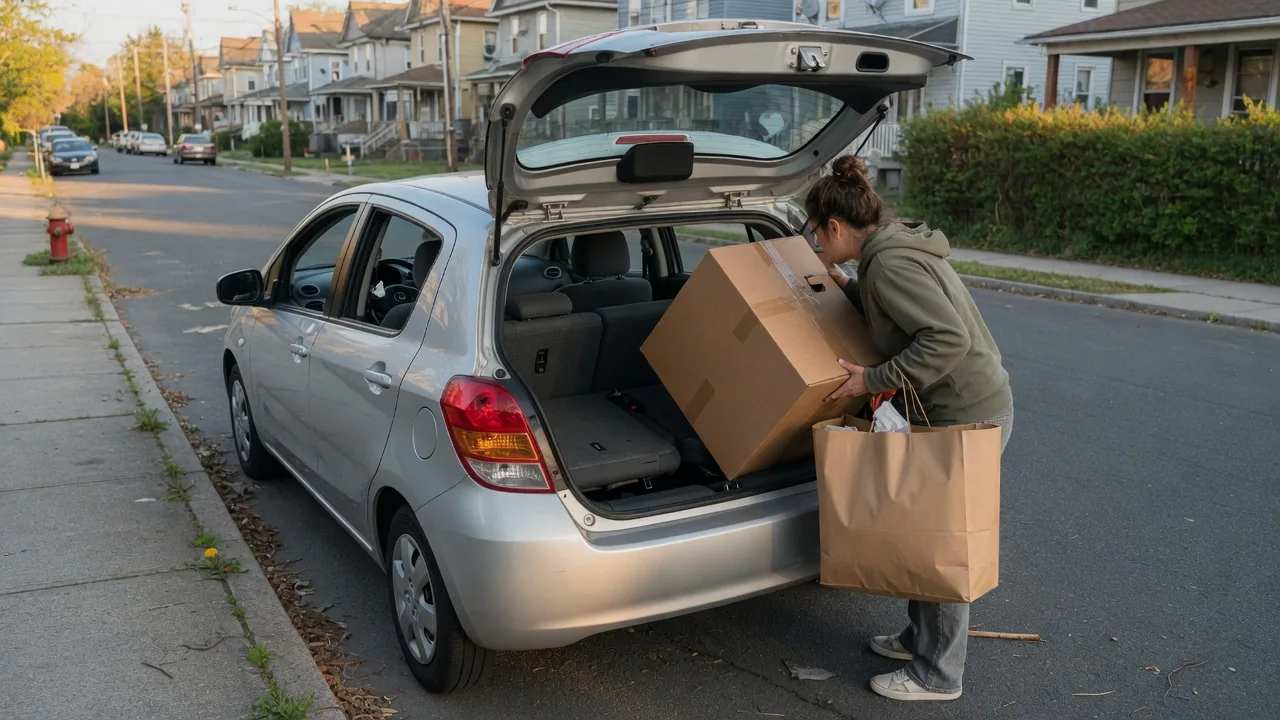
Working out how to fit bulky packaging into a small car starts well before you lift anything. A flat-pack carton, an appliance box, or a boxed television can ride safely in a compact hatchback or sedan if you compare its dimensions with the cargo opening, consider breaking the load down, and refuse to let anything hang out unsecured.
Measure box and opening
Start with the box itself, recording length, width, and height, then measure the narrowest part of the cargo opening rather than the widest. On a hatchback, the limiting points are usually the gap between the tail lamp housings, the height from the load lip to the top of the opening, and the slope of the rear glass. On a sedan, the trunk aperture is often much smaller than the trunk floor, so a carton that would lie flat inside may never pass through the opening.
Interior depth matters as much as the opening. Measure from the closed hatch or trunk lid line to the back of the front seats, and note the wheel arch intrusions that narrow the floor partway forward. A long box can sometimes travel diagonally, corner to opposite corner, gaining several useful inches over a straight measurement. These figures vary widely between body styles and even trim levels, so a tape measure in your own car is more reliable than any published cargo volume number.
Fold seats
Folding the rear seatbacks turns a short trunk into a long load floor, but the result differs by vehicle. Some seats drop nearly flat, others leave a step or a slope, and split-folding designs let you lower only one side so a passenger can still ride. Look for release levers on the seatback shoulders or pull handles inside the trunk, and check the owner's manual if head restraints need to be removed or lowered before the backs will tilt forward fully.
On sedans, the pass-through behind the folded seat is often narrower than the seat itself, framed by structural bracing, so measure that opening too. Sliding the front passenger seat forward and reclining its backrest can create a long channel for narrow cartons, though nothing should press against the dashboard airbag area or interfere with the shifter and parking brake. Protect folded seatbacks with a blanket, since cardboard corners and staples can scuff upholstery, and keep seat belt buckles from being trapped under the load.
Secure visibility
A box that fits is not automatically a box that is safe to drive with. Cargo stacked above the seatbacks can block the interior mirror, and a tall carton beside the driver can hide the passenger-side mirror or the view through the side glass at junctions. Sit in the driving position before setting off and confirm that both door mirrors are clear, the shifter moves freely, and nothing can slide forward into the pedals or against your elbow during a hard stop.
Restraint matters because an unsecured load keeps moving when the car brakes. Many cars have tie-down loops in the cargo floor, and ratchet straps or sturdy rope through those points hold a carton far better than bungee cords, which stretch. Heavy items belong low and against a seatback rather than perched on top of lighter ones. If the hatch or trunk lid cannot close completely, treat that as a sign the load is too large, since an open lid can draw exhaust fumes into the cabin.
Everyday Use and Observations
In practice, the packaging is often the real obstacle rather than the product. Retail cartons include foam blocks, corner protectors, and air space that can add considerable bulk, so removing the item from its outer box in the parking lot frequently solves the problem. Flat-pack furniture can be split into individual panels and hardware bags, and a boxed chair or shelf unit may nest into footwells once separated. Keep the padding to wrap edges and glass surfaces so parts do not chafe against each other.
Disassembly has a trade-off worth weighing. Some retailers ask for original packaging on returns, and screens or appliances can be more vulnerable once their molded supports are gone, so photograph the contents and keep the protective pieces that still fit. On the drive itself, expect the car to feel different: added weight lengthens braking distances and softens the rear suspension, and you may hear panels shifting over bumps. A brief stop after the first few minutes to recheck straps is a sensible habit.
Limits and Next Steps
Every car has a payload rating, usually shown on a placard in the driver's door jamb, covering passengers and cargo together. Dense loads such as tile, paving, or boxed gym weights can exceed that figure long before the space fills up, so volume is not the only limit. Overhang is the other boundary. Rules on how far a load may project, and whether a flag or light is required, differ by state, and anything protruding from an open trunk also risks shifting out under acceleration.
When the measurements simply do not work, forcing the load is the wrong answer. Store delivery, a rented pickup or cargo van, or a properly rated roof rack with crossbars are all reasonable alternatives, though roof loads carry their own weight limits set by the vehicle manufacturer and rack maker. A second trip with the load divided in half is often the cheapest fix. Whatever the choice, the goal remains a closed hatch, clear mirrors, and cargo that stays put when you brake.