Car Overhang Limits: What They Mean for Vehicle Dimensions and Cargo
The short answer
The phrase "car overhang limits" can mean two different things, and the answer depends on which one you need. As a vehicle specification, overhang is the distance the body extends ahead of the front axle or behind the rear axle. For passenger cars, the practical limit there is physical: how much overhang the car can carry before its bumpers or underbody hit ramps, curbs or uneven ground. As a legal question, overhang usually refers to cargo that sticks out past the front, rear or sides of a vehicle. In the US, those limits are set mainly at the state level and vary, so no single national figure covers every driver.
This guide covers both meanings. It does not cite specific measurements or legal distances, because none were confirmed for this article. Where a number matters, check the manufacturer's published specifications for your exact vehicle or the current vehicle code for your state.
Overhang as a vehicle dimension
Manufacturers usually list two overhang figures. Front overhang runs from the center of the front wheels to the forwardmost point of the body, usually the bumper. Rear overhang runs from the center of the rear wheels to the rearmost point. Added to the wheelbase, the distance between the axle centers, these figures roughly equal the vehicle's overall length.
Overhang figures can differ within the same model line. Body style, bumper design, trim-specific styling, towing hardware and mid-cycle refreshes can all change them. Confirm figures for the specific model year, generation and trim rather than assuming they carry over.
How overhang limits clearance
Overhang works together with ground clearance to decide what a vehicle can drive over without scraping. Three related measurements explain the relationship:
Approach angle: the steepest incline the front can meet before the bumper or lower body touches the surface. Longer, lower front overhang reduces it. Departure angle: the equivalent measurement at the rear. Longer, lower rear overhang reduces it, which is why the rear can scrape when leaving a steep driveway. Breakover angle: the steepest crest the vehicle can cross between its axles without the underbody touching. Overhang does not set it; wheelbase and ground clearance do.
In daily driving, a car with long or low overhangs is more likely to scrape on steep driveway transitions, parking ramps, speed humps and curbs. Vehicles with short overhangs and higher clearance tolerate these obstacles better. That is why off-road-oriented vehicles typically advertise approach and departure angles, while many passenger cars list only overall dimensions.
Overhang also affects parking and maneuvering. The front and rear corners sweep wider arcs than the wheels during tight turns, so a long overhang needs more room near walls, posts and other vehicles.
Overhang as a legal limit on cargo
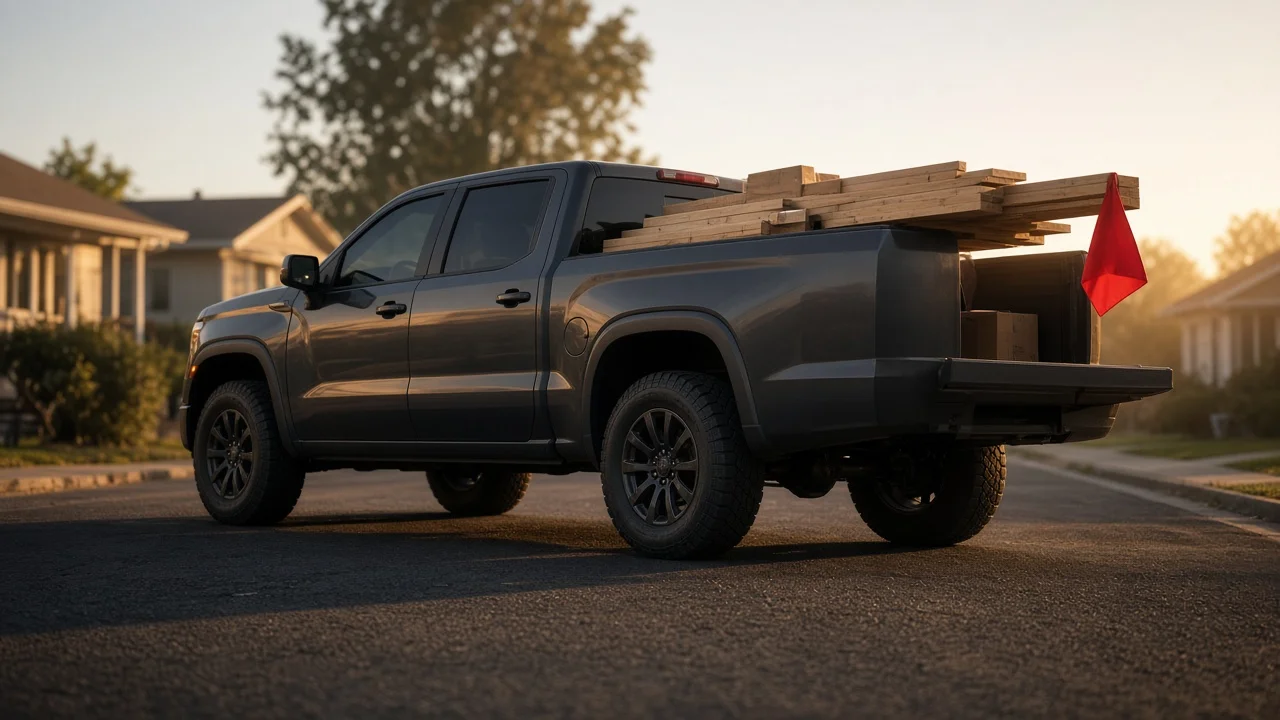
When people ask about overhang limits in a legal sense, they usually mean how far a load may extend beyond the vehicle. Examples include lumber or ladders on a roof rack, kayaks, pipe in a pickup bed, or items on a hitch-mounted carrier. In the US, these rules come mostly from state vehicle codes. Federal rules focus largely on commercial vehicles, so a private car owner generally needs to check the law in each state where they drive.
State rules commonly address these points, though the specifics vary:
Rear projection: how far a load may extend past the rear bumper, and the distance at which it must be marked. Front projection: whether and how far a load may extend ahead of the front bumper. Side projection: limits on cargo extending beyond the sides. Some states treat the left side more strictly than the right because of oncoming traffic. Marking and lighting: requirements for a visible flag on projecting loads in daylight and a light or reflector at night. Securement: general requirements that loads be fastened so they cannot shift, fall or blow off.
Because thresholds, flag sizes and lighting rules differ by state and can change, this article does not state specific distances. Check the current vehicle code or the motor vehicle agency for each state on your route, especially before an interstate trip with a long load.
Manufacturer limits that also apply
Besides legal rules, the vehicle and its accessories have their own ratings. The owner's manual may limit roof load, and roof rack and crossbar makers rate their products separately. Hitch-mounted carriers and bike racks carry their own capacity and fitment guidance. A rear-mounted carrier also adds rear overhang, which can lower the effective departure angle and make scraping more likely on steep transitions. When ratings differ, the lowest one applies.
What to check next
For dimension and clearance questions: look up the front overhang, rear overhang, ground clearance and, if listed, the approach and departure angles for your exact model year and trim in the manufacturer's specifications. For cargo questions: read the current load projection, marking and securement rules in the vehicle code of each state you will drive through. For equipment: confirm the load ratings in the owner's manual and the accessory maker's instructions, and follow the lowest limit. Where a rule is unclear: contact the state motor vehicle agency or law enforcement for clarification before carrying an oversized load.
Information gaps
No confirmed figures were available for this article. That includes overhang measurements for specific vehicles, state-by-state cargo projection distances and accessory load ratings. The principles above describe how overhang works and where the limits come from. They are not a substitute for the published figures that apply to your vehicle, equipment and location.