How to Check Wheel Runout

Wheel runout describes how much a rim wobbles or moves up and down as it rotates. Too much radial or lateral deviation can create steering wheel shake, vibration through the seat, and uneven tire wear even when balance weights are correct. Checking runout helps separate a bent rim, corrosion between the hub and mounting surface, or a failing hub assembly from a simple balance problem. A dial indicator and a safe, stable jacking setup give a repeatable measurement that tells you whether the wheel is serviceable.
Direct answer
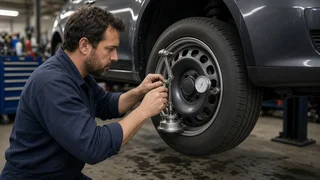
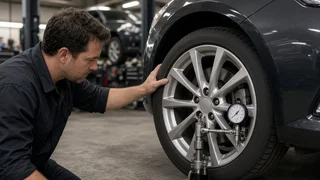
To check wheel runout, raise the vehicle so the wheel clears the ground, rotate the assembly slowly, and use a dial indicator to measure movement at the rim. Radial runout is read from the tire seating area or inner barrel and shows out-of-round movement. Lateral runout is read from the rim flange face and shows side-to-side wobble. A bent rim often produces a steady, repeatable needle sweep, while a loose bearing may shift the whole assembly and give an inconsistent reading.
The hub pilot and mounting surface matter because a wheel that is not seated flat can imitate runout. Clean the hub and wheel mating faces before measuring. If the indicator needle moves more than a small fraction of an inch, the rim, hub, or mounting fit tolerance needs attention. Remember that a fault code is not involved here; the dial indicator is the diagnostic tool, and the pattern of movement tells you where to look next.
How to proceed
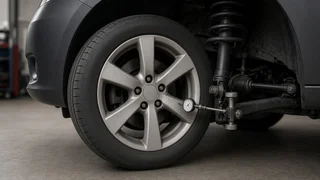
Secure the vehicle on level ground, chock the opposite wheels, and use a jack stand rated for the load before removing the wheel or measuring underneath. Mount the dial indicator base on a stable surface, such as a suspension arm or a separate stand, so it does not move with the rotating assembly. Press the indicator plunger gently against the rim lip for lateral runout or the inner barrel for radial runout, preload the needle slightly, and zero the dial.
Rotate the wheel one full turn by hand and watch the total needle movement. Work slowly and do not force a stiff hub or dragging brake. If the reading exceeds the manufacturer's service limit, remount the wheel after cleaning the mating surfaces and measure again. A repeatable high reading points to rim damage or a distorted hub, while a reading that changes between positions suggests loose hardware or worn bearings. Stop before disassembly if the wheel is cracked or visibly bent.