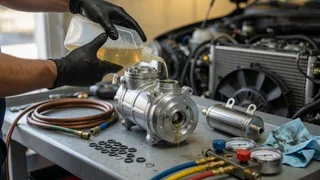
How Much PAG Oil to Add to a Car AC System
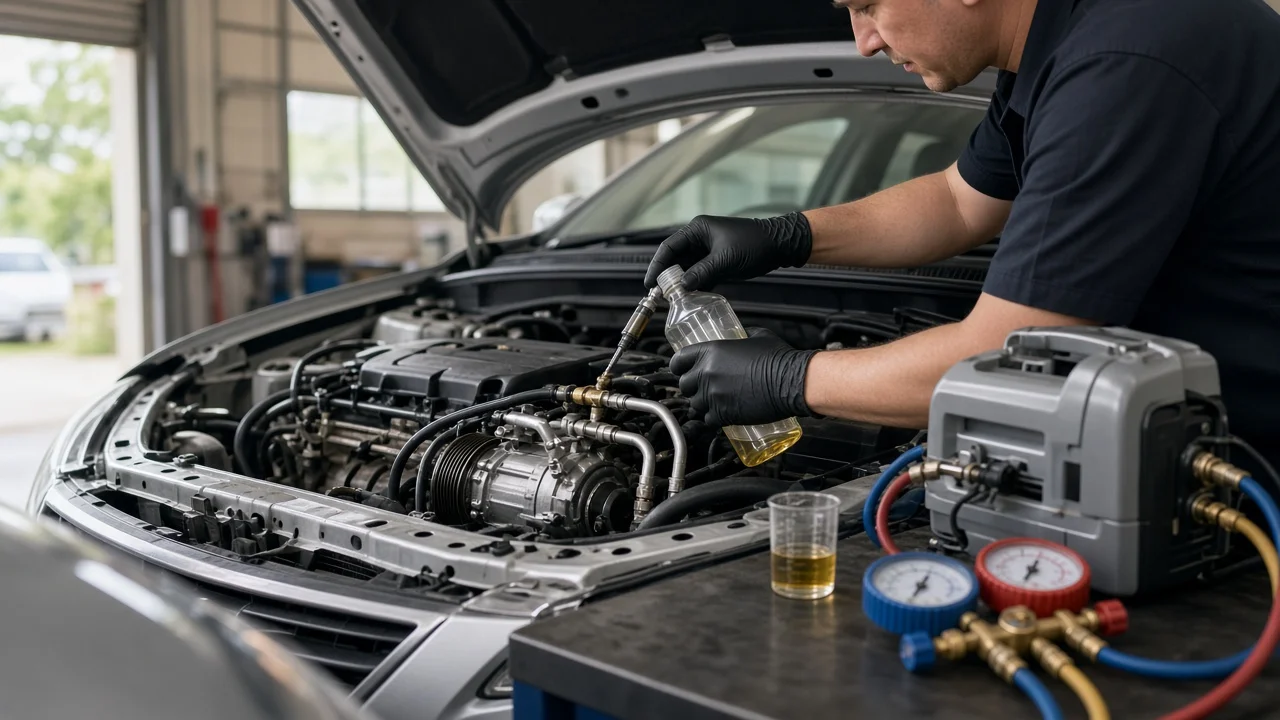
There is no single amount of PAG oil that is right for every car AC system. The correct quantity depends on two things: the total oil capacity the vehicle manufacturer specifies for that system, and how much oil left the system during service. A simple top-up recharge on a system that has not leaked oil usually needs little or no added oil. Replacing a component means adding back roughly what that part held. A fully flushed or rebuilt system needs the full specified fill quantity. Adding oil without knowing which of these situations applies is how most lubrication problems start.
The short answer
Add only enough PAG oil to replace what was lost or removed, and never exceed the manufacturer's total system oil capacity. That capacity, along with the refrigerant charge, is usually printed on the under-hood AC label or listed in the vehicle's service information. The exact figure varies by make, model, model year, engine and whether the car has rear or dual-zone air conditioning, so a number taken from a different vehicle is not a reliable substitute.
What PAG oil does and why the amount matters
PAG (polyalkylene glycol) oil is the synthetic lubricant used in most belt-driven automotive AC compressors running R-134a or R-1234yf refrigerant. The oil circulates with the refrigerant, lubricating the compressor's internal parts and helping seal it. Only part of the oil sits in the compressor at any time; the rest is distributed through the condenser, evaporator, hoses and the receiver-drier or accumulator.
Too little oil starves the compressor and can lead to wear, noise or seizure. Too much oil coats the inside of the heat exchangers, reduces their ability to transfer heat and takes up space the refrigerant needs, which lowers cooling performance and can raise system pressures. Getting the fill quantity right is therefore about protecting the compressor without hurting cooling.
How much to add in common service situations
Situation | Typical oil approach; Recharge with no leak or component replaced | Usually no added oil; the oil is still in the system; Slow refrigerant leak, no visible oil loss | Little or none; follow service information for the vehicle; Leak with oily residue around a fitting, hose or component | Replace the estimated oil lost after the leak is repaired; Single component replaced (condenser, evaporator, hose, drier/accumulator) | Add the oil allowance specified for that component; Compressor replaced | Match the oil drained from the old compressor, adjusted to the new compressor's instructions; System flushed or fully rebuilt | Add the full total oil capacity, distributed as specified
Recharging a system that has not lost oil
When refrigerant is recovered and recharged with recovery equipment, the machine typically separates and measures any oil that comes out with the refrigerant. Only that measured amount needs to go back in. If the system was simply low and no parts were opened, adding a full bottle of oil on top of what is already there risks overfilling. Many DIY refrigerant cans already contain oil, so using several of them can add oil without the owner realizing it.
Replacing a single component
Each part of the system retains some oil, so a new part arrives dry and needs its share. Service information normally lists a specific oil allowance for the condenser, evaporator, receiver-drier or accumulator, and hoses. Larger heat exchangers and the accumulator generally hold more oil than a short hose. The usual practice is to add the specified amount directly into the new component before installing it, or to inject it into the system afterward under vacuum.
Replacing the compressor
Drain the old compressor into a measuring container, turning it by hand to empty it as fully as practical, and note the amount. Many replacement compressors come pre-filled, sometimes with the full system capacity and sometimes with a shipping charge only. Follow the compressor supplier's instructions: some call for draining the new unit and refilling it to match what came out of the old one plus allowances for any other parts replaced, while others say to leave the factory fill alone. Assuming the pre-fill is correct without checking is a common way to end up overfilled or underfilled.
After a flush or full rebuild
Flushing removes essentially all oil from the parts that were flushed, so the system needs its total specified oil capacity. Spread the oil between components the way service information directs rather than putting it all in the compressor, which can cause liquid slugging and damage on first start-up.
Why a level check is not like checking engine oil
There is no dipstick for most car AC systems, and the oil is spread throughout the circuit, so you cannot read the level directly once the system is assembled. The only practical ways to know the amount are to measure what comes out during recovery or component removal and to work from the manufacturer's figures. That is why record-keeping during the job matters more than any after-the-fact guess.
Choosing the right lubricant specification
Quantity is only half the decision; the wrong oil type in the right amount can still cause trouble. Before adding anything, identify the system and the oil the manufacturer approves.
Viscosity grade: PAG oils come in grades such as PAG 46, PAG 100 and PAG 150. The correct grade depends on the compressor and vehicle, not on preference. Refrigerant type: R-1234yf systems generally call for PAG oils formulated and approved for that refrigerant, which may differ from oils sold for R-134a. Check the label and service information. Electric compressors: Many hybrids and electric vehicles use electrically driven compressors that require a specific dielectric oil, often POE-based or a special PAG type. Ordinary PAG oil can compromise the compressor's electrical insulation, so do not substitute it. Manufacturer approval: Where the vehicle or compressor maker names an approved oil, use that or a product stated to meet the same specification. Moisture: PAG oil absorbs moisture readily. Keep containers sealed, use fresh oil and avoid leaving bottles open.
Equipment identification: where to find the numbers
Under-hood AC label: often near the radiator support or on the hood underside; typically lists refrigerant type and charge, and sometimes oil type and capacity. Compressor tag or body: may identify the compressor model and the oil it uses. Vehicle service information: the most complete source for total oil capacity and per-component allowances. Replacement part instructions: compressors and some other parts include their own oil guidance, which applies to that part.
Is there a service interval for AC oil?
Automotive AC systems are sealed, and the oil is not normally changed on a fixed schedule the way engine oil is. Oil is replaced when it is lost through a leak, removed with a component, or flushed out during repair. If the oil drained from a failed compressor looks dark, sludgy or contains metal particles, that usually points to internal failure and contamination, which typically calls for flushing the parts that can be flushed, replacing those that cannot, and refilling to the full specification.
Practical takeaway
To decide how much PAG oil to add, first identify what work is being done: a straight recharge, a single part swap, a compressor replacement or a full flush. Then confirm the oil type and total capacity for your specific vehicle, measure any oil that comes out, and add back only what is needed. If you cannot find the specification or cannot measure what was removed, that is the point where a shop with recovery equipment and service data is likely to produce a more reliable result than an estimate.