How Is a Car's Turning Circle Measured? Curb-to-Curb vs. Wall-to-Wall
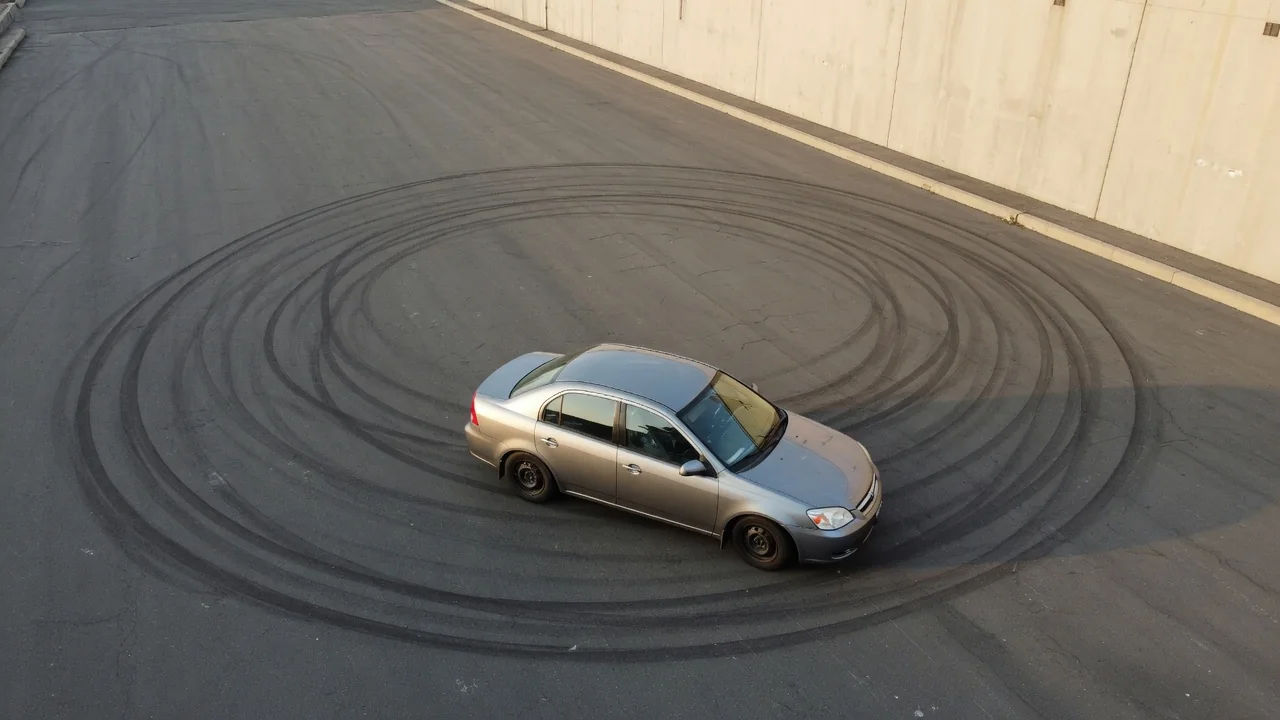
A car's turning circle describes how much space it needs to make a complete U-turn with the steering wheel held at full lock. The figure looks simple on a spec sheet, but it can be measured in more than one way, and the method changes the number. Understanding vehicle turning circle measurement means knowing which point on the car is traced, whether the result is a diameter or a radius, and what conditions apply.
Curb-to-Curb: Tracing the Tire Path
The curb-to-curb turning circle is the diameter of the smallest circle traced by the outer front tire when the steering is turned to full lock and the vehicle is driven slowly through a complete circle. The name comes from a practical picture: it is the width of street, measured between two curbs, that a car would need to turn around in one sweep without its tires touching either curb. Because only the tire path is considered, the body is allowed to overhang the curb, as it would on a real street where the bumper passes above the curb.
In a typical measurement, the vehicle sits on a flat, level surface, the steering wheel is turned fully to one side, and the car is driven at walking pace through a full circle. The path of the outside front tire is marked, and the diameter of that circle is measured. The process is then repeated with the steering turned the other way, because many vehicles do not turn identically left and right. Steering stops, the geometry of the steering linkage, and packaging around components such as the engine or drive shafts can make one direction tighter than the other, so a published figure may be an average of both directions or the larger of the two.
Conventions also vary at the tire itself. Some definitions trace the outermost edge of the tire where it meets the ground, which reflects the true space needed between curbs. Others trace the center of the tire's contact patch, which produces a slightly smaller number. The difference is roughly one tire width, so it rarely changes how a car feels in use, but it matters when two figures are placed side by side.
Wall-to-Wall: Including the Body's Swept Path
The wall-to-wall turning circle measures the diameter of the circle swept by the outermost point of the vehicle body during the same full-lock turn. On most cars this is a front corner of the bumper, since the front overhang extends beyond the front wheels and swings out wider than the tires. Mirrors may or may not be included depending on the definition used, which is another reason to check how a figure was defined. The scenario is a turn between two solid walls, or any obstruction tall enough that the body cannot pass over it.
Because it includes overhang, the wall-to-wall figure is always larger than the curb-to-curb figure for the same vehicle. How much larger depends on how far the bodywork extends ahead of the front axle and how wide the body is relative to the wheel track. A vehicle with a long front overhang or a wide body will show a bigger gap between the two figures than one with short overhangs and wheels pushed toward the corners. Wall-to-wall is the more relevant number for tight spaces bounded by walls, posts, or parked vehicles, such as parking structures and narrow driveways.
Spec Interpretation: Reading Turning Circle Figures
When reading a specification, first identify which method was used. Manufacturer data, owner's manuals, and reviews do not always label the figure, and different sources for the same vehicle may report different values simply because one quoted curb-to-curb and another quoted wall-to-wall. If the label is missing, the number cannot safely be assumed to be either. A figure that seems unusually small may be curb-to-curb, measured at the tire center, or a radius rather than a diameter.
The radius-versus-diameter confusion is especially common. The phrase turning radius is often used loosely in everyday language when the value given is actually a diameter. A true turning radius is half the diameter, so mistaking one for the other doubles or halves the apparent space required. If a stated number seems implausibly tight for a full-size car, it is worth checking whether it describes a radius. Units matter as well: figures are typically given in feet in the United States and in meters in many other markets.
Vehicle configuration can change the number too. Tire and wheel size, drivetrain layout, and steering hardware may differ across trims of the same model, and larger tires can require reduced steering lock to maintain clearance. Some vehicles offer rear-wheel steering, which can reduce the turning circle by angling the rear wheels opposite the fronts at low speed. A published figure normally applies to a specific configuration, so it should be matched to the exact version being considered rather than applied to every variant of a model.
Practical Implications and Limits
In daily driving, the curb-to-curb figure helps estimate whether a U-turn can be completed on a given road without a multi-point maneuver. Comparing it to the width of the street gives a reasonable first estimate, though real roads add variables such as road crown, parked cars, and tall curbs that the bumper may not clear. The wall-to-wall figure is the better guide where obstructions are tall, as in garages, loading areas, and tight parking ramps. Neither figure describes how quickly or easily the car changes direction at speed, since both are taken at walking pace with the steering at its limit.
Several factors can make real-world behavior differ from the published value. Aftermarket wheels, tires, or spacers can rub at full lock, and some installations call for steering stops to be adjusted, which enlarges the turning circle. Incorrectly set steering stops, alignment changes, and suspension modifications can also shift the result. Surface conditions play a role, since tires scrub at full lock and may slip on loose or wet ground. In vehicles with hydraulic power steering, holding the wheel hard against the stop for long periods places extra load on the system, so easing off slightly once the turn is established is a common practice. Published figures are best treated as a consistent reference under defined conditions rather than an exact prediction for every situation.