Chevrolet Transmission Identification and Codes
The Short Answer
Chevrolet has used many different transmissions over the decades, so there is no single code that covers every model. Most identification comes from three sources: the vehicle's factory option codes (called RPO codes), the build record tied to its VIN, and the markings on the transmission itself. Which source is most useful depends on the model year, the vehicle line and whether the original transmission is still installed.
The factory codes describe what the vehicle was built with. They do not prove what is installed now. A transmission can be swapped during repair or modification, so a physical check of the unit is the only way to confirm what is in the vehicle today.
How GM Transmission Names Work
Many modern Chevrolet automatics use GM's alphanumeric naming system. Names such as 4L60-E, 6L80, 8L90 and 10L80 follow a consistent pattern:
The first number is the number of forward gears. The letter shows how the transmission is mounted. L means longitudinal, for rear-wheel-drive and many four-wheel-drive layouts. T means transverse, for front-wheel-drive layouts. The next number is a relative torque-capacity rating within GM's lineup. A higher number means a stronger unit, but the number is not a torque figure in any unit of measurement. A trailing E, where it appears, means electronic control.
Older Chevrolet automatics use earlier names, such as Powerglide, Turbo-Hydramatic 350 and Turbo-Hydramatic 400, and the 700R4. Some heavy-duty trucks use Allison automatics instead of GM-named units. Manual transmissions come from various suppliers and follow their own naming conventions.
The transmission name and the RPO code are separate identifiers. The RPO code is a factory option code on the vehicle's records. The transmission name is the engineering designation of the unit. You may need a reference that matches one to the other for your model year.
How to Find and Recognize the Transmission
1) Check the Service Parts Identification Label
Many GM vehicles carry a Service Parts Identification label listing the vehicle's three-character RPO codes. It is often in the glovebox, though the location varies by vehicle and era. In some vehicles it is on a door, in the trunk or on another interior panel. One of the codes identifies the factory transmission. You will need a model-year-specific RPO reference to match it to a transmission name, because this guide does not include a verified code-by-code list.
2) Use the VIN to Pull Build Data
The 17-character VIN identifies the vehicle and usually encodes engine information. In most cases it does not directly spell out the transmission. A Chevrolet dealer service department or a GM build-data lookup can use the VIN to retrieve the original options, including the transmission. This is useful when the label is missing or unreadable.
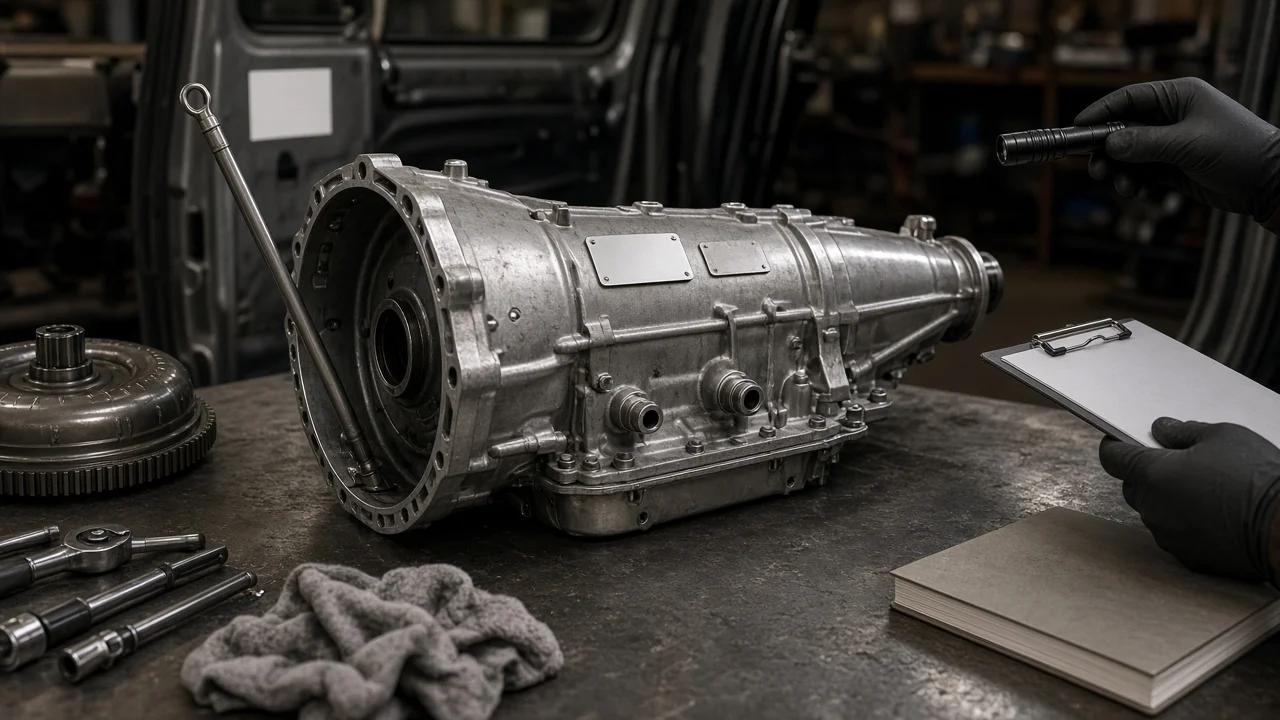
3) Inspect the Transmission Case
Transmissions usually carry an identification tag, a stamped code or a cast marking on the case. These can include a model designation, a build date and a serial or plant code. Where to look and how to read the marking differ by transmission family. Use documentation for the specific unit you suspect is installed. Dirt, corrosion or a missing tag can make these markings hard to read, so clean the area before you inspect it.
4) Use Visual Cues as a Secondary Check
On older rear-wheel-drive Chevrolet automatics, enthusiasts often identify a unit by the shape of the oil pan and its bolt count. Other cues include the case length, the location of the dipstick or fill point, and whether there is an electrical connector for electronic control. These cues help narrow the options, but several families look alike. Confirm a visual match against a pan-gasket or case reference for the right era rather than relying on appearance alone.
Commonly Confused Items
Factory RPO code versus installed unit: the label shows original equipment, not later swaps. Similar names in the same family: units such as the 4L60-E and 4L65-E share a naming pattern but are not automatically interchangeable. Check the exact designation. Transmission versus transfer case: on four-wheel-drive models, the transfer case has its own codes and identification. Engine code versus transmission code: a VIN engine digit does not tell you which transmission was fitted.
What This Guide Does Not Cover
No verified model-specific evidence was available for this article. It therefore does not list specific RPO-to-transmission mappings, tag formats, bolt counts, fluid specifications or which transmissions came in which Chevrolet models and years. For those details, consult the service information for your vehicle's model year, powertrain and market, or ask a Chevrolet dealer to run the VIN. Confirm parts, fluids and repair procedures against the identified transmission before ordering or starting work.