Identify a Transmission by VIN
The short answer
A VIN can often lead you to the factory-installed transmission, but in many cases it does not spell out the transmission directly. The 17-character Vehicle Identification Number reliably encodes things like the manufacturer, model year and assembly plant. Whether it also encodes the transmission depends on the manufacturer, model, model year and market. For many vehicles the VIN is better understood as a key. You use it to retrieve the original build record, and that record lists the transmission.
There is one important qualification. A VIN describes the vehicle as it was built. If the transmission has since been replaced, rebuilt with different internals or swapped for another unit, the VIN-based answer may no longer match what is actually installed. To confirm the current transmission, check the identification markings on the unit itself.
How a VIN is structured
For road vehicles sold in the US, the modern standardized VIN has 17 characters arranged in three broad sections. Knowing these sections helps explain why transmission information is sometimes present and sometimes missing.
World Manufacturer Identifier (positions 1–3): identifies the manufacturer and the region or country of origin. Vehicle Descriptor Section (positions 4–8): manufacturer-defined attributes such as model line, body style, engine or restraint system. The manufacturer chooses what goes here. Check digit (position 9): a calculated character used to detect transcription errors. Vehicle Identifier Section (positions 10–17): includes the model year code (position 10), the assembly plant code (position 11) and a production sequence number.
Each manufacturer decides what the Vehicle Descriptor Section encodes, so there is no universal VIN position for the transmission. Some manufacturers, for some vehicles, include drivetrain details in these characters. Many do not. Where they do, the meaning of a character applies only to the specific make, model and model-year range in that manufacturer's decoding documentation. The same character in another vehicle line can mean something entirely different.
Ways to identify the transmission using the VIN
The routes below run roughly from the most to the least authoritative for factory build data. The level of detail available varies by brand and vehicle age.
Dealer or manufacturer build data: a franchised dealer's parts or service department can usually enter the VIN into the manufacturer's system and see the original build configuration, including the transmission. This is often the most dependable source for the factory unit. Original window sticker or build sheet: some manufacturers can reproduce these from the VIN. Transmission type, and sometimes the specific option, is typically listed. Government VIN decoding: the US National Highway Traffic Safety Administration offers a public VIN decoder. Its transmission fields depend on data the manufacturer submitted and are frequently blank or general, such as automatic versus manual. Commercial VIN decoders: these may report a transmission. The detail and accuracy vary, and some infer the transmission from trim or engine rather than reading an actual build record. Treat their results as a lead, not confirmation. Parts catalog lookups: many parts retailers and dealer catalogs filter by VIN. When a catalog asks you to choose between transmission options, the VIN alone did not resolve the transmission for that vehicle.
Build labels and option codes on the vehicle
Several manufacturers place a label on the vehicle that lists factory option codes, including the transmission. These labels carry the VIN, or are tied to it, and they are often the fastest way to read the factory transmission without a decoder. The examples below are common conventions. Label location, format and code meanings differ by model and model year, so check them against documentation for your specific vehicle.
General Motors: many vehicles have a Service Parts Identification label, often in the glove box, trunk or spare tire area on older models. It lists three-character Regular Production Option (RPO) codes. Transmission RPO codes commonly begin with the letter M. Ford: the Safety Compliance Certification label on the driver's door jamb or door edge on many vehicles includes a field marked TR for the transmission code. Chrysler, Dodge, Jeep and Ram (Stellantis): factory sales codes appear on build sheets and, on some vehicles, on body code tags or labels. Transmission sales codes commonly begin with the letter D. Other manufacturers: many use a model code or option code on a door-jamb, under-hood or trunk label rather than a dedicated transmission field. In these cases the model code is decoded against the manufacturer's catalog to find the transmission.
Identification markings on the transmission itself
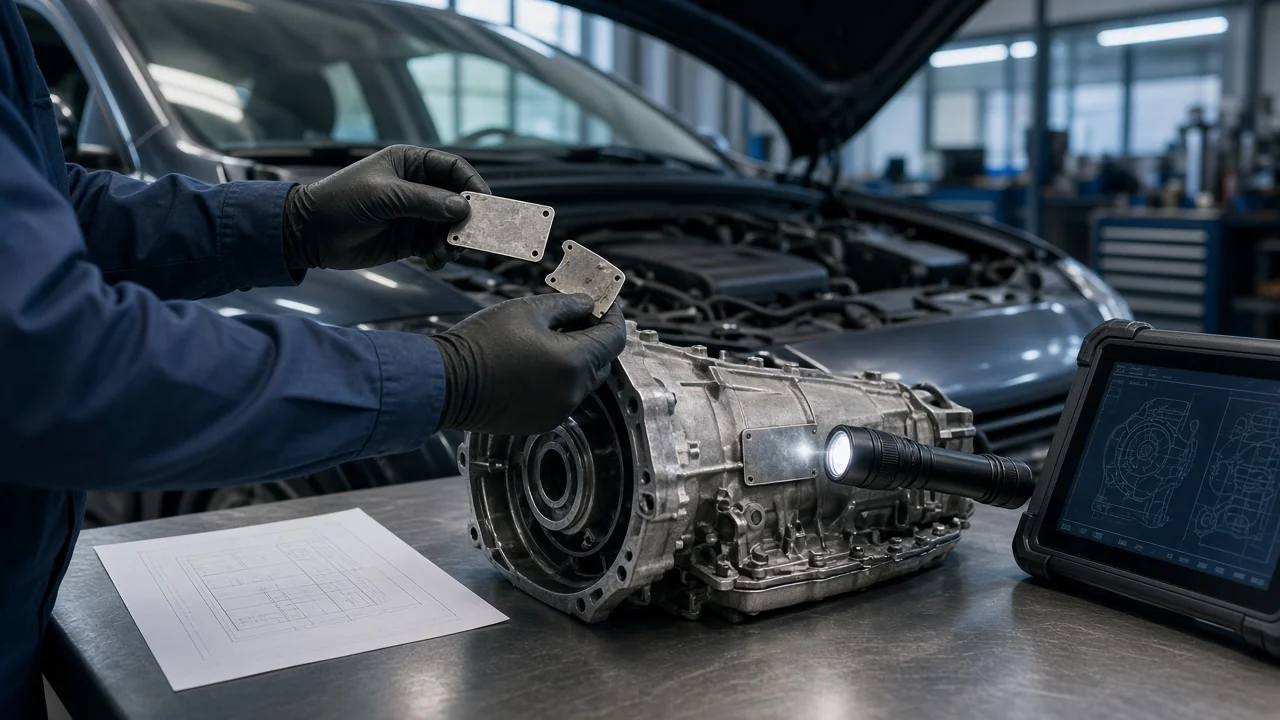
To confirm what is physically installed, look at the transmission case. Manufacturers commonly attach a metal identification tag or sticker, or stamp or cast an identification number into the housing. These markings identify the transmission model or assembly part number and sometimes a serial or build date. Their location varies widely by transmission. They are often on the side of the case, near the bellhousing or near the oil pan, and may be obscured by dirt, heat shields or crossmembers. A service manual or transmission identification reference for the specific unit will show where to look.
On some vehicles, major components including the transmission are also marked with all or part of the vehicle's VIN as a theft-deterrence measure. If the VIN marking on the transmission does not match the vehicle, the unit may have been replaced. This kind of parts marking applies only to certain vehicle lines and years, so its absence does not by itself indicate a replacement.
Easily confused identifiers
Transmission type versus transmission model: a decoder that reports "automatic" or "6-speed automatic" gives the type, not the specific model or part number. Ordering parts or fluid usually needs the model or build code. Transmission code versus axle code: build labels often list both near each other. The axle or gear ratio code describes the differential, not the gearbox. Engine code versus transmission code: in some VINs the engine is encoded but the transmission is not. A given engine may have been offered with more than one transmission. Transmission case marking versus vehicle VIN marking: an identification tag on the case describes the transmission assembly. A VIN stamp on the case links that unit to a vehicle. Both are useful, but they answer different questions. Transfer case versus transmission: on four-wheel-drive and some all-wheel-drive vehicles, the transfer case has its own identification tag and option code, separate from the transmission.
A practical sequence
1) Record the full 17-character VIN from the dashboard plate visible through the windshield or from the driver's door jamb label, and confirm the two match. 2) Check the build or option label for your brand, such as the GM parts identification label, the Ford door jamb TR field or Stellantis sales codes, and note any transmission code. 3) Ask a dealer parts department to look up the original build by VIN if the label is missing or unclear. 4) Use public or commercial decoders as a cross-check, keeping in mind that their transmission fields may be general, inferred or empty. 5) Inspect the transmission's own tag or stamping if you need to confirm the unit currently installed, particularly on a used vehicle or one with repair history.
Limits of this guide
This guide covers general principles. It does not include manufacturer-specific VIN position charts or tables of transmission code meanings, because these vary by make, model, generation and model year and were not available as verified data here. Before relying on any character position or option code, confirm its meaning in the manufacturer's decoding documentation or service information for your exact vehicle.