Identify a Vehicle's Transmission by VIN
The Short Answer
A Vehicle Identification Number (VIN) can often narrow down which transmission a vehicle has, but it rarely names the exact unit on its own. On modern road vehicles sold in the US, the VIN follows a standardized 17-character format. That format requires the VIN to identify the manufacturer, vehicle attributes, model year, assembly plant and serial number. It does not require a dedicated transmission field. Some manufacturers encode the transmission type, or a drivetrain detail that implies it, in certain models and years. Many do not.
In practice, the VIN is best treated as a lookup key. A dealer parts department, a manufacturer build record or a parts catalog uses the VIN to pull the vehicle's original build data, which usually includes the transmission. When the VIN alone leaves more than one possibility, a factory option label or the identification tag on the transmission case settles the question.
What the VIN Contains
The 17-character VIN is divided into sections. Knowing which section holds which information helps explain why transmission details are inconsistent from one brand to the next.
Positions | Section | General content; 1–3 | World Manufacturer Identifier (WMI) | Manufacturer and, in effect, country or region of origin; 4–8 | Vehicle Descriptor Section (VDS) | Manufacturer-defined attributes such as model, body style, engine and restraint system; 9 | Check digit | Calculated value used to detect transcription errors; 10 | Model year | Coded model year; 11 | Plant code | Assembly plant; 12–17 | Production sequence | Serial number of the individual vehicle
Any transmission information will almost always appear in the Vehicle Descriptor Section, positions 4 through 8. The manufacturer decides how those characters are used. As a result, a character that indicates the transmission for one brand, model or year may mean something entirely different elsewhere. Engine codes are much more commonly encoded in the VDS than transmission codes. An engine code can sometimes narrow the transmission options, because certain engines were paired only with certain transmissions, but that is an inference rather than a direct identification.
Ways to Find the Transmission Using the VIN
Free VIN decoders: General-purpose decoders, including the NHTSA's public decoder, report whatever the manufacturer has submitted for that VIN pattern. They usually show basic drivetrain data. They may list transmission style, such as automatic or manual, but often omit the specific model or code. Dealer parts or service department: A franchised dealer for the brand can usually look up the original build configuration from the VIN, including the factory transmission and its part or option code. This is generally the most reliable route for original-equipment information. Manufacturer owner portals and build sheets: Some manufacturers give owners access to window-sticker or build data by VIN. Availability varies by brand and model year. OEM and aftermarket parts catalogs: Catalogs that ask for a VIN filter parts to the vehicle's build. The transmission-related parts they return can indicate which unit was installed. Vehicle-to-transmission application indexes: Transmission rebuilders and parts suppliers publish indexes that map year, make, model and engine to transmission models. A VIN supplies the year, the make and often the engine, which narrows the index to the few candidates offered for that combination.
A vehicle-to-transmission index is useful for seeing which units were offered, but it lists possibilities, not the specific unit fitted to a given vehicle. If the index shows more than one transmission for the same year, model and engine, check the build data or the physical markings described below.
How to Confirm It on the Vehicle
Physical labels and markings provide confirmation, and they matter most when the VIN result is ambiguous or the transmission may have been replaced. Locations differ by manufacturer, model and year, so check them against the owner's manual or service documentation for the specific configuration.
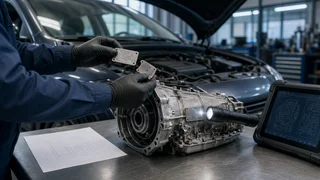
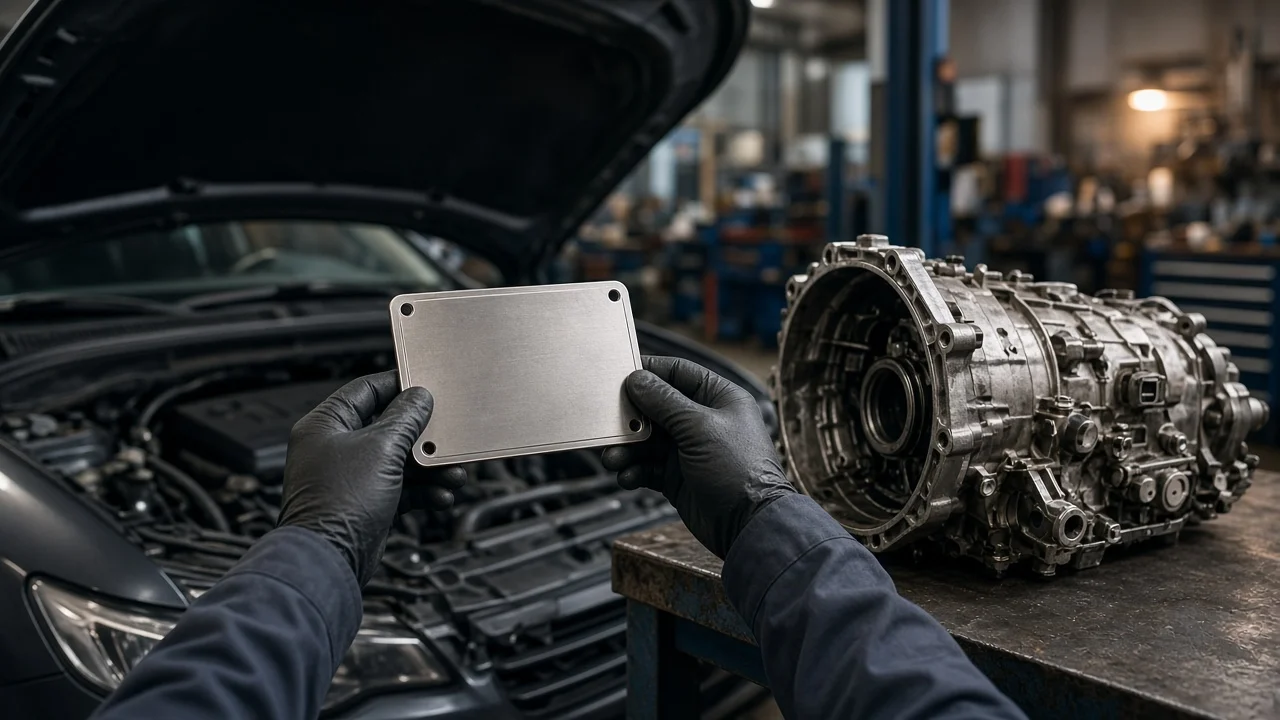
Factory option or build label: Some manufacturers place a label listing option codes on the vehicle, such as GM's Service Parts Identification label, which lists Regular Production Option (RPO) codes. Typical locations include the glove box, the trunk area, or a door jamb or pillar, depending on the vehicle. One of the codes usually identifies the transmission, and the manufacturer's code list explains what it means. Door-jamb certification or vehicle information label: On some brands, the label on the driver's door or door pillar includes a transmission code alongside paint and axle codes. Ford is a commonly cited example on many models, but it does not apply to every brand or year. Transmission case tag or stamping: Most transmissions carry an identification tag, sticker or cast or stamped marking on the case or housing. It may give the model, a manufacturer part number or a serial number. Reaching it can require getting under the vehicle, and the tag can be dirty, painted over or missing. Service records and window sticker: An original window sticker or dealer invoice often names the transmission or its option package.
Common Points of Confusion
Several terms are easily mixed up. Transmission type, such as automatic, manual, continuously variable (CVT) or dual-clutch, is broad and is what most decoders report. A transmission model or code identifies the specific unit and is what parts and rebuild work require. Drive type, such as front-wheel, rear-wheel, all-wheel or four-wheel drive, is a separate attribute. It may appear in the VIN even when the transmission does not, and it can narrow down the transmission without fully identifying it.
Keep in mind that VIN-based lookups describe the vehicle as built. If the transmission was replaced with a different unit, swapped from another vehicle or rebuilt with different internals, the VIN and build records will not reflect that. The tag on the transmission itself is the better evidence of what is installed now.
Limits of This Guide
This guide covers the general structure of the VIN and common identification methods. It does not give brand-specific VIN position meanings, option code lists or exact label locations, because these vary by manufacturer, model, generation and market. For a definitive answer about a particular vehicle, use the manufacturer's service information or a dealer's VIN-based build lookup, and then verify against the markings on the transmission case.