10L80 Transmission Valve Body Identification
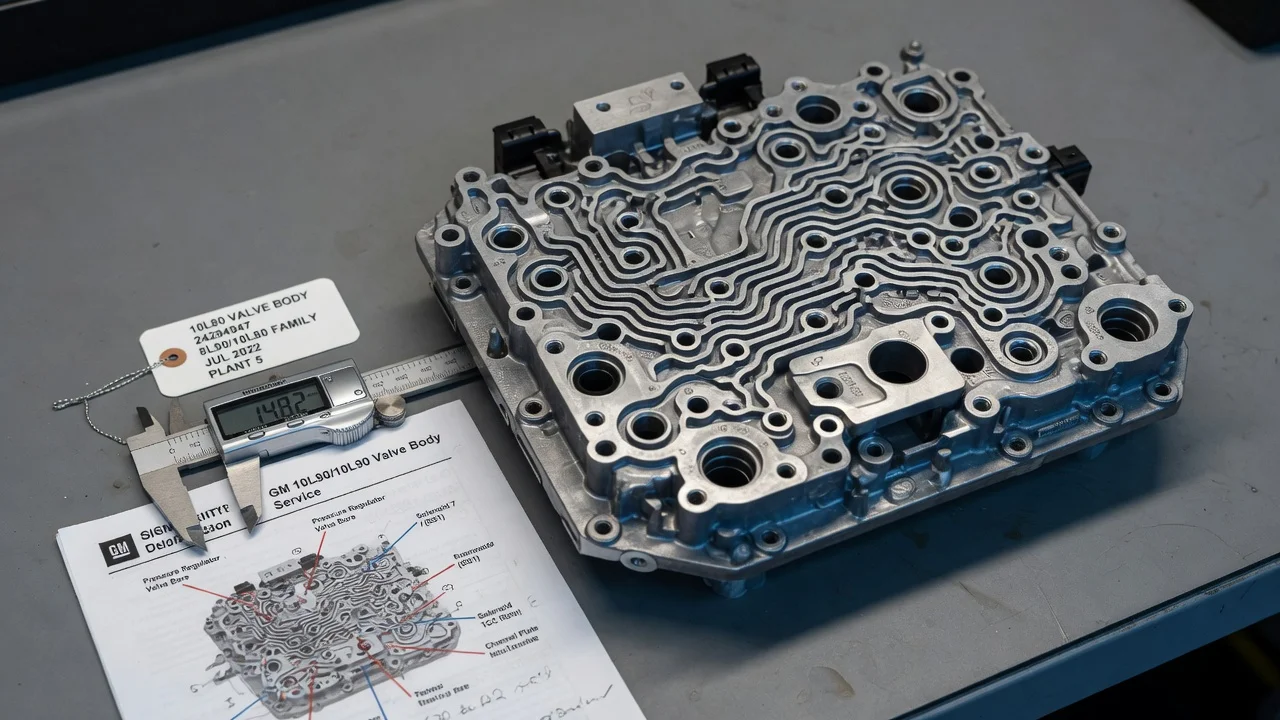
The 10L80 is a ten-speed rear-wheel-drive automatic used in a range of GM trucks, SUVs and performance cars. Identifying its valve body correctly matters because control assemblies, calibrations and related parts differ between model years and applications. This guide covers how to confirm the transmission, where identification information is found, what the valve body actually does, and why a shift complaint alone does not prove the valve body has failed.
How to identify a 10L80 valve body
Start by confirming the transmission type, then match parts to the specific vehicle. The most reliable route is the VIN combined with the RPO codes printed on the vehicle's service parts identification label, which is usually in the glove box or another interior location. The transmission appears there as an RPO code, and a dealer or parts catalog can decode it. The transmission case also carries an identification tag or stamping with model and build information. The valve body itself has casting numbers and the control assembly may carry its own label, but a casting number alone does not confirm fitment. The same casting can be machined, assembled and calibrated differently for different applications, so a replacement should be matched by VIN rather than by appearance.
Avoid mixing up related transmissions. The 10L90 is a heavier-duty version paired with higher-output engines, and Ford's 10R80 comes from the same jointly developed ten-speed family. They can look similar from the outside, but their valve bodies, electronics and software are not interchangeable, and a part that fits one should never be assumed to fit another.
What the valve body does
The valve body is the hydraulic control center of the transmission. It sits inside the case beneath the oil pan and routes pressurized fluid through machined passages and spool valves to apply and release the clutches. Ten forward gears come from different combinations of clutches acting on planetary gearsets, so precise pressure control during each change is what makes a shift smooth or harsh. Solenoids, commanded by the transmission control module, regulate line pressure, clutch apply pressure and torque converter clutch operation.
On this transmission the solenoids and control module are typically part of a control assembly attached to the valve body. That means replacing the valve body or control assembly can involve programming and an adaptive relearn, not just bolting in a part. It also means the same symptom can originate in several places: worn valve bores, a sticking valve, debris in the passages, a faulty solenoid, a module problem, or wiring and connector faults. Fluid condition and level affect all of them.
What changes the answer
Model year, vehicle application, engine and calibration all influence which valve body or control assembly is correct. Parts may be revised during production and superseded by updated part numbers, so an older listing can point to an assembly that is no longer the current service part. Whether a replacement arrives with the control module included, and whether it must be programmed with VIN-specific software, varies by supplier and part. Programming generally requires dealer-level or compatible professional tooling, which affects both cost and where the work can be done.
Operating conditions matter as well. Fluid temperature, fluid condition and learned adaptive values all change shift behavior, and heavy towing, aftermarket tuning or changed tire size can alter how the transmission feels. A modified calibration can mimic or mask a hydraulic problem. Service history is equally relevant: a previous fluid exchange with the wrong fluid, an earlier valve body or module replacement, a software update, or an applicable manufacturer bulletin can each change what a technician checks first.
What the owner can do
Gather information before buying parts. Record the VIN, photograph the RPO label, note the mileage and collect the service history. Describe the symptom precisely: which gear change is affected, whether it happens on upshifts or downshifts, at light or heavy throttle, cold or fully warm, and whether a warning light is on. Have diagnostic codes read with a scan tool that communicates with the transmission module, not only a basic engine code reader, and save any freeze frame data. Treat each code as a description of a circuit or performance condition rather than a verdict on a specific part.
Fluid checks on the 10L80 are not a quick driveway task. There is no conventional dipstick; the level is checked at a fill or check plug with the transmission at a specified temperature, normally read with a scan tool. The fluid specification is a low-viscosity Dexron fluid, generally DEXRON ULV for this family, but confirm it in the owner's manual or service information for your vehicle. Incorrect fluid or an incorrect level can produce shift complaints that resemble valve body faults.
Repair options range from a software update and adaptive relearn, through fluid service or wiring and connector repair, to valve body or control assembly replacement, or a transmission overhaul if clutches are damaged. Ask the shop which test result pointed to the valve body. When buying a new, used or remanufactured unit, confirm fitment by VIN, check whether programming is included, and be cautious with salvage parts sold only by casting number.
Limitations and next step
This is general guidance. Exact identification details, test procedures and part numbers come from GM service information for your VIN. Confirming a valve body fault often requires commanded solenoid tests, live data analysis, pressure testing and sometimes pan removal, and debris found in the pan can indicate deeper internal wear that a valve body alone will not fix. If there are stored transmission codes, slipping, harsh engagement or flare between gears, have a dealer or transmission specialist diagnose it, and check warranty or extended coverage before anyone opens the transmission.