Corvette Transmission Identification: How to Confirm Which Gearbox a Corvette Has

The Short Answer
There is no single transmission that applies to every Corvette. The gearbox depends on the generation (commonly labeled C1 through C8), the model year, the engine, the trim and the options the original buyer chose. To identify the transmission in a specific car, rely on that car's own records and markings: the factory option codes tied to the vehicle, the build documentation linked to its VIN, and any identification tag or casting marks on the transmission itself. Avoid assuming a transmission based on model year or appearance alone.
This guide covers how to find and cross-check those identifiers. The supplied research did not include confirmed transmission model names, option codes or year-by-year pairings, so none are listed here. Confirm any specific code against official documentation for the exact vehicle configuration.
Why Identification Matters
Knowing the exact transmission affects fluid selection, service intervals, replacement parts, repair procedures and resale descriptions. It also matters when buying a used Corvette, because a car may have had its original transmission replaced, rebuilt or swapped. In that case, the factory records describe what the car was built with, not necessarily what is installed today.
How to Recognize and Locate the Transmission Identifiers
Use several sources and compare them. When the sources agree, the identification is reliable. When they don't, the car may have been modified.
1) Check the Factory Option Codes
General Motors records factory equipment using Regular Production Option (RPO) codes. These are short alphanumeric codes that identify items such as the engine, transmission and axle ratio. On many GM vehicles, the codes are printed on a Service Parts Identification label inside the vehicle. The label's location differs by model and generation. Common places on GM cars include the glovebox, the console lid area and a door or trunk panel. Check the owner's manual or service documentation for your model year to find where your Corvette's label is.
An RPO code tells you what the factory specified. To learn which code stands for which transmission, you need a reference that matches your model year. Generic or cross-generation code lists can give misleading results.
2) Use the VIN and Build Records
The 17-character Vehicle Identification Number (VIN) appears on modern vehicles in standard places, such as the lower driver-side windshield area and the driver door jamb. Older Corvettes may use a different VIN format and location. A franchised dealer's service department can usually look up the factory build configuration from the VIN. An original window sticker or build sheet, if one survives, can also list the transmission. The VIN itself does not reliably encode the transmission type for every year. Treat VIN decoding as a way to reach the build record, not as the answer on its own.
3) Inspect the Transmission Itself
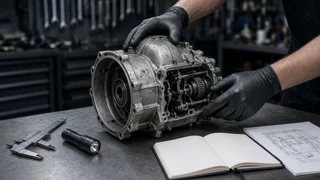
Transmissions often carry an identification tag, stamped numbers or cast markings on the case. Depending on the unit, these may include a model designation, a serial or build number, or a date code. Where these markings sit on the case varies by transmission design. Many are hard to see without lifting the car safely. A service manual for the specific transmission is the best guide to where to look and how to read the markings.
This physical check is the only way to confirm what is actually installed. That matters most on older, modified or high-mileage cars.
4) Use Basic Cues From the Cabin
Some quick observations narrow the possibilities but cannot identify a specific unit:
A clutch pedal indicates a manual transmission. No clutch pedal indicates an automatic-type transmission, which may be a conventional torque-converter automatic or a dual-clutch design, depending on the generation. Paddle shifters by themselves do not tell you whether the car has a conventional automatic or a dual-clutch unit. The number of gears shown on the shifter or in the instrument display can help, but should still be checked against documentation.
Common Points of Confusion
Transmission versus transaxle: in some Corvette layouts, the gearbox is mounted toward the rear and combined with the differential. Parts and service listings may call this a transaxle rather than a transmission, so search under both terms. Transmission versus rear axle or differential codes: RPO labels also list axle and differential options. Make sure you are reading the transmission code and not a neighboring axle code. Factory versus installed: build records and RPO labels describe original equipment. A replaced or swapped unit will only show up through physical inspection or service history. Similar-looking units: transmissions from different suppliers or generations can look alike from underneath. Rely on tags and markings rather than case shape.
A Practical Order of Steps
Find the Service Parts Identification label and note the option codes. Look up those codes in a reference for your exact model year. Give the VIN to a dealer service department or use official build documentation to confirm the factory transmission. Check service records for any transmission replacement or rebuild. If there is any doubt, inspect the transmission case for its identification tag or markings, using the correct service manual.
What This Guide Does Not Confirm
The available evidence did not include verified transmission model names, RPO codes, gear counts, label locations or production-year ranges for specific Corvette generations. Those details vary by model year and configuration and are not stated here. Before ordering parts, choosing fluid or listing a car for sale, verify them against GM service documentation, the vehicle's build records or a qualified Corvette technician.