B-Series Transmission Identification and Specifications
The Short Answer
"B-series transmission" is not a single, universal part. Enthusiasts most often use the phrase for the gearboxes paired with Honda's B-series family of four-cylinder engines. The same words can also come up in searches about other vehicles that carry a "B-Series" name, such as Mazda's B-Series pickup line, which used different transmissions from different suppliers. Before comparing parts or specifications, confirm which vehicle family you mean.
Even within one family, "B-series transmission" describes a group of related units, not one specification. Gear ratios, final drive, differential type, clutch actuation and mounting details can vary by model year, model, trim, engine variant and market. The reliable way to identify a specific unit is to read its identification code and check that code against documentation for the vehicle it came from.
What This Guide Can and Cannot Confirm
No verified specification data was available for this guide, so it includes no gear ratios, final-drive figures, weights, fluid capacities, part numbers or code-to-vehicle lookup tables. For those details, use a factory service manual, the manufacturer's parts catalog or a dealer parts department, matched to the exact vehicle configuration. Treat figures from forums or sellers as claims to verify, not as documented specifications.
How to Identify a B-Series Transmission
Identification usually moves from general to specific: work out the vehicle family, read the code on the transmission itself, then confirm what that code means using documentation for that configuration.
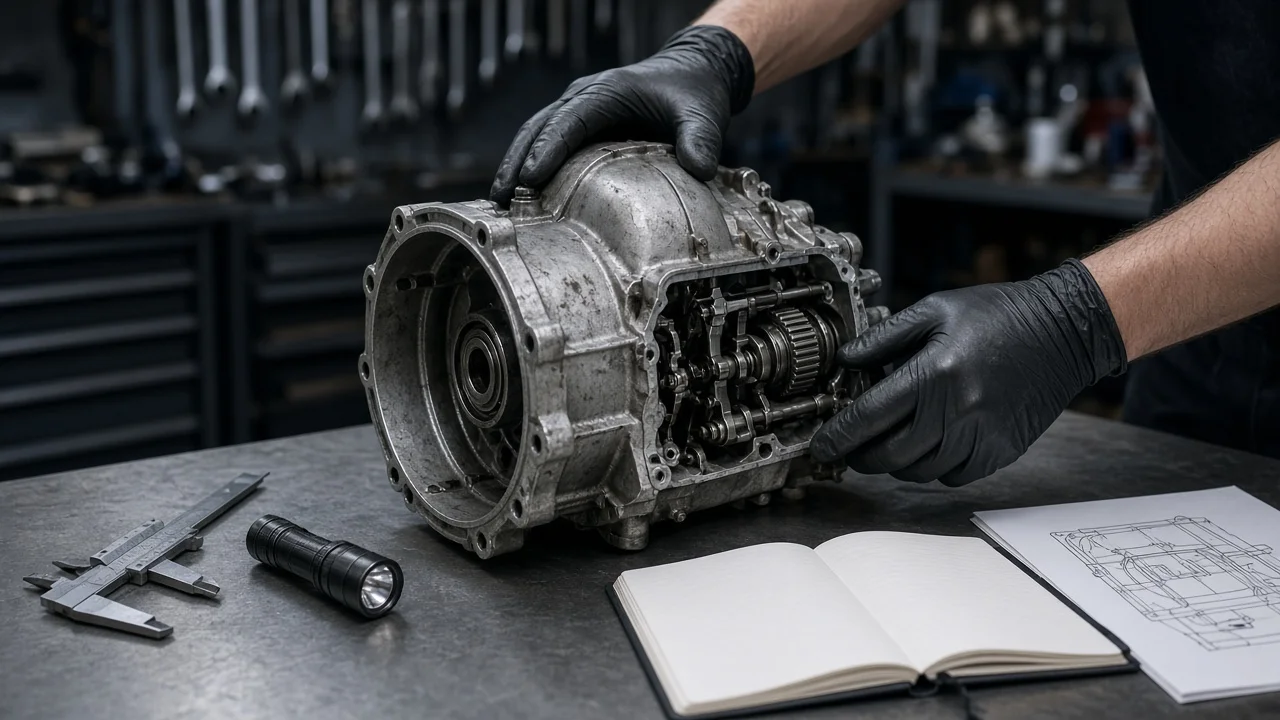
1) Confirm the vehicle family. Check whether the transmission came from a Honda with a B-series engine, a Mazda B-Series truck or another vehicle. The identification method and code format differ between manufacturers. 2) Look for a stamped or cast code on the transmission case. Manufacturers commonly stamp a model or type code and a serial number on the case, often near the bellhousing or on a flat machined pad. Dirt and grime can hide it, so clean the area before reading. 3) Check for a tag or label. Some transmissions carry a metal tag or sticker with identifying information. Tags can fall off or be swapped, so treat a stamped case code as the stronger evidence. 4) Use the vehicle's own records. If the transmission is still in its original vehicle, the VIN and the vehicle's build or emissions labels can help confirm the original configuration through a dealer or parts catalog. This only tells you what the car left the factory with. It cannot tell you whether the transmission has since been replaced. 5) Cross-check the code against documentation. Match the code to the factory service manual or parts catalog for the applicable model year, model and market. This is the step that confirms ratios, differential type and compatibility.
Easily Confused Items
Several mix-ups lead to wrong conclusions about B-series transmissions. Each is worth ruling out before you buy or install a unit.
Engine code versus transmission code: The engine and the transmission carry separate identification codes in separate places. A B-series engine code tells you nothing definitive about the gearbox bolted to it, especially in a used or modified vehicle. Serial number versus model code: The case may show both a type or model code and a unique serial number. The model code identifies the design and variant. The serial number identifies the individual unit. Original versus swapped units: Engine and transmission swaps are common in this enthusiast community. The vehicle's VIN and labels describe factory equipment, not necessarily what is installed now. Similar-looking cases: Related transmissions can look nearly identical from the outside while having different internal ratios or differentials. Visual similarity is not proof of a match. Shared names across manufacturers: "B-Series" as a Mazda truck name and "B-series" as a Honda engine family are unrelated. Parts and identification methods do not carry over between them.
Specifications to Confirm for a Given Unit
Once you have a verified code, use documentation for that configuration to confirm the specifications that matter for your purpose. The table lists common items to check and why each one matters. It does not give values, because those depend on the specific unit.
Specification | Why it matters; Gear ratios | Determine acceleration and engine speed in each gear; Final drive ratio | Affects overall gearing, cruising engine speed and speedometer accuracy; Differential type | Open versus limited-slip affects traction and handling; Clutch actuation type | Must match the vehicle's clutch system (for example, cable or hydraulic); Mounting and bellhousing fitment | Determines whether the unit bolts to the intended engine and chassis; Axle and shift linkage compatibility | Affects which drive axles and shifter components are needed; Speed sensor or speedometer drive | Must match the vehicle's instrument and engine-management setup; Recommended fluid and capacity | Required for correct servicing
Practical Next Steps
If you are buying a used transmission, ask the seller for a clear photo of the stamped case code before agreeing to a price, then verify that code yourself against factory documentation. If you are identifying a transmission already in a vehicle, clean the case, record the code and serial number, and compare them with what the VIN-based parts lookup says the vehicle originally had. Any mismatch suggests a swap and calls for further checking.
If you cannot find a readable code, a dealer or a specialist familiar with the vehicle family may be able to help. Without a verified code, treat any claimed specification as unconfirmed.