Car Overheated and Smoking: What It Means and What to Do Next
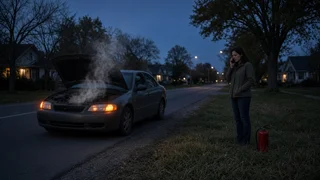
If your car overheated and is smoking, stop driving as soon as you can do so safely and switch off the engine. In most cases the white cloud coming from under the hood is steam: hot coolant escaping from the cooling circuit and flashing into vapor. Steam means the engine has lost or is losing coolant and is too hot to keep running, but it is not the same as a fire. Dark, gray or blue smoke, a burning-plastic or rubber smell, visible flames or smoke that keeps building after the engine is off point to a possible fire, and that changes what you should do. This guide explains how to tell the two apart, what to do in the first few minutes, why an engine overheats and produces white smoke, and the order in which the likely causes are usually checked once everything has cooled down.
Steam or Smoke: How to Tell the Difference
The first decision is whether you are dealing with steam from the cooling system or smoke from something burning. Appearance and smell are the most useful clues you have at the roadside.
Sign | More likely steam (coolant) | More likely smoke (possible fire); Color | White, thin, wispy | Gray, black, or bluish; Behavior | Dissipates quickly in the air; usually eases once the engine is off and pressure drops | Lingers, thickens, or grows after the engine is off; Smell | Sweet, syrupy odor typical of coolant | Burning plastic, rubber, electrical insulation, or acrid oil; Other signs | Temperature gauge high or overheating warning lit; coolant dripping or puddling under the front | Flames, glow, popping sounds, smoke from the dashboard or wheel area
Overheating can also cause real smoke. Oil or coolant that leaks onto a very hot exhaust manifold can burn off, and extreme heat can damage hoses or wiring. If you are not sure which you are seeing, treat it as a possible fire.
What to Do Right Away
Signal, pull completely off the road to a safe spot, and turn the engine off. Running an overheated engine, even at idle, can turn a repairable fault into serious internal damage. Turn on your hazard lights and get everyone out of the vehicle if there is any doubt about smoke versus steam. Move well away from the car and away from traffic. If you see flames, thick or dark smoke, or smoke coming from inside the cabin, do not open the hood. Opening it feeds air to a fire and puts your face and hands near it. Call emergency services and stay clear. If it is clearly steam and is subsiding, still leave the hood closed until the hissing stops and the engine bay has had time to cool. Never open the radiator cap, pressure cap, or coolant reservoir cap on a hot engine. The cooling system runs under pressure, and opening it hot can spray scalding coolant. Arrange a tow if you see heavy coolant loss, smoke from the exhaust, or any sign of fire, or if you are unsure the car is safe to restart.
Why White Smoke Comes From the Engine When a Car Overheats
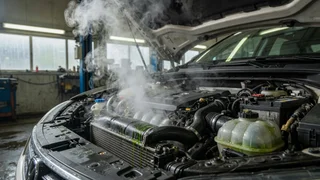
White smoke from the engine bay after overheating is almost always coolant escaping as vapor. The cooling circuit is sealed and pressurized, which raises the coolant's boiling point. When the engine gets too hot, or when pressure is lost through a leak or a faulty cap, coolant boils and escapes through the weakest point: a split hose, a loose clamp, a cracked radiator or reservoir, a leaking water pump seal, or the overflow outlet. Coolant that drips onto hot engine or exhaust parts also produces vapor.
Where the white smoke appears matters. Vapor from under the hood points to an external leak or boil-over. White smoke from the tailpipe that persists, especially with a sweet smell, can mean coolant is getting into the combustion chambers. That is commonly associated with a failed head gasket or, less often, a cracked cylinder head or block, and overheating is a frequent cause of both. A small amount of white vapor from the exhaust on a cold or humid morning that clears as the car warms up is normal condensation and is not related to overheating.
Common Causes of Overheating
Overheating happens when the cooling system cannot carry heat away from the engine fast enough. The usual causes, roughly from most to least common, are:
Low coolant from a leak: hoses, clamps, radiator, heater core, water pump, reservoir, or internal leakage. Low coolant is the single most frequent reason a car overheats and steams. Faulty pressure cap: a cap that no longer holds pressure lets coolant boil at a lower temperature and escape through the overflow. Thermostat stuck closed: the thermostat controls coolant flow to the radiator. If it stays shut, coolant circulates only through the engine and temperature climbs quickly. Radiator problems: internal clogging from old or mixed coolant, external blockage from debris or bent fins, or leaks reduce how much heat the radiator can shed. Cooling fan not working: an electric fan with a failed motor, relay, fuse, sensor, or wiring, or a worn fan clutch on engines with a mechanical fan. This typically shows up in traffic or at idle, when there is little natural airflow. Water pump failure: a worn impeller, failing bearing, or leaking seal reduces circulation. On engines where the pump is driven by a belt, a broken or slipping belt has the same effect. Air pockets in the cooling circuit: trapped air after a coolant change or repair can block flow and cause hot spots, erratic gauge readings, or no heat from the heater. Wrong coolant or wrong mix: coolant that does not meet the vehicle's coolant specification, or an incorrect coolant concentration (too much water or too much concentrate), can reduce heat transfer, protection against boiling and freezing, and corrosion protection. Head gasket failure: combustion gases forced into the cooling system displace coolant and create pressure, which in turn causes more overheating. It can be a cause as well as a result.
Order of Checks Once the Engine Has Cooled
Only begin inspecting after the engine is fully cool to the touch and there is no sign of fire. The sequence below moves from the simplest observations to the ones that need tools or a shop.
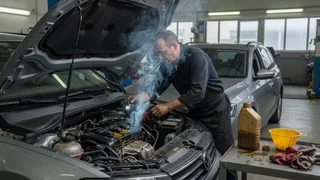
Look under the car for fresh coolant. Its color depends on the type used, and it usually has a sweet smell. Note whether it is dripping from the front (radiator area), the middle of the engine, or near the firewall. Check the coolant reservoir level against its markings. An empty reservoir confirms coolant loss but does not by itself tell you where it went. With the engine cold, open the radiator cap if your vehicle has one and check whether the radiator is full. Some vehicles have no radiator cap and are filled only through a pressurized reservoir. Inspect hoses, clamps, the radiator, and the reservoir for wet spots, crusty residue, cracks, or swollen or collapsed hoses. Check the engine oil on the dipstick and under the oil filler cap. A milky, light-brown, or foamy appearance can indicate coolant mixing with oil, which points toward a head gasket or other internal fault. Do not drive the car if you see this. Check the drive belt, if the water pump is belt-driven, for breakage or obvious slack. After topping up, idle the engine briefly while watching the temperature gauge and confirm that the cooling fan switches on as the engine warms. If the gauge climbs quickly, switch off. Have a shop pressure-test the cooling system and cap, and test for combustion gases in the coolant if a head gasket is suspected. These tests locate leaks that are not visible and confirm or rule out internal damage.
Refilling Coolant Correctly
If you need to add fluid to reach help, plain water can be used briefly in an emergency, but it should be replaced with proper coolant as soon as possible. For a lasting fill, use coolant that matches the coolant specification listed in your owner's manual or on the reservoir, because requirements vary by manufacturer, model year, and engine. Mix it to the concentration the manufacturer calls for, or use a pre-diluted product. Mixing incompatible coolant types can reduce corrosion protection and, in some cases, form sludge.
After a significant coolant loss or refill, air pockets are common. Many engines purge air on their own over a few heat cycles, while others need a specific bleeding procedure, such as opening a bleed screw, raising the front of the car, or using a vacuum fill tool. The correct method depends on the vehicle. Recheck the level once the engine is cold again after driving, and top up if needed.
Is It Safe to Keep Driving?
Generally not until the cause is known. Driving with the temperature gauge in the red or with steam pouring out risks warping the cylinder head, failing the head gasket, or seizing the engine, and those repairs cost far more than a hose, cap, or thermostat. If the cause turns out to be simple and you have corrected it, such as a loose clamp or low coolant from a slow leak, drive cautiously, watch the gauge constantly, and get the system properly inspected soon. If the overheating returns, white smoke comes from the exhaust, the oil looks milky, or you saw any sign of fire, have the car towed.
Reducing the Chance It Happens Again
Check the coolant level regularly with the engine cold, and investigate any steady drop rather than just topping up. Replace coolant at the interval your manufacturer recommends, using the correct type and mix. Have hoses, the pressure cap, and the drive belt inspected during routine service, especially on older vehicles. Keep the front of the radiator clear of leaves, bugs, and debris. Pay attention to early warnings: a temperature gauge that reads higher than usual, a sweet smell after driving, a heater that blows cold air, or a cooling fan that seems to run constantly or not at all.