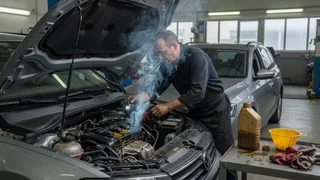
White smoke coming from the engine bay
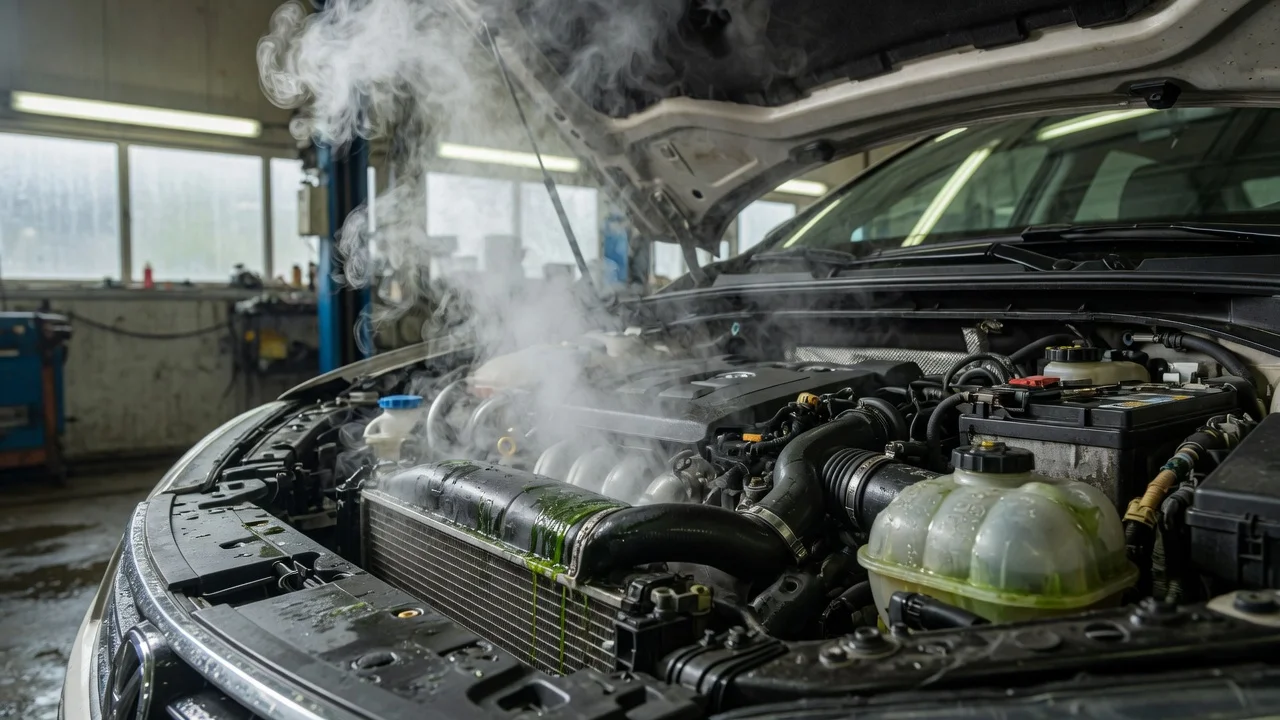
White smoke rising from under the hood is alarming, but the cause is often identifiable. In most cases it is steam from coolant escaping the cooling system. Less often it is another fluid, such as oil, transmission fluid or power steering fluid, burning on a hot engine or exhaust part. This guide covers smoke or vapor coming from the engine compartment itself, not white smoke from the tailpipe, which has different causes.
The short answer
White vapor from the engine bay most commonly means coolant is leaking onto hot components or venting from an overheating cooling system. Coolant (also called antifreeze) is the fluid that carries heat away from the engine. When it escapes under pressure or drips onto hot metal, it flashes into a visible white cloud. A leak can quickly lead to overheating, and overheating can cause serious engine damage, so treat this as a reason to pull over and investigate rather than keep driving.
There is one important exception. A small amount of vapor that appears briefly after driving through rain, puddles or a car wash, or on a cold, damp morning, can simply be water evaporating off hot surfaces. That should clear quickly, with no smell, no warning lights and no change in the temperature gauge.
Common causes
Coolant leak: a split or loose radiator hose, a leaking radiator, a failed water pump seal, a cracked coolant reservoir or a faulty radiator or reservoir cap can let hot coolant escape as steam. Overheating: if the engine runs too hot, for example because of low coolant, a stuck thermostat, a failed cooling fan or a blocked radiator, coolant can boil and vent from the reservoir or cap. Heater core or heater hose leak: a leak in the heating circuit can release steam near the firewall, sometimes with a sweet smell inside the cabin or fogging on the windshield. Oil burning on hot parts: oil leaking from a valve cover gasket or spilled during an oil change can smoke when it reaches the exhaust manifold. This smoke is often bluish-white and smells acrid or like burnt oil. Other fluids: transmission fluid or power steering fluid dripping onto hot exhaust components can also produce white or gray smoke with a burnt smell. External water: rain, road spray or washing can create harmless, short-lived vapor as it evaporates off the engine and exhaust.
Telling steam from smoke
A few observations help narrow down the source. These are general indicators, not a definitive diagnosis.
Observation | Likely meaning; Thin white vapor that disappears quickly, no smell | Water or steam, possibly harmless evaporation or a coolant leak; Sweet, syrupy smell | Coolant, which commonly contains ethylene glycol; Temperature gauge rising or overheating warning | Cooling system problem, coolant loss or boiling; Acrid, burnt-oil smell, bluish-white haze that lingers | Oil burning on the exhaust or engine; Burnt smell with reddish or brown fluid traces | Possibly transmission or power steering fluid; Wet, crusty or colored residue around hoses, radiator or reservoir | Ongoing coolant leak
What to do right away
Watch the temperature gauge and dashboard warnings. If the engine is overheating, pull over as soon as it is safe to do so. Turn the engine off once stopped. Some drivers turn on the heater to shed heat on the way to a safe stop, but continuing to drive an overheating engine risks damage. Do not open the radiator cap or coolant reservoir cap while the engine is hot. The system is pressurized, and hot coolant can spray out and cause burns. Be cautious opening the hood. Let the steam settle first, and keep your face and hands away from the vapor. If you see flames or the smoke is thick, dark or increasing, move away from the vehicle and call emergency services. Once the engine has fully cooled, check the coolant level in the reservoir and look for leaks, wet spots, loose clamps or damaged hoses. Note any smell and the color of any fluid under the car, as this helps a mechanic find the source.
Can you keep driving?
If the vapor was brief, had no smell and the temperature gauge stayed normal, it was likely external water evaporating, and normal driving is generally reasonable while you keep an eye on it. If there was a sweet coolant smell, falling coolant level, a rising temperature gauge or smoke that keeps coming, the safer choice is not to drive until the cause is found. Topping up coolant may get a vehicle to a nearby repair shop in some situations, but it does not fix a leak, and an engine that overheats repeatedly can suffer costly damage such as a failed head gasket or warped cylinder head. Burning oil or other fluids on the exhaust also carries a fire risk and should be inspected promptly.
Limits of this guide
Component layouts, coolant types, warning systems and common failure points vary by make, model, model year and powertrain. No vehicle-specific information was available for this article, so it cannot say which parts are most likely to fail on a particular car. Electric vehicles and hybrids also have different cooling and high-voltage systems; if vapor appears from an EV or hybrid, consult the owner's manual and a qualified technician rather than relying on guidance written for conventional engines. For an accurate diagnosis, a mechanic can pressure-test the cooling system and inspect for leaks.