Why Is a Departure Walkaround Useful on Every Trip Day?
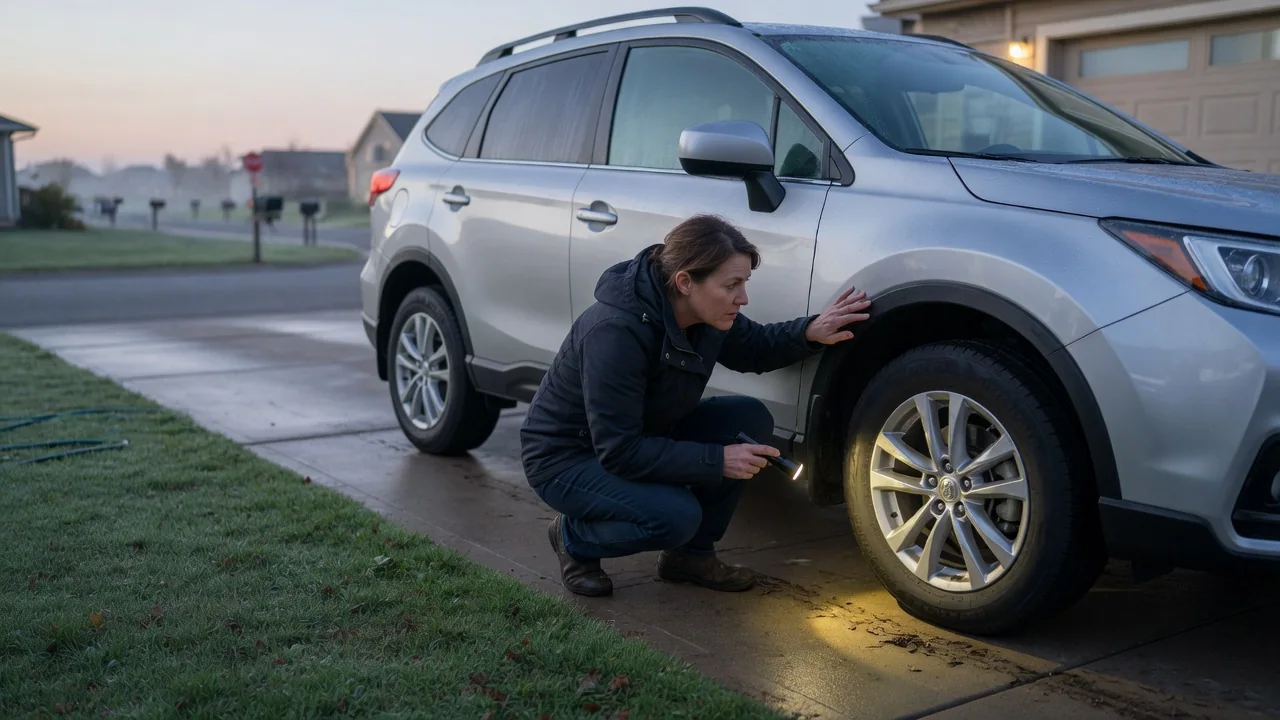
A road trip puts a vehicle through conditions that change from one day to the next: long highway stretches, unfamiliar parking spots, temperature swings, and luggage that gets repacked every morning. A departure walkaround is a short, deliberate lap around the vehicle before you drive off. Done on every trip day, it helps you notice changes that happened overnight or during the previous day's driving. You find them while the vehicle is still parked, when fixing a problem is easier than on the shoulder of a busy road.
Tires and leaks: catching slow changes early
Tires are the only part of the vehicle touching the road, and on a multi-day trip they accumulate wear, heat cycles, and exposure to debris. A slow leak from a nail or a damaged valve stem may not produce an obviously flat tire after one night, but a tire that looks slightly lower than the others is worth checking. During the walkaround, look at each tire's shape where it meets the ground, scan the tread for embedded objects, and check the sidewalls for cuts, scrapes, or bulges. A bulge can indicate internal damage, often from a pothole or curb strike, and is a reason to have the tire inspected before driving further.
A visual check does not replace a gauge. Pressure is best measured when tires are cold, before driving, which makes the morning departure a natural moment to do it. The correct values come from the vehicle's tire placard, usually on the driver's door jamb, or from the owner's manual, not from the maximum figure molded into the sidewall. Many vehicles have a tire pressure monitoring system, but these systems generally warn only after pressure has dropped meaningfully, so a gauge reading can reveal gradual loss earlier. Temperature differences between overnight stops can also shift readings, which is another reason a daily check is useful on a road trip.
The walkaround is also a chance to look at the ground where the vehicle sat overnight. Fresh drips under the engine bay, the transmission area, or near the wheels can signal a leak that developed during the previous day's driving. Clear water dripping near the front of the cabin is commonly condensation from the air-conditioning system and is often normal, while oily, colored, or sweet-smelling fluid deserves a closer look. Fluid colors vary by product and vehicle, so checking the relevant reservoirs and the owner's manual is more reliable than judging by color alone. Noting where a spot appeared helps narrow down its source.
Cargo: confirming the load is still secure
Cargo shifts. Bags packed tightly on the first morning get unloaded, searched through, and reloaded differently each day, and straps that started tight can loosen as loads settle over hours of vibration. A walkaround lets you confirm that rooftop carriers are latched and locked, that tie-down straps on roof racks or in a truck bed are still tensioned with no loose ends flapping, and that bike racks, hitch-mounted carriers, and anything else attached outside the vehicle are secure. Loose external cargo is a hazard to drivers behind you, not only a risk of losing your own belongings.
Inside the vehicle, check that heavy items sit low and toward the front of the cargo area where possible, and that nothing is stacked high enough to block the rear window or become a projectile under hard braking. Confirm the trunk, liftgate, or tailgate is fully latched. Weight matters as well: the vehicle's load limits are listed on the door jamb placard or in the owner's manual, and a vehicle carrying passengers and gear for a long trip can approach them. If the load has grown since departure, the daily check is a moment to reassess both weight and tire pressure, since some manuals specify different pressures for heavier loads.
Lights: being seen and signaling clearly
Lights tend to fail without warning, and a burned-out brake light or turn signal is rarely obvious from the driver's seat. Some vehicles display a bulb-out warning on the instrument cluster, but not all do, and not every lamp is necessarily monitored. A quick functional check during the walkaround covers headlights, high beams, tail lights, turn signals on both sides, hazard lights, and the license plate light. Brake lights are easiest to verify with a helper, or by watching their reflection in a window, a garage door, or the vehicle parked behind you.
Condition matters as much as function. After a day on highways or unpaved roads, lenses can be coated with dirt, insect residue, or road grime that reduces how well others see you and how well your headlights illuminate the road ahead. Cracked lenses can let moisture in over time. A bike rack or cargo carrier can also block tail lights or the license plate, which affects visibility and may matter legally depending on where you are driving. Wiping lenses and confirming nothing obstructs them takes little time and is especially relevant before driving at dusk or in poor weather.
Practical implications and limits
The value of a departure walkaround comes from repetition rather than thoroughness on any single day. Seeing the vehicle in the same order every morning builds a baseline, so a tire sitting a little lower, a new spot on the pavement, or a strap that has crept loose stands out. Keeping the routine consistent, for example starting at the driver's door and circling in one direction, makes it less likely that a step gets skipped when everyone is eager to get going. In a daily road trip walkaround, the goal is noticing change, not diagnosing every system.
There are clear limits. A walkaround cannot detect internal engine, brake, or suspension wear, and it does not replace scheduled maintenance or a more thorough inspection before a long journey. It also does not explain why something looks wrong. A low tire, an unfamiliar leak, or a dashboard warning is a signal to investigate, consult the owner's manual, or have a qualified technician examine the vehicle. Details also vary by vehicle: placard locations, how lighting is monitored, and which fluids are used differ between models, so the manual for your specific vehicle remains the authority.
Context matters too. Parking lots often carry stains left by other vehicles, so a spot is most meaningful when it appears where the ground was clean before or when you can see it still dripping. Doing the walk in a safe place, away from traffic and with enough light to see clearly, is part of the routine. When a check does reveal a problem, the advantage is timing: you have found it while parked, with time to plan a repair stop, rather than discovering it at highway speed far from services.