How to Pack for a Day Trip Without Filling the Cabin
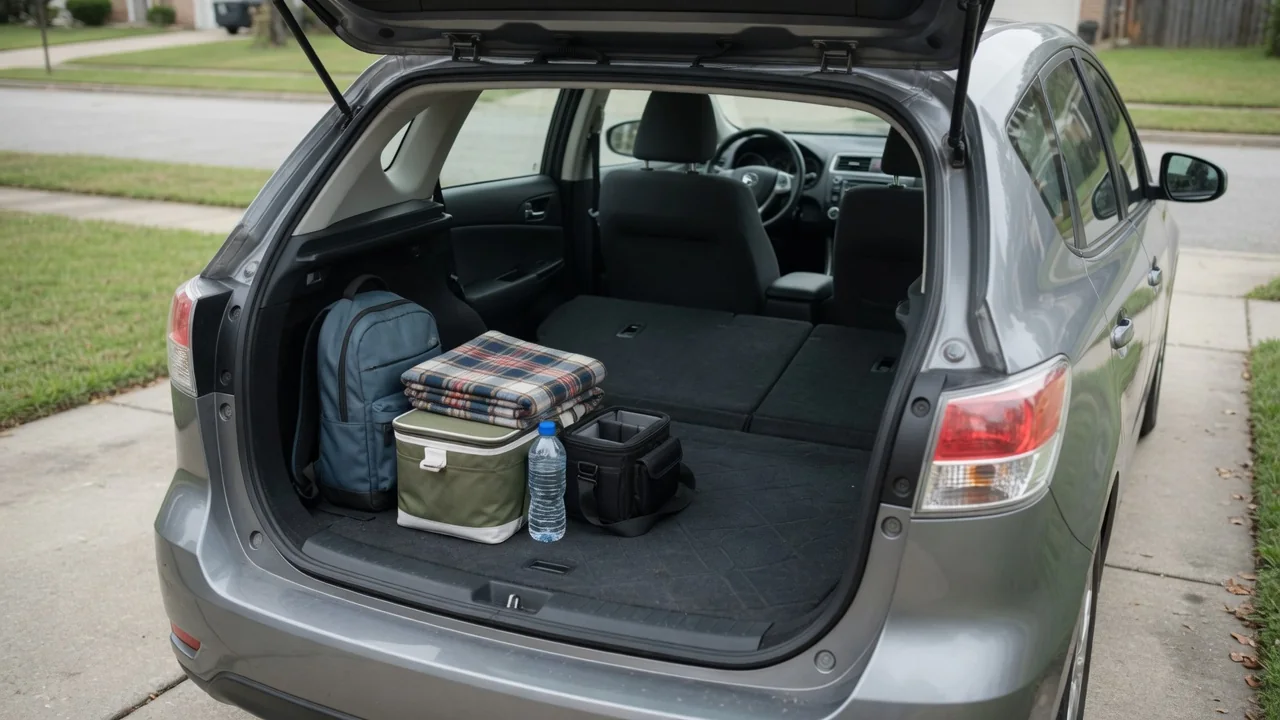
Learning how to pack for a day trip without filling the cabin comes down to three habits: bringing less, putting most of it behind the seats, and tying down whatever remains. A few hours on the road rarely needs more than a small bag per person, yet loose jackets, coolers, and chargers can quickly crowd footwells and seats. This guide explains a compact, secured approach.
List needs
Start with a short written list before anything goes into the vehicle. Divide it into what the trip demands, such as water, food, weather layers, sun protection, and any activity gear, and what the vehicle should already carry, such as a first aid kit, a flashlight, and whatever tire equipment the manufacturer supplied. Seeing both groups on paper makes duplicates obvious, and it shows which items will be needed while driving and which can stay out of reach until the destination.
The list also reveals how much the vehicle itself changes the answer. Some cars carry a spare wheel and jack under the cargo floor, while others have a sealant kit or run-flat tires, so check what is actually there rather than assuming. Count the passengers as well, because every occupied seat removes a place where a bag might otherwise sit. A useful test is to lay everything out on the driveway; if the pile looks larger than one medium tote per person, trim it before loading.
Use cargo area
The trunk or cargo area is the right home for nearly everything on that list. Place the heaviest items, such as a cooler or a case of water, low on the floor and as far forward as possible, against the back of the rear seat. That position keeps weight between the axles, where it has less effect on handling, and gives heavy objects a solid surface to rest against under braking. Lighter, softer things like jackets and towels can fill the gaps on top.
Securing matters as much as placement. Many vehicles provide tie-down rings, a cargo net, bag hooks, or an underfloor compartment, though the equipment differs widely between sedans, hatchbacks, SUVs, and pickups, and the owner's manual shows what a particular model includes. A sedan's enclosed trunk separates luggage from occupants by design, while an open cargo area in a wagon or SUV relies on the seatback, a cover, or a net. A lidded bin or collapsible organizer stops small items from sliding and rattling through every corner.
Keep sightlines
Anything stacked above the top of the rear seatbacks begins to block the interior mirror, and anything on the parcel shelf or rear deck does the same while also sitting ready to fly forward in a hard stop. Keep the load below the window line wherever possible. In hatchbacks and SUVs, pulling the cargo cover closed is a quick check: if it will not close, the pile is too tall and something should be moved or left behind.
Sightlines forward and to the sides deserve the same attention. The dashboard top should stay clear, since objects there reflect in the windshield, slide in corners, and may sit over a passenger airbag panel. Rear side windows need to stay open to view for shoulder checks, so avoid hanging garments or propping bags against the glass. Before leaving, sit in the driver's seat and look through each mirror and window in turn; vehicles with a rear camera or digital mirror still benefit from clear glass.
Everyday Use and Observations
A few things do belong in the cabin: a phone and charging cable, sunglasses, a water bottle for each person, tissues, and perhaps a small snack. Give each a fixed home in the cupholders, door pockets, center console, glovebox, or seatback pockets. The driver's footwell should hold nothing at all, because a bottle or shoe that rolls under the pedals can interfere with braking. A small bag belted onto an empty rear seat is better than one sitting loose on the cushion.
The first few miles tell whether the packing worked. Listen for thumps or rattles from behind when braking and turning, which suggest something has shifted and needs wedging or strapping at the next stop. Notice whether passengers can move their feet freely and reach their own belts and buckles without lifting bags. On the return leg, wet clothing, trash, and souvenirs tend to drift into the cabin, so an empty bag kept in the cargo area gives those extras a place to go.
Limits and Next Steps
Some trips simply outgrow the available space. A small coupe with four occupants, or a day that involves bicycles, folding chairs, and a large cooler, may not fit below the window line no matter how carefully it is arranged. Every vehicle also has a load limit covering passengers and cargo together, usually shown on a placard in the driver's door opening and in the owner's manual. Recommended tire pressures sometimes differ for a fully loaded vehicle, so check that label before setting off.
When the load will not fit safely, the better options are to cut the list again, fold part of a split rear seat if a passenger place is free, or consider a roof box or hitch carrier rated for the vehicle. Roof and hitch equipment have their own weight limits and fitting requirements, which vary by model and should be confirmed in the manual or with a dealer. After the trip, note what went unused; removing those items next time is the simplest way to keep the cabin clear.